“Free VPN” does not describe one standard type of service. It can mean an ongoing plan with limits, a short trial that converts to a subscription, a refund window after payment, or only an app that is free to download.
BearVPN reviewed the official plan, pricing, trial, help, and terms pages of 22 VPN providers. We coded whether an ongoing free tier existed, the main time or data limit, location choice, simultaneous connections, account requirements, payment obligations, and clearly disclosed speed or advertising restrictions.
Direct Answer: Is There a Free VPN?
Yes. In our review of 22 VPN providers, 12 offered ongoing free VPN access on at least one platform as of October 28, 2026. But “free” did not mean unlimited or unrestricted. Only two of those 12 clearly offered unlimited data in the main free plan reviewed. Others used daily or monthly allowances, reduced speeds, automatic server selection, fewer locations, or platform-specific rules. Of the 10 providers without an ongoing free tier, seven documented a time-limited trial. We counted refund guarantees separately because they require payment first.
The findings describe official plan disclosures, not hands-on performance, security, or overall product quality.
Publisher disclosure: This study was produced by BearVPN, a VPN provider that offers a free mobile plan. BearVPN was not included in the 22-provider comparison or headline statistics. A separate publisher self-disclosure using the same fields appears after the main dataset.
Key Findings at a Glance
- 12 of 22 providers offered an ongoing free VPN tier on at least one platform.
- 2 of those 12 clearly offered unlimited data in the main free plan reviewed.
- 7 of 12 ongoing free tiers clearly let users choose among the free locations available to them.
- 7 of the 10 providers without an ongoing free tier documented a time-limited trial.
These results use different denominators. The 22-provider sample measures overall availability. Data limits and location controls are calculated only among the 12 providers with an ongoing free tier. Trial results use the 10 providers without one.
Jump to the 22-provider comparison
What Does “Free VPN” Mean in This Report?
We used four categories because combining them would give readers the wrong idea about what they can access and when they may be charged.
Ongoing free tier
The provider says its core VPN connection can be used for $0 without a fixed end date. The plan may still restrict data, speed, locations, devices, or features. “Ongoing” does not mean unlimited.
Time-limited free trial
The service is available without an initial charge for a fixed period. The trial may end automatically or convert to a paid subscription. We recorded whether a payment method and auto-renewal were disclosed.
Money-back guarantee
The user pays first and may request a refund within a stated window. We did not treat this as a free trial, even when a provider described the purchase as “risk-free.”
Free download only
The app can be downloaded at no charge, but an active subscription or trial is still required to use the VPN service. A free download was not counted as free VPN access.
A provider can have more than one offer type. An ongoing free plan and a premium mobile trial, for example, can exist at the same time.
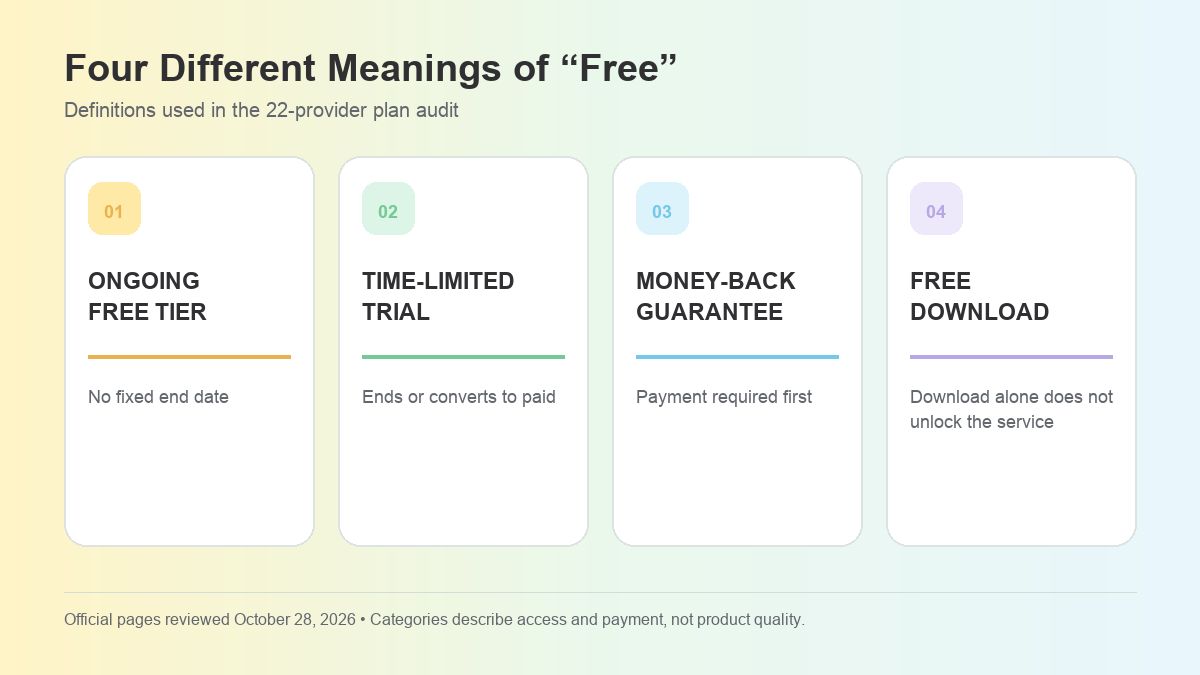
The four offer types answer different questions about access, payment, and duration. They should not be combined into one “free” category.
How We Audited 22 VPN Providers
Sample selection
The sample includes widely searched consumer VPN brands and providers representing different free-access models: unlimited data, daily or monthly allowances, automatic location selection, platform-specific availability, limited trials, and refund-only access. It is a purposive sample, not a ranking and not a census of the entire VPN market.
BearVPN was excluded because it published the study. Atlas VPN was not included because the service had closed. We did not replace missing fields with third-party review claims.
Sources reviewed
For each provider, we prioritized current official sources in this order:
- current pricing or plan-comparison pages;
- current pages dedicated to a free plan or trial;
- current official help-center or knowledge-base pages;
- current App Store or Google Play descriptions;
- official blogs or older pages used only as supporting or conflict evidence.
This audit reviews provider plan pages. Our separate study examines how U.S. App Store listings disclose ads and free-tier limits before download.
Fields coded
We recorded the offer type, time or data boundary, free location access, whether users could choose a location, simultaneous connections, account or email requirements, payment method, upfront payment, auto-renewal, and any explicit speed or advertising disclosure. We also recorded the relevant platform, region, evidence date, and conflicts between official pages.
Missing and conflicting information
“Not clearly disclosed” does not mean “No.” We did not assume that an unmentioned restriction was absent. We also kept servers, locations, and countries as separate terms because providers do not use them consistently.
When current official pages disagreed, we generally prioritized the current plan-specific page and retained the older or differently scoped page as a conflict note. Platform- and channel-specific offers were separated rather than forced into one brand-level answer. Provider statements such as “unlimited” or “no ads” were coded as disclosures, not independently tested claims.
The headline denominators were registered before drafting: 22 providers for ongoing free-tier availability, 10 providers without an ongoing free tier for trial status, and 12 providers with an ongoing free tier for plan limits.
Free VPN Plan Limits: The 22-Provider Comparison
The table gives the main current answer for each provider. A “No” in the ongoing free-tier column does not mean there is no way to try the service. Trials and refund periods are shown separately because they create different payment obligations. Rules may also differ by platform, purchase channel, country, or account status.
The table is alphabetical and is not a recommendation or quality ranking. Provider names link to the primary official source used for the summary.
Finding 1: 12 of 22 Providers Offered Ongoing Free Access
Twelve providers offered an ongoing free tier on at least one platform: AdGuard VPN, Avira Phantom VPN, Bitdefender VPN, hide.me, Hotspot Shield, PrivadoVPN, Proton VPN, Speedify, TunnelBear, Urban VPN, Windscribe, and ZoogVPN.
“Ongoing” means that the official material did not give the free VPN access a fixed end date. It does not mean the plan was unlimited, available on every platform, or identical to the paid service. Eight of the 12 used a hard recurring data allowance. Others restricted speed, location control, simultaneous connections, or platform availability.
Urban VPN shows why the platform qualifier matters. Its official material described free desktop and browser products, a separate Android allowance, and premium-only iOS access on the page reviewed. We therefore counted the provider as offering an ongoing free tier on at least one platform, not as offering the same free plan everywhere.
The other 10 providers required a paid subscription for ongoing access. A free app download, free non-VPN tool, or referral reward did not change that classification.
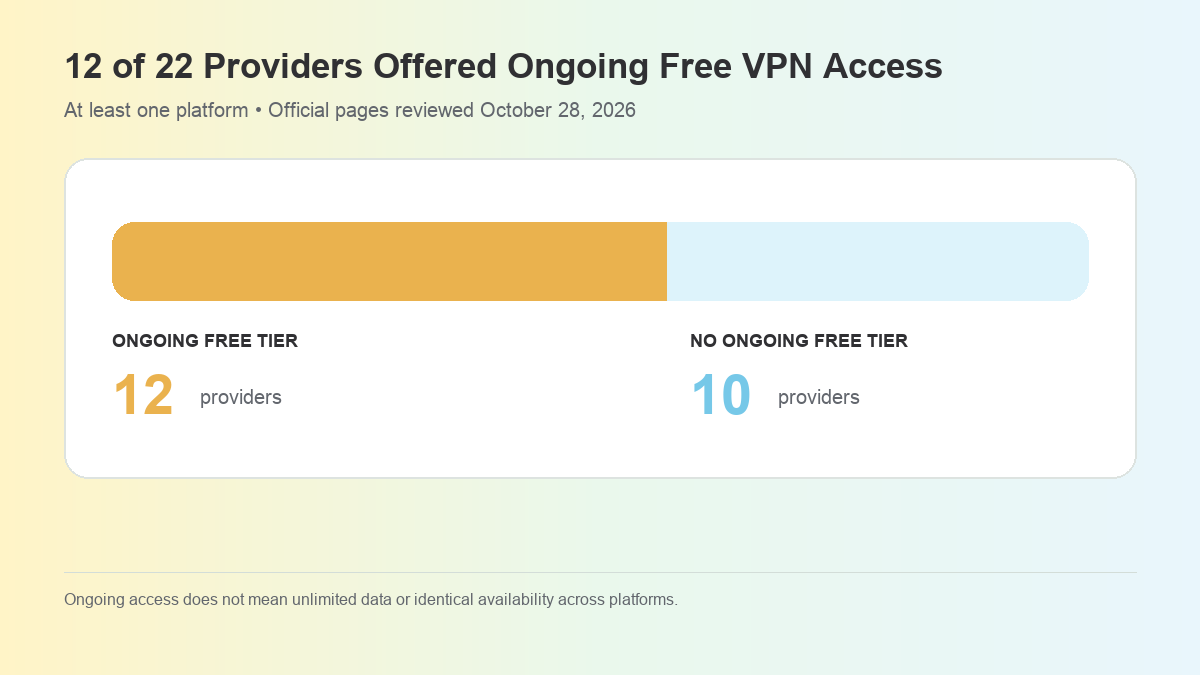
Ongoing access does not mean unlimited data or identical availability across platforms.
Finding 2: Only 2 of 12 Ongoing Free Tiers Clearly Offered Unlimited Data
Only Proton VPN and hide.me clearly described unlimited data in the main ongoing free plan reviewed. That is 2 of 12 free-tier providers, or 16.7%. Even then, “unlimited data” did not mean every other condition was unrestricted. Proton VPN described automatic or random free-server selection with a cooldown, while hide.me disclosed restricted speeds and one connection.
Eight providers used hard recurring allowances: Windscribe, TunnelBear, PrivadoVPN, Hotspot Shield, Speedify, Avira Phantom VPN, Bitdefender VPN, and ZoogVPN. Their units were not directly comparable. The official rules included daily limits, monthly limits, and 30-day reset periods. Some allowances changed after account registration or email verification.
AdGuard VPN formed a separate category. Its free plan included 3 GB per month and then continued at a reduced speed, so we did not classify it as a hard stop. Urban VPN was also separate because its allowance varied by platform.
We did not calculate an “average free data allowance.” Multiplying a daily limit by 30 would assume unused data carries over and that the provider treats every month the same way. Combining that estimate with monthly, 30-day, unlimited, and throttled plans would produce a number that does not match how the plans work.
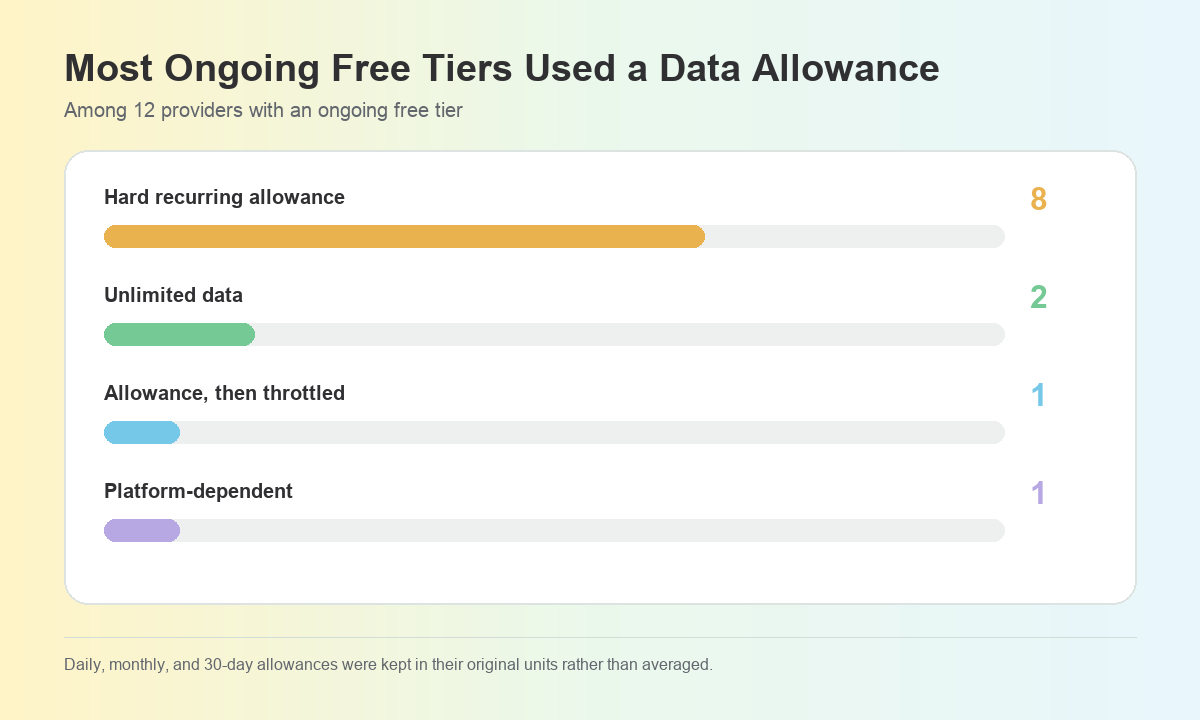
Daily, monthly, and 30-day allowances were kept in their original units rather than averaged.
Finding 3: Free Location Choice Was Not Universal
Seven of the 12 ongoing free tiers clearly let users choose among the free locations available to them: AdGuard VPN, Avira Phantom VPN, hide.me, PrivadoVPN, Urban VPN on applicable free products, Windscribe, and ZoogVPN.
Four used automatic or random selection, or withheld country selection from free users. Proton VPN initially selected the fastest free server and described later changes as random with a cooldown. TunnelBear moved country selection to its paid tier. Hotspot Shield’s Basic Mode did not allow virtual-location selection, while Bitdefender selected an optimal server automatically.
Speedify was the remaining unclear case. Its current registered-account article established the 5 GB allowance but did not clearly resolve the location-choice field. Older official material described broader network access, but we did not use that page alone to make a current claim.
These results measure control, not network size. A user may be able to choose among only a few locations, while another service may have a larger network but assign the connection automatically. Providers also use “server,” “location,” and “country” differently, so we did not publish a cross-provider server-count ranking.
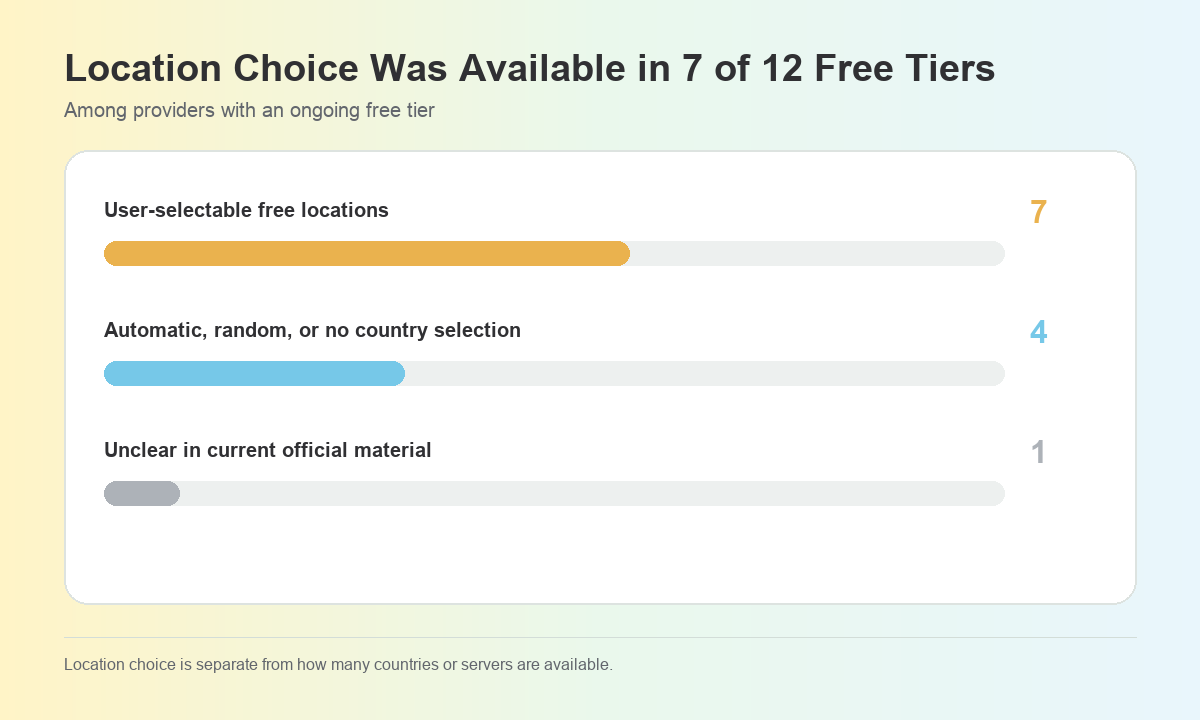
The ability to choose a location is separate from how many countries or servers are available.
When a VPN Has No Ongoing Free Tier, What Can You Try?
Of the 10 providers without an ongoing free tier, seven documented a time-limited trial: Avast SecureLine VPN, CyberGhost VPN, ExpressVPN, NordVPN, Norton VPN, Private Internet Access, and Surfshark. A trial did not always mean “no card required.” Most mobile or subscription-linked trials required a payment method and converted to paid access unless canceled.
Mullvad and Mozilla VPN documented paid access with refund windows rather than zero-payment trials. Astrill’s official FAQ contained directly conflicting statements: one passage said the provider did not offer free trials, while another said users could try the service for seven days before purchase. We marked the status unclear and excluded it from the confirmed-trial count.
Trial duration can also vary within one brand. CyberGhost offered a 24-hour desktop trial without payment details, while its Android and iOS trials were longer but required a payment method. NordVPN and Avast documented different routes by website, app store, eligibility, or country. Readers should check the exact purchase channel rather than relying on one brand-level number.
A trial does not show what the service will cost over time. Compare introductory and renewal VPN prices in our separate pricing study.
Official Pages Did Not Always Describe the Same Offer
Ten of the 22 providers required a freshness, platform, channel, or scope note in our coded evidence. A difference was not automatically an error. A mobile trial can legitimately differ from a desktop trial, and an account can change the free allowance. But readers need the scope to interpret the number correctly.
TunnelBear’s current material described 2 GB per month, while an older help page still said 500 MB. Windscribe’s dedicated free page listed 10 countries, while another official help article listed 11. Speedify’s current account page described 5 GB per month for a registered free account, while other official flows described 2 GB without registration. ZoogVPN’s official pages listed either three or five free locations.
Astrill presented the clearest unresolved conflict because opposite trial statements appeared in the same official FAQ. We did not choose the more favorable or less favorable interpretation. “Unclear” is the finding until the provider publishes a consistent current rule.
This is why the report shows an evidence date, keeps platform and channel notes, and links to primary pages. Official pages can change after publication, and an older accurate statement can become stale.
What This Audit Does Not Tell You
We did not install or run the 22 apps. We did not test connection speed, IP or DNS leaks, reliability, advertising frequency, streaming access, or whether a provider’s “unlimited” or “no ads” statement worked exactly as described. We also did not evaluate logging policies, ownership, jurisdiction, code, security audits, or vulnerability handling.
Plan limits describe access and convenience, not whether an app is safe. For technical and privacy evidence, see what independent research says about free VPN safety.
Likewise, an App Store privacy label answers a different question from a plan page. Our separate study examines what free VPN apps say they collect in Apple’s iOS privacy labels.
A larger allowance does not prove that a VPN is safer, more private, or faster. A smaller allowance does not prove that a provider is less transparent. Those conclusions require different evidence. This report only compares what current official sources say users can access and under what conditions.
How to Read a “Free VPN” Offer Before You Install
Before choosing a free plan or starting a trial, check the following:
- Is it an ongoing free tier or a trial with a fixed end date?
- Will the trial convert to a paid subscription automatically?
- Is a payment method required, and is there any upfront charge?
- Does the data allowance reset daily, monthly, or every 30 days?
- Can you choose a location, or is it automatic or random?
- How many simultaneous connections are explicitly allowed?
- Does registering an account or verifying an email change the allowance?
- Are speed, advertising, P2P, or streaming restrictions clearly disclosed?
- Does the rule apply to your device, platform, country, and purchase channel?
- When was the official page last updated?
Plan limits describe access and convenience. They do not, by themselves, establish whether a VPN is safe or private.
Publisher Self-Disclosure: BearVPN
BearVPN was excluded from the 22-provider sample and every comparison percentage because it produced this report. For transparency, the following is a publisher-supplied description using comparable fields; it is not an independent audit result.
This self-disclosure applies to the iOS product information supplied for publication and should be rechecked immediately before the report goes live. It is not included in the 12-of-22, 2-of-12, 7-of-12, or 7-of-10 findings.
Frequently Asked Questions
Yes, if “completely free” means an ongoing plan that does not require a recurring subscription. Twelve of the 22 providers reviewed offered one on at least one platform. Most still limited data, locations, speed, devices, or platform availability, so “free” should not be read as “unrestricted.”
Some are. Others offer only a short trial, require payment before a refund can be requested, or let users download the app without unlocking the service. Check whether the offer has a fixed end date and whether it requires a payment method or upfront charge.
An ongoing free VPN tier has no stated end date, though it may have usage limits. A free trial lasts for a fixed number of days and may convert to a paid subscription automatically. The trial’s cancellation and payment terms matter as much as its duration.
No. A money-back guarantee normally requires payment first, followed by a refund request within the stated window. A zero-payment trial gives temporary access before the initial charge. This report records them separately.
Some ongoing free tiers in this sample explicitly required no credit card or payment. Other offers required an account or email but not payment. Many premium trials required a valid payment method and renewed automatically. Check the exact platform and purchase-channel terms.
Some do, but it was uncommon in this sample. Only two of the 12 providers with an ongoing free tier clearly offered unlimited data in the main plan reviewed. Unlimited data can still come with speed, location, connection, or feature restrictions.
Sometimes. Seven of the 12 ongoing free tiers clearly let users select among available free locations. Four used automatic or random selection, or did not offer country selection to free users. One provider’s current official material did not clearly resolve the field.
A free-plan limit does not establish whether an app is safe. Security and privacy require separate evidence, including technical testing, data practices, ownership, audits, and incident history. See our review of independent research on free VPN safety.
Sources and Reproducibility
The evidence was checked on October 28, 2026. The downloadable dataset contains provider-level offer rows, primary source URLs, platform and region scope, checked dates, confidence labels, and conflict notes. Offers were split into separate rows when one provider documented different rules by platform or purchase channel.
We prioritized current official plan and pricing pages, followed by dedicated free-plan or trial pages and current help-center material. App-store pages were used when the offer was store-specific. Older official pages were retained only to document conflicts or possible stale wording. Not clearly disclosed was not converted to No.
Download the full coded dataset. To report a correction, use BearVPN’s published contact channel and include the provider, field, official source, and date checked.
Primary official pages used for the comparison:
- AdGuard VPN free plan
- Astrill VPN FAQ
- Avira free VPN
- Avast SecureLine VPN
- Bitdefender VPN limits
- CyberGhost VPN free trials
- ExpressVPN trial
- hide.me pricing
- Hotspot Shield Basic Mode
- Mozilla Subscription Services Terms
- Mullvad Terms of Service and refund conditions
- NordVPN trial and refund information
- Norton VPN free-trial information
- Private Internet Access free trial
- PrivadoVPN pricing
- Proton VPN plans
- Speedify free-account information
- Surfshark free trial
- TunnelBear free-account changes
- Urban VPN free-platform explanation
- Windscribe free plan
- ZoogVPN FAQ
Because plan terms change, the headline fields should be rechecked before publication and on a regular update schedule. Source URLs may also move when providers redesign their sites.