BearVPN reviewed 30 U.S. App Store search results for “free vpn” to see what prospective users could learn before downloading an app. Sixteen of the 30 descriptions did not state whether the product contained ads. Eight disclosed advertising directly, while six disclosed it only indirectly.
The search results also showed that “free VPN” is not one consistent type of offer. The same query returned ongoing free tiers, ad-supported services, rewarded-ad models, limited free access, trials, and subscription-led products.
This report measures the clarity of public App Store descriptions. It does not test the apps, verify their advertising behavior, or rank their privacy, security, speed, or technical quality.
Key Findings at a Glance
- 16 of 30 listings did not state their ad status. This does not mean the apps contained ads; it means their descriptions did not answer the question.
- 8 of 30 disclosed advertising directly. Another six implied it through wording such as promoting Premium as ad-free.
- 18 of 30 clearly described ongoing free access. Eight were unclear, and four did not establish an ongoing free tier.
- 6 of the 18 clearly ongoing-free listings did not state their ad status. Seven disclosed ads directly and five indirectly.
- “Free VPN” search results represented several business models. A free download did not always mean continuing VPN use without payment.
The Main Finding: Ad Status Was Often Left Unclear
Advertising was the least consistently explained part of the offer. Eight listings directly acknowledged advertising in the free experience. Six more disclosed it only indirectly—for example, by promoting Premium as “ad-free” or describing an upgrade that removes ads. The other 16 did not state whether ads were present.
“Not stated” should not be read as “contains ads” or “has no ads.” It records only that the public description reviewed on October 12, 2026 did not provide enough information to determine the answer.
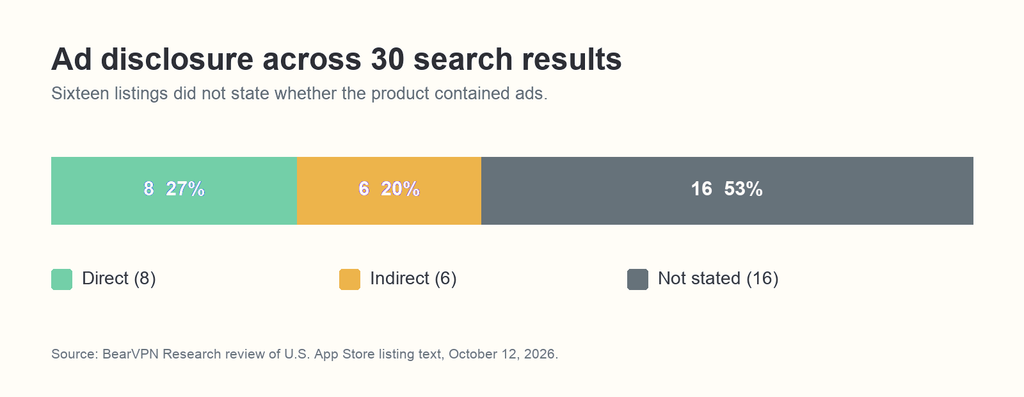
Figure 1. Ad disclosure across all 30 U.S. App Store search results. Source: BearVPN review of public listing descriptions collected October 12, 2026.
What Changed When We Looked Only at Clearly Ongoing-Free Listings
The 30-result sample included trials and subscription-led products, so we separately examined the 18 listings that clearly described continuing free access. This subgroup provides a more relevant comparison when asking how clearly an ongoing free VPN explains its advertising model.
Among these 18 listings, seven disclosed ads directly, five did so indirectly, and six did not state their ad status. In other words, one-third of the clearly ongoing-free listings left the advertising question unanswered in the public description.
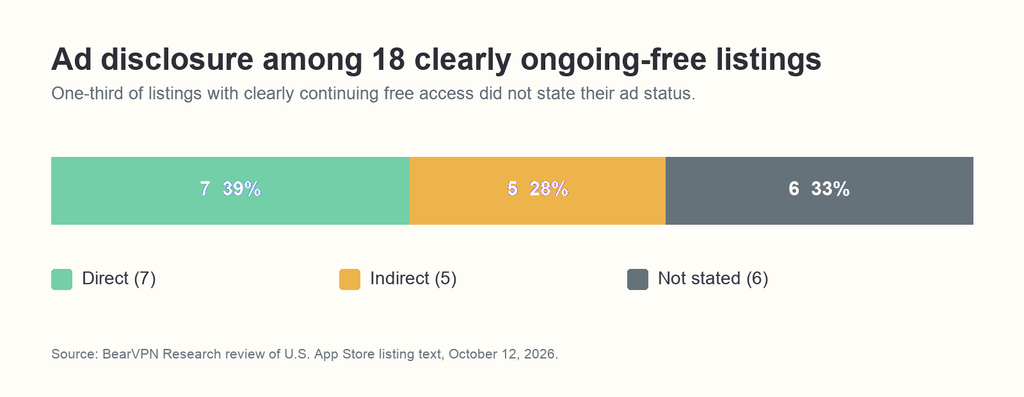
Figure 2. Ad disclosure among the 18 listings that clearly described ongoing free access. Source: BearVPN review of public listing descriptions collected October 12, 2026.
“Free VPN” Covered Several Different Business Models
A user searching for a free VPN could encounter materially different offers. We found four recurring structures:
- Ad-supported ongoing free access. A free tier continues over time and advertising helps support it. Some listings offer a paid, ad-free upgrade.
- Ad-free ongoing free access. A continuing free tier is funded by paid plans or another model, and the listing explicitly says that the free tier has no ads.
- Rewarded-ad or time-based access. Watching an ad, waiting, or completing an action unlocks additional connection time or access.
- Trial or subscription-led access. Downloading the app is free, but continuing VPN use requires a trial conversion, subscription, or purchase.
These categories explain why a single combined score would be misleading. For example, “free-tier limits” may not apply in the same way to a subscription-led app, while advertising may not be part of an ad-free service. We therefore report each disclosure field separately instead of publishing a best-to-worst ranking.
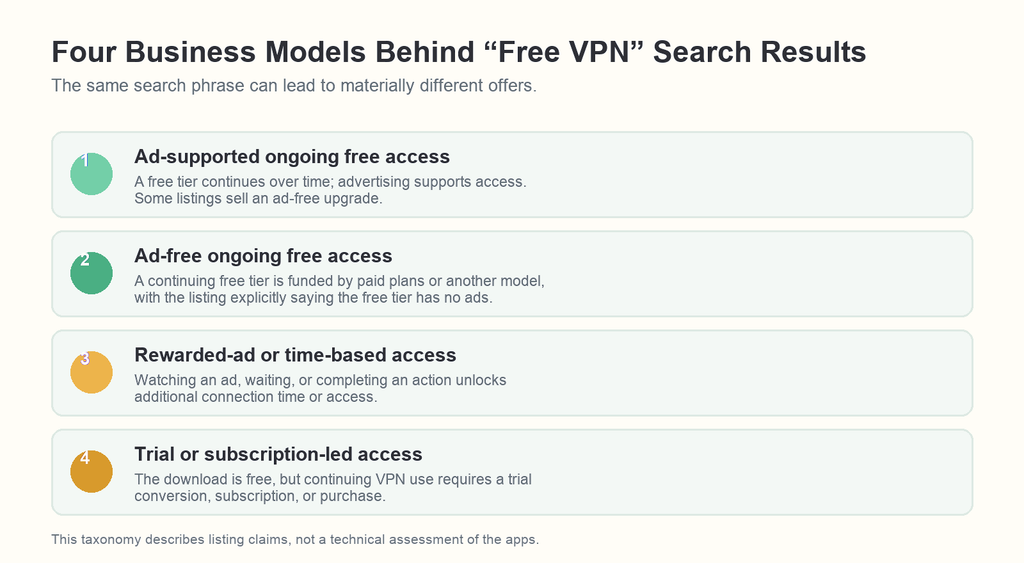
Figure 3. Four business models found in or associated with “free vpn” search results. The categories describe listing claims, not technical assessments of the apps.
Five Representative Disclosure Patterns
The following examples show how different descriptions presented their offers. They are not product recommendations or a ranking of VPN quality.
Free VPN by Free VPN .org™: direct ad-supported disclosure
The description clearly presented ongoing free access, said that the free service was supported by ads, explained free-tier and Premium differences, and included subscription information.
Ostrich VPN – Proxy Master: rewarded-ad access
The listing directly connected advertising with access and clearly described the free offer, limitations, Premium differences, and billing terms.
Proton VPN: Fast & Secure: an ad-free ongoing free tier
The description clearly established continuing free access and directly described the free tier as ad-free. Product differences were clear, while the billing disclosure was partial under this study’s criteria.
VPN – Super Unlimited Proxy: indirect ad disclosure
The free scope and Premium differences were clear, but the presence of advertising was inferred from wording that presented Premium as free from ad interruptions rather than directly explaining ads in the free experience.
PureVPN: Secure VPN for iPhone: a subscription-led search result
The app appeared in the “free vpn” search sample, but its description did not establish an ongoing free tier. Premium and billing information were present, while ad status was not stated.
What the Five Disclosure Fields Showed
We assessed five questions a prospective user might reasonably want answered before downloading an app. These totals use the classifications from the completed second editorial review.
The rows measure different questions and should not be added together. These figures also should not be interpreted as market share: they describe one fixed set of U.S. App Store search results on one date.
What Users Should Check Before Choosing a “Free” VPN
- Confirm what “free” means. It may describe an ongoing tier, a limited allowance, a trial, or only a free download.
- Look for a direct statement about ads. If a listing only says Premium is ad-free, advertising in the free experience is implied rather than plainly explained.
- Check the actual limits. These may involve server choice, speed, connection time, daily use, data volume, devices, or access to specific features.
- Read subscription terms before starting a trial. Check the renewal period, price, trial conversion, and cancellation timing. For a separate comparison of first payments and renewal costs, see How Much Does a VPN Cost? Introductory vs. Renewal Prices
- Treat transparency as one screening factor. A clear listing is useful, but it is not proof of strong privacy, security, or performance.
Full 30-Listing Disclosure Table
The table preserves the order returned by Apple’s U.S. search interface on October 12, 2026. App names link to the U.S. App Store pages reviewed. “Not stated” records an absence of relevant wording in the description; it is not a claim about what happens inside the app.
Methodology
Sample selection
We used Apple’s public U.S. Search API with the query free vpn, country set to the United States, and entity type set to software. We retained the first 30 returned iOS apps in the order supplied on October 12, 2026.
We did not remove paid, trial-led, or subscription-led apps after collection. Their presence is part of what a user encountered when searching the phrase, and excluding them after seeing the results would change the original sample.
Unit of analysis
The unit of analysis was each App Store listing description, not the developer, company, VPN protocol, or broader product line. Multiple apps from one developer could appear separately if Apple returned them separately.
Coding fields
Each description was reviewed against five questions:
- Ongoing free access: Did the description clearly establish continuing VPN use without payment?
- Advertising: Did it directly state that ads were present or absent, only imply an answer, or not state an answer?
- Free-tier limits: Did it explain restrictions involving servers, speed, time, data, devices, or features?
- Premium differences: Did it explain what payment changes or unlocks?
- Billing and renewal: Did it explain price, subscription period, automatic renewal, trial conversion, or cancellation timing?
How to interpret the labels
Scope and Limitations
- This is a fixed snapshot of 30 U.S. iOS search results, not an estimate of every VPN app, platform, country, or App Store user’s results.
- Search order, descriptions, prices, policies, and product terms can change after the collection date.
- The study reviewed public descriptions available before download. It did not install the apps, observe ads, test network traffic, inspect code or SDKs, verify subscription screens, or audit actual data handling.
- “Not stated” measures a disclosure gap in the reviewed description. It does not prove that a feature, restriction, or practice was present or absent.
- Search position was preserved for reproducibility, but this report does not analyze or explain Apple’s ranking system.
- The categories describe the clarity of individual fields. They should not be converted into an overall safety, privacy, or quality ranking.
Publisher Disclosure
This study was prepared by BearVPN Research. BearVPN is associated with a VPN provider and may benefit from attention to VPN disclosure practices. BearVPN was not part of the fixed 30-result sample or its statistics. The sampling rule, classifications, links, and research date are published so readers can inspect the basis of the findings.
Frequently Asked Questions
No. It shows that 16 of the 30 descriptions reviewed did not state their ad status. Silence in a listing is not evidence that ads are present or absent.
Because the sample reflects the first 30 results returned by Apple’s U.S. search interface for that phrase. Keeping those results shows the range of offers a searcher could encounter instead of redefining the sample after collection.
Direct disclosure plainly states that ads are present or absent in the free experience. Indirect disclosure uses wording—such as describing Premium as ad-free—that implies an answer without clearly explaining the free offer.
Not necessarily. Clear disclosure can help users understand an offer, but this study did not test security controls, privacy practices, data flows, performance, or app behavior. Disclosure clarity and technical safety are different questions. BearVPN’s review of independent free VPN research examines reported traffic leaks, advertising identifiers, and VPN configuration issues.
Yes. App Store search results and descriptions can change at any time. The figures in this report apply to the U.S. search snapshot collected on October 12, 2026.
Conclusion
The clearest result was not that one free VPN business model dominated. It was that the phrase “free vpn” led to materially different offers while advertising was often the least clearly explained field.
Sixteen of the 30 descriptions did not state their ad status. Even among the 18 listings that clearly offered ongoing free access, six left the question unanswered. At the same time, the sample included direct ad-supported offers, explicitly ad-free tiers, rewarded-ad access, and subscription-led products.
A useful App Store description should let prospective users understand what remains free, what the limits are, whether advertising supports the service, what Premium changes, and what happens when a trial or subscription renews. Clearer disclosure cannot answer every privacy or security question, but it gives users a better basis for deciding what to download.
Sources and Reproducibility
- Apple iTunes Search API documentation
- Search request used for the sample:
https://itunes.apple.com/search?term=free%20vpn&country=us&entity=software&limit=50 - Each app name in the full 30-listing table links to the U.S. App Store listing reviewed.
The search request returns live JSON data. Because Apple’s search results and listing details can change, rerunning the same request today may not reproduce the order captured on October 12, 2026.
The research archive retains the Apple API response captured on October 12, 2026, individual app records, a manifest, and checksums used during review.