In the long-term VPN offers we reviewed, prices such as $1.11 or $1.99 per month did not mean the provider would charge that amount each month. The number was the monthly equivalent of a longer subscription paid upfront. The first term could also include bonus months that lowered the displayed rate. When the term ended, the plan could renew for fewer months at a higher monthly-equivalent cost.
BearVPN reviewed one consumer plan from each of 12 VPN providers. We recorded the first payment, service period, whether the plan renewed automatically, and, when applicable, the first renewal amount and period. We then converted each payment into a monthly equivalent so the two stages could be compared on the same basis.
This is a dated price snapshot, not a prediction of what every customer will pay. Promotions, currencies, taxes, location, and pricing tests can change the offer shown to a visitor.
Key findings at a glance
- 8 of 10 increased. Eight of the 10 auto-renewing plans with enough published price and term information for comparison cost more per month after the introductory term.
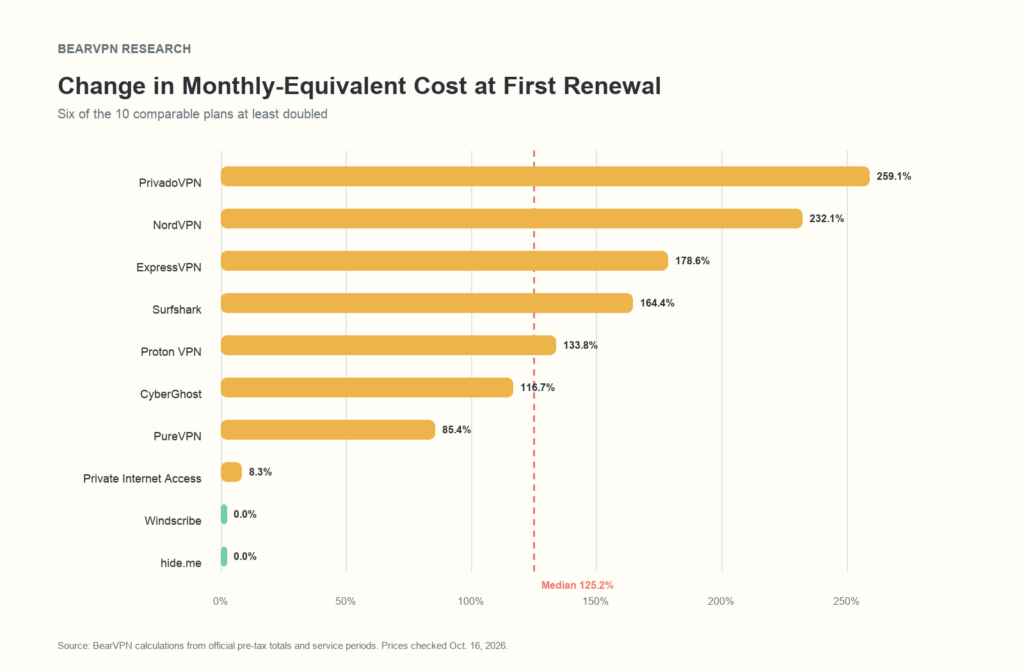
- The median increase was 125.2%. This is the median of the 10 individual renewal changes, not an estimate for the entire VPN market.
- 6 plans at least doubled. Six of the 10 comparable plans had a first-renewal monthly equivalent at least twice their introductory rate.
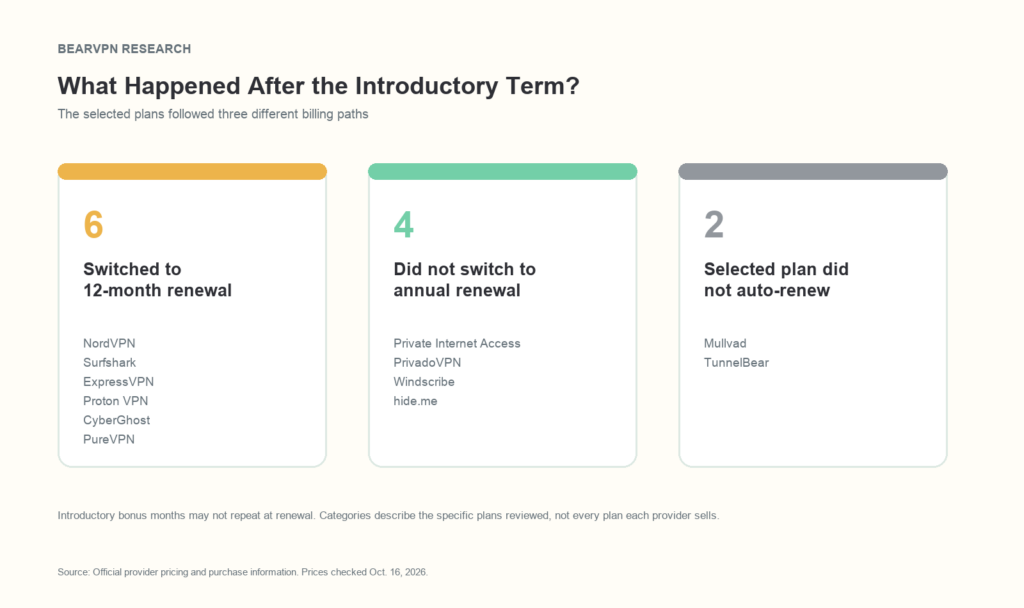
- 6 switched to annual renewal. Six introductory terms covering 24 to 28 months renewed for only 12 months.
Two other providers used non-renewing payment models for the lowest-priced plan reviewed. They are included as billing-model comparisons but excluded from renewal-increase calculations.
What these findings mean
The most important difference is not always a simple price increase. Three things can change at once: the total charged, the number of included months, and the length of the next billing cycle.
An advertised monthly price is useful for scanning offers, but it does not tell a buyer how much will be charged today. It also may not describe the renewal period. A plan can renew for the same total amount and still become more expensive per month if the second payment covers fewer months.
This report compares billing structures. It does not compare speed, privacy protections, server coverage, support, or overall value, and it does not name a “best” or “cheapest” VPN.
Introductory and renewal VPN prices compared
The table below shows the specific plans observed in our October 16, 2026 collection. “Monthly equivalent” means the total payment divided by the months of service. It does not mean the provider charges monthly.
Prices exclude tax unless stated otherwise by the provider. N/A means the selected plan did not automatically renew, not that a missing renewal price was treated as zero. Private Internet Access displayed $1.89 per month for 39 months; the $73.71 first payment is a BearVPN calculation from those published figures. Source links may now show a different offer because prices and experiments change.
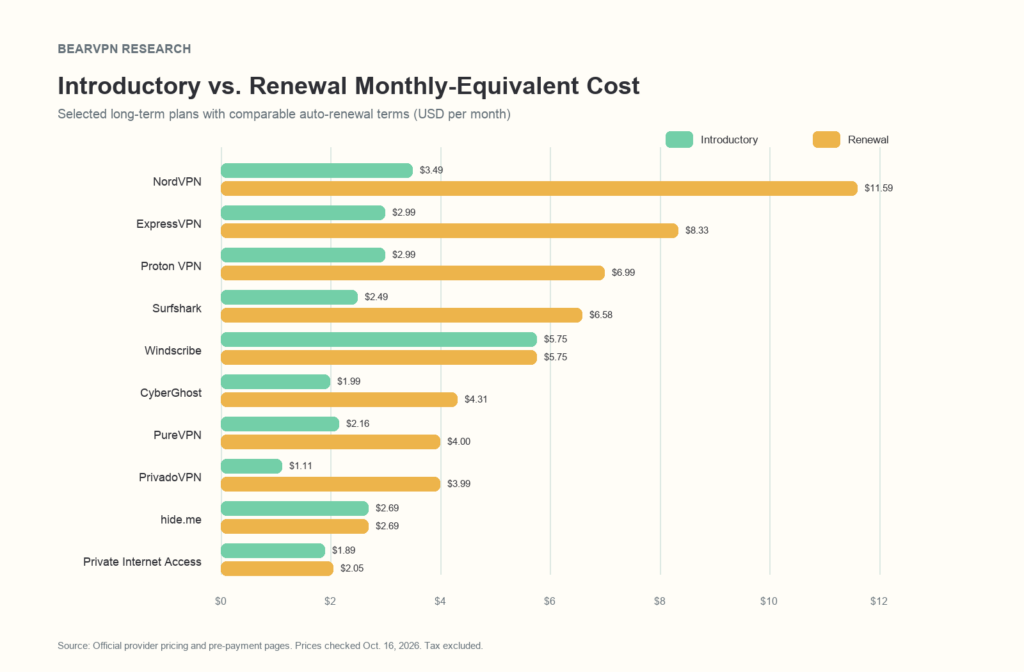
The highest percentage increase in this snapshot was PrivadoVPN. Its pricing card advertised $1.11 per month for a 24-month plan with three free months. The payment flow showed a $30 first payment for 27 months and a $95.76 renewal for 24 months. The monthly equivalent therefore rose from $1.11 to $3.99.
NordVPN had the highest renewal monthly equivalent in the comparison, at $11.59. The observed Basic offer covered 27 months for $94.23, then renewed at $139.08 for 12 months.
CyberGhost illustrates why the service period matters. The first and renewal totals were both $51.74, but the first payment covered 26 months while the renewal covered 12. The total did not increase, but the monthly equivalent rose by 116.7%.
The advertised monthly price is usually not a monthly payment
Long-term VPN offers often turn one upfront charge into a smaller monthly-equivalent number. The calculation itself is simple:
Monthly equivalent = total payment ÷ months of service
For example, a $67.23 payment covering 27 months has a monthly equivalent of $2.49. The customer is still charged $67.23 upfront, not $2.49 each month.
Bonus months also affect the displayed rate. If a provider charges for 24 months and adds three free months, the first payment is divided across 27 months. Those extra months may not be included again when the subscription renews.
Before subscribing, the amount labeled “billed today,” “first payment,” or “total” is more useful for budgeting than the large monthly-equivalent figure on a pricing card.
Six long-term offers switched to a one-year renewal
NordVPN, Surfshark, ExpressVPN, Proton VPN, CyberGhost, and PureVPN each had an introductory term covering 24 to 28 months in the captured offer. Their first renewals covered 12 months.
That change makes a direct comparison of the two total payments misleading. CyberGhost is the clearest example: $51.74 appeared at both stages, but the second payment bought less than half as much time. PureVPN moved in the other direction on the total charge, from $58.20 initially to $47.95 at renewal, yet its monthly equivalent still rose because the renewal covered only one year.
The renewal-period change also affects cash flow. A customer who first paid for more than two years may later be charged every year. The billing frequency deserves the same attention as the renewal amount.
Not every plan switched to annual renewal
Four auto-renewing plans in the sample did not switch from a long first term to a one-year renewal, but they did not all follow exactly the same model:
- Private Internet Access offered 36 paid months plus three extra months, then renewed every 36 months. The bonus months did not repeat.
- PrivadoVPN offered 24 paid months plus three free months, then renewed every 24 months. The bonus months did not repeat.
- Windscribe remained an annual plan, billed at $69 every 12 months with no introductory discount in the offer reviewed.
- hide.me stated that its 26-month plan renewed at the same price and for the same duration.
The two remaining providers used a different model for the selected lowest-priced offer. Mullvad sells prepaid account time at a flat €5 monthly rate and does not automatically renew website purchases. TunnelBear’s three-year option was presented as a one-time payment in the purchase flow reviewed. TunnelBear also offers an annual subscription, but that was not its lowest advertised long-term price.
These cases show why missing or non-applicable renewal values should not be converted to zero. “Does not auto-renew” is a billing model, not a zero-dollar renewal.
Where the renewal information appeared
The location of renewal information varied across the official purchase paths we reviewed.
Some providers displayed the initial and renewal totals together. CyberGhost’s purchase page, for example, stated that the $51.74 first payment covered 26 months and then renewed annually at $51.74. PureVPN also displayed the first-term and annual renewal amounts together for the selected Standard plan.
Other providers required an additional step or page. PrivadoVPN’s public pricing card emphasized the monthly-equivalent offer, while the exact payment and renewal totals appeared later in the pre-payment flow. Surfshark maintained a separate standard renewal-pricing page and disclosed that displayed renewal prices may be affected by A/B price testing.
Proton VPN showed why a capture rule is necessary. Its public pricing page and USD checkout displayed different introductory offers during the collection period. We used the pre-payment checkout amount because it was closer to the actual transaction, while retaining the conflict as a note.
These examples are descriptive. We did not create a disclosure score, and this report does not rank providers by transparency.
How to compare VPN prices before subscribing
Use these five checks before relying on a “per month” figure:
- Check the amount charged today. Look for the total or order summary, not only the monthly equivalent.
- Count paid and bonus months separately. Free months can lower the introductory monthly equivalent without repeating at renewal.
- Find the first renewal total and period. A similar total may cover a much shorter period.
- Check whether auto-renewal is enabled. Do not assume every long-term offer renews automatically.
- Read the refund conditions. The number of days is only part of the policy. Payment method, usage, sales channel, and whether the charge is an initial payment or a renewal may matter.
Pricing and renewal information is not presented with the same level of clarity across every purchase channel. BearVPN’s Free VPN Ad Disclosure Study separately examined how 30 U.S. App Store listings described ongoing free access, Premium differences, subscriptions, and renewals.
Refund rules differed in this sample. Windscribe’s official terms limited its refund window to seven days, applied it only to the initial payment, and included a usage condition. Mullvad’s refund page offered 14 days for eligible payment methods and excluded cash, cryptocurrency, vouchers, and App Store purchases. CyberGhost’s purchase page displayed 45 days for its long-term offer and 14 days for its monthly plan. These examples are purchasing considerations, not a complete legal analysis of refund rights.
Methodology
BearVPN collected this price snapshot on October 16, 2026.
BearVPN produced this report. BearVPN was not included in the provider comparison, totals, or rankings because its current free-tier and app-based subscription model is not directly comparable with the website plans analyzed here.
Sample
We purposefully selected 12 consumer VPN providers to cover several common website pricing models: long introductory offers, annual pricing without an introductory discount, same-price renewal, and prepaid or one-time payment options. This was not a random or market-share-weighted sample, so the results should not be generalized to every VPN service.
Plan selection
For each provider, we selected the lowest website tier centered on the VPN service, avoiding higher-priced security bundles where possible. We used the longest standard term promoted on the official website because this is commonly the source of the lowest advertised monthly equivalent. We excluded app-store billing, affiliate-only pages, student discounts, manual coupon codes, dedicated IPs, and optional paid add-ons.
If the lowest-priced long-term option did not automatically renew, we kept it as a billing-model comparison rather than replacing it with a more expensive renewing plan.
Sources and evidence priority
We used official provider pricing pages, pre-payment order summaries, renewal pages, help centers, and terms. When an official pricing card conflicted with a pre-payment summary in the same collection period, we used the pre-payment amount and recorded the conflict.
The evidence priority was:
- Pre-payment order summary or checkout page.
- Official pricing page with explicit first-term and renewal amounts.
- Official renewal page, help center, or terms.
- A clearly labeled BearVPN calculation from official amounts and service periods.
Calculations
We calculated:
- Introductory monthly equivalent = first payment ÷ first-term service months.
- Renewal monthly equivalent = first renewal payment ÷ renewal period in months.
- Renewal increase = (renewal monthly equivalent ÷ introductory monthly equivalent − 1) × 100.
Bonus months were included in the introductory service period. Taxes were excluded. We recorded US-dollar prices when the captured official purchase path displayed USD and did not convert prices between currencies. Mullvad remained in euros and was excluded from the renewal-change calculations because the selected website purchase did not automatically renew.
The median increase was calculated from the 10 auto-renewing plans with enough published price and term information to calculate both stages. PIA’s introductory total was derived from its displayed $1.89 monthly equivalent and 39-month service period; it is labeled as a calculated value in the table.
Limitations
- Prices are a snapshot. Promotions, A/B tests, location, cookies, currency, billing address, and taxes can change the offer a visitor sees.
- A same-day visit in another context can return a different plan or promotion. We kept one internally consistent capture rather than combining prices from different sessions.
- We did not complete a purchase or wait for a subscription to renew. The analysis uses the amounts and terms shown before payment.
- A currently published renewal price may change before a customer’s future renewal if the provider’s terms permit changes with notice.
- The sample was purposefully selected and is not an industry census.
- This study compares billing structure only. It does not measure product quality or value for money.
FAQ
There is no single monthly price, and this study did not compare standalone month-to-month plans. Among the 10 comparable long-term, auto-renewing plans in this selected sample, the median introductory monthly equivalent was $2.59 and the median renewal monthly equivalent was $5.03. These are figures from a dated, purposefully selected sample, not market-wide averages.
Many providers apply a discount to the first subscription term and use a standard price for renewal. Bonus months may also end, and the renewal may cover fewer months. The combination can increase the monthly-equivalent cost even when the renewal total looks similar to the first payment.
Most of the website subscriptions in this comparison did, but not every plan followed that model. Mullvad’s website purchases used prepaid account time, and the selected TunnelBear three-year plan was treated as a one-time payment. Always check the exact plan rather than assuming the brand uses one billing rule for every option.
Often, turning off auto-renewal stops the next charge rather than ending the time already paid for. The exact process and effect depend on the provider, plan, and purchase channel, so confirm the applicable account instructions and terms before making a change.
Not always. This report uses pre-tax prices. The final tax can depend on the billing country, state, payment method, and information entered at checkout.
Conclusion
A low advertised monthly price can accurately describe the average cost of an introductory term while still giving an incomplete picture of the purchase. The buyer may need to pay the full term upfront, lose bonus months at renewal, or move to a shorter billing cycle.
Price should also be separated from technical safety. A paid VPN is not automatically secure, just as a free VPN is not automatically unsafe. See what independent research shows about free VPN safety for the evidence and warning signs users can evaluate.
In this snapshot, eight of 10 comparable auto-renewing plans became more expensive per month at first renewal, and six at least doubled. The simplest way to avoid a surprise is to record two pieces of information before paying: the total charged today and the amount and date of the first renewal. Those figures are more useful than the promotional monthly equivalent on its own.
Prices change. Check the provider’s current order summary and terms before subscribing.