Finding a website blocked in Singapore can feel confusing because not all restrictions look the same. Sometimes a site is filtered by local ISPs, sometimes a domain is restricted after enforcement actions, and sometimes the “block” is actually a DNS or network problem on your end.
In this guide, you’ll get a clear overview of internet restrictions in Singapore, the most common categories of blocked websites, why blocks happen, and what the law-focused questions really mean in practice. You’ll also learn safe, privacy-first ways to restore access where it’s lawful—without turning this into a risky workaround manual.
Overview of Internet Restrictions in Singapore
Singapore’s internet controls are more precise than people often assume. Instead of blanket restrictions across the entire web, blocks tend to be category-based and implemented through ISPs under specific regulatory or enforcement contexts. That means the blocked websites in Singapore experience is usually about certain content types rather than a general censorship wall.
In day-to-day use, you may notice that most mainstream platforms work normally, while some sites in high-risk categories become unreachable or intermittently restricted. It also helps to remember that availability can change over time: enforcement priorities shift, domains move, and ISPs update filtering methods.
Check Blocked Website Categories in Singapore
When you’re trying to understand restricted websites in Singapore, categories explain more than individual domain names. Different categories tend to be restricted for different reasons—public policy, consumer protection, copyright enforcement, or harmful/inauthentic content concerns. Thinking in categories also helps you diagnose whether you’re dealing with a likely ISP-level block, a site issue, or something else.
Common blocked categories you may encounter
1. Unlicensed gambling & “vice” content
Offshore gambling sites are a frequent target in many countries, and Singapore is no exception. You may see full-domain blocks or rotating restrictions as sites rebrand or shift domains.
2. Piracy & illegal streaming
Blocked torrent websites in Singapore and illegal streaming portals are often tied to copyright enforcement. On January 5, 2026, the Singapore High Court ordered ISPs to block an additional 53 piracy domains. These blocks tend to expand over time as mirror domains appear.
3. Selected adult content
Singapore has historically used targeted blocking for adult content rather than broad filtering of everything. As a result, you may see some adult sites unreachable while others remain accessible.
4. Inauthentic or harmful websites
Beyond content categories like gambling or piracy, restrictions can also involve sites flagged as deceptive, inauthentic, or harmful—especially when authorities warn that the sites are linked to manipulation or fraud risks.
5. Financial scams and high-risk “too good to be true” portals
This isn’t always described as “internet censorship in Singapore,” but from a user perspective, it can look similar: a suspicious domain becomes unreachable after warnings or enforcement actions.
Check the Popular Websites Blocked in Singapore
Because domain blocks in Singapore can change over time, a list of blocked websites is best read as a snapshot of patterns—not a permanent catalog. The examples below focus on well-known sites that have been reported as blocked or restricted, plus recent enforcement cases where authorities published specific domains.
Why Are Websites Blocked in Singapore?
If you’re asking why websites are blocked in Singapore, the answer is rarely a single reason. Blocks usually reflect a mix of legal enforcement, public-interest policy, and risk reduction—especially in the areas of harm, fraud, and intellectual property. Understanding the “why” helps you avoid accidental exposure to risk, and it also clarifies which access steps are reasonable versus reckless.
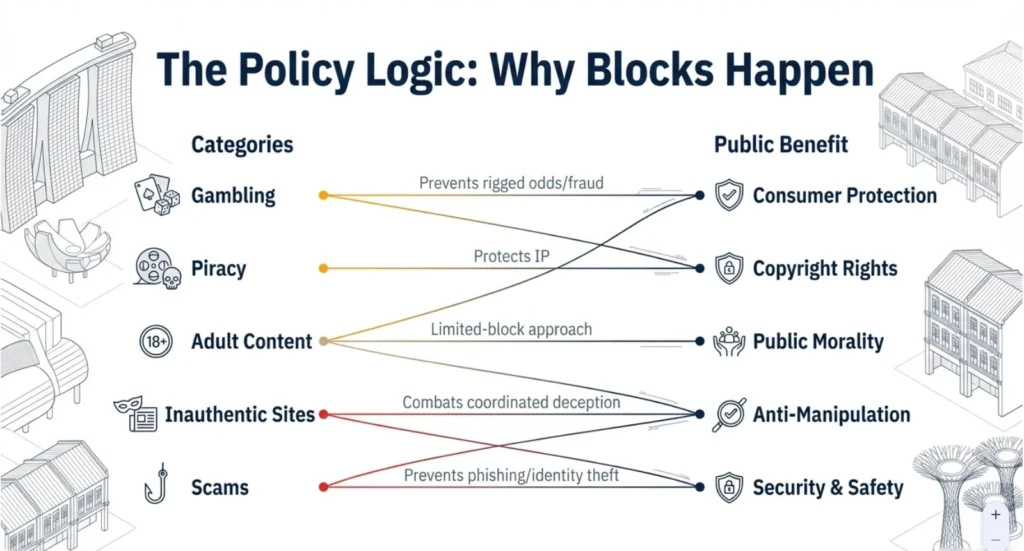
The most common drivers behind blocks
1) Licensing and consumer protection (especially gambling)
Unlicensed gambling can create consumer harm: payment fraud, rigged odds, and difficulty with dispute resolution. Restricting access is one way governments try to reduce exposure and enforce licensing rules.
2) Copyright and piracy enforcement
Piracy sites—whether torrents or streaming—often become targets because they facilitate large-scale infringement. In practice, this is why “blocked websites in Singapore” lists frequently include torrent indexes and streaming portals.
3) Limited adult content restrictions
Instead of trying to filter everything, some jurisdictions restrict a defined set of adult domains. If you notice selective blocks rather than a complete category shutdown, that pattern often aligns with a limited-block approach.
4) Deceptive, inauthentic, or harmful sites
Sometimes restrictions aren’t about content taste; they’re about credibility and harm. “Inauthentic” sites can be linked to manipulation, scams, or coordinated deception, and blocks can follow official warnings.
5) Security threats and fraud prevention
Phishing pages, malware distribution domains, and impersonation sites are common reasons for takedowns and restrictions. From your perspective, it may look like censorship, but the practical goal is often user safety.
Is Visiting Banned Sites Illegal in Singapore?
This is the question that drives many searches, but the most useful way to think about it is: what are you accessing, and what are you doing with it? “Banned websites in Singapore” can include different categories, and legal exposure often depends more on actions than on curiosity clicks.
In general, you should separate three layers:
- Accessing information (viewing a page)
- Distributing or enabling access (sharing, re-uploading, operating a service)
- Commercial or repeated infringement (profiting, systematic distribution, large-scale activity)
For example, copyright enforcement risk usually escalates when you move from passive viewing into distribution or repeated infringement. The same logic applies to fraud-related sites: a blocked domain may exist because it’s harmful, and interacting with it can expose you to financial loss or identity theft even if you’re not breaking a law.
You’ll also see the question “is using a VPN legal in Singapore.” The practical point is: a VPN can be legal while specific activities remain illegal. A VPN changes how your connection is routed and encrypted; it doesn’t rewrite the underlying rules about gambling, piracy distribution, fraud, or other regulated areas.
How to Access Blocked Websites in Singapore Safely (and Lawfully)
If a website is blocked in Singapore, your first step should be diagnosis—not bypass. Many access problems come from DNS, network policies, or temporary ISP filtering. A careful, privacy-first approach helps you avoid unnecessary risk and also prevents you from mistaking a simple technical issue for a legal restriction.
1) Quick checks that solve a surprising number of “blocked” cases
Try these before anything else:
- Switch between Wi-Fi and mobile data to see if the issue is network-specific.
- Test the site on another device or browser to rule out a local configuration issue.
- Check whether the site is actually down (service outages happen everywhere).
- If you’re on a workplace or school network, remember that local network policies can restrict websites even when the broader internet does not.
2) Understand DNS-based blocks vs. other restrictions
Some restrictions manifest at the DNS level (how your device translates a domain name into an IP address). Others are enforced via ISP filtering, routing blocks, or domain-level restrictions that persist regardless of your device settings. Practically, this means one “fix” won’t work universally—and it’s why you should avoid random tweaks that may create security issues.
3) When privacy is the real need: protect yourself on public Wi-Fi
A lot of people look up “how to unblock websites in Singapore” when the real concern is privacy: hotels, airports, cafés, and shared networks are where tracking and interception risks rise. Even when you’re accessing perfectly lawful sites, your traffic can still be exposed to:
- session hijacking risks on poorly configured networks
- tracking via network-level observation
- profiling based on IP and location signals
This is where a reputable VPN is often used—not as a magic key for everything, but as a practical privacy layer that encrypts your connection and reduces exposure on untrusted networks.
Is a VPN the Right Option in Singapore? What to Look For
If you decide a VPN fits your situation, choosing one is less about flashy claims and more about matching the tool to your real problem. People usually want a VPN in Singapore for one of three reasons: safer browsing on public Wi-Fi, reducing tracking and profiling, or restoring access to services that are blocked or limited by network-level filtering (where that access is lawful).
What matters most for everyday use
1) Reliable connections and modern protocols
If your connection drops or slows dramatically, you’ll stop using the VPN. Look for support for modern protocols (commonly WireGuard-based options) that balance speed and security.
2) Leak protection and a kill switch
If your VPN disconnects unexpectedly, your traffic can revert to your normal connection. A kill switch helps prevent that “silent exposure,” which is especially useful when you’re on public Wi-Fi or switching networks.
3) Clear privacy stance you can understand
You’re not looking for vague marketing. You’re looking for plain-language explanations about data handling, logging, and how the service is operated.
Using BearVPN for Everyday Privacy in Singapore
While Singapore’s internet remains largely open for mainstream services, accessing public Wi-Fi networks in high-traffic spots like Changi Airport, hotels, or coffee shops introduces privacy risks. BearVPN serves as a reliable security layer:
- End-to-End Encryption: Protects your unencrypted browsing sessions from local network sniffers or session hijacking on shared Wi-Fi connections.
- DNS Leak Shield: Forces DNS queries through secure, private resolvers so local ISPs or public routers cannot track your domain lookup history.
- Automatic Kill Switch: Prevents accidental IP exposure by instantly cutting internet traffic if your VPN tunnel drops unexpectedly while switching between Wi-Fi and mobile data.
Conclusion
When you run into blocked websites in Singapore, you’ll get the most clarity by stepping back from the frustration and identifying the category and likely mechanism: ISP filtering, DNS/network quirks, or a site that’s down. From there, you can make safer choices—especially avoiding risky interactions with scam or inauthentic domains. If your real need is privacy and stable access to lawful services across different networks, a reputable VPN can be a practical layer of protection, particularly on public Wi-Fi. The goal isn’t to “beat” restrictions; it’s to browse responsibly, reduce exposure, and stay on the right side of both security and local rules.
FAQs
No. Using a VPN is completely legal in Singapore. Businesses and private users widely use VPNs for cybersecurity and encrypted browsing. However, using a VPN does not exempt users from local laws regarding illegal online activities.
Mainstream platforms like Netflix, YouTube, and Social Media are not blocked in Singapore. However, Netflix content catalogs vary by region, and certain titles may be geo-restricted or self-regulated according to local media classification standards.
The Infocomm Media Development Authority (IMDA) and Singapore High Court issue targeted blocking orders to protect copyright holders and enforce public safety regulations against unlicensed gambling, explicit adult content, and foreign misinformation portals.
While personal viewing of adult content is generally not actively prosecuted, major commercial adult websites and torrent indexes (like The Pirate Bay) are blocked at the ISP level under statutory regulatory orders.
This usually indicates a DNS or local network filtering policy specific to your Wi-Fi router or workplace network, rather than an official nationwide government block.
References
- Infocomm Media Development Authority (IMDA): public announcements and press releases on website restrictions and enforcement actions
- Cyber Security Agency of Singapore (CSA): advisories on safe internet use and VPN/security practices
- Tech.gov.sg: government tech explainer content, including VPN-related guidance
- Channel NewsAsia (CNA): reporting on specific website-blocking actions and policy context


![How to Change YouTube TV Location [Still Works in 2026]](/_next/image/?url=https%3A%2F%2Fcms.bearvpn.com%2Fwp-content%2Fuploads%2F2026%2F06%2Fhow-to-change-location-youtube-tv.webp&w=640&q=75)