VPN providers describe server counts, locations, RAM-only systems, ownership, hosting, and audits using different definitions. We reviewed official disclosures from 20 brands to compare what users can check in public records—and what remains unclear.
Direct Answer
VPN providers disclose very different levels of detail about the servers behind their services. In our 20-brand review, 19 providers had enough retrievable official evidence for structured comparison. Nine directly documented network-wide RAM-only systems. Mozilla VPN uses Mullvad’s same underlying infrastructure, bringing the brand count on such networks to ten without adding a separate implementation. Only five providers published usable physical-host mappings or explicitly said they did not use virtual locations, and only two independent networks published per-server ownership or hosting-provider details.
These findings describe public documentation checked on November 13, 2026. They do not independently verify the physical configuration, current behavior, or security of every server.
Publisher disclosure: This report was produced by BearVPN, a VPN provider. BearVPN was excluded from the 20-provider sample and all percentages. We reviewed public vendor documentation and published assessment material; we did not inspect data centers, scan live servers, or independently verify vendor infrastructure claims.
Key Findings at a Glance
- Nine independent network-wide RAM-only claims: Nine of the 19 providers in the comparison denominator directly documented a network-wide RAM-only system. Mozilla VPN uses Mullvad’s underlying servers, so ten brands operated on networks described as fully RAM-only, but they did not represent ten separate implementations.
- Five stronger virtual-location disclosures: ExpressVPN, Proton VPN, and Private Internet Access published usable mappings between logical locations and physical host locations. Windscribe and IVPN explicitly said they did not use virtual locations, with Windscribe identifying a named “Fake Antarctica” exception hosted in Toronto.
- Two independent networks with per-server hosting details: Mullvad and IVPN published server- or gateway-level ownership and provider information. Mozilla VPN directs users to Mullvad’s same underlying server list.
- Ten of 19 providers had downloadable assessment material: The material ranged from sampled servers and standardized containers to deployment scripts, assurance letters, and executive summaries. These were not equivalent in scope, recency, or depth.
- Four official-data conflicts: TunnelBear, Hotspot Shield, PureVPN, and Astrill VPN showed conflicting counts or lists across current official pages.
We reviewed 20 VPN brands. Nineteen had enough retrievable official evidence for structured comparison. IPVanish remains in the evidence table but is excluded from percentage denominators because the relevant current documentation was incomplete or unstable during collection.
VPN Server Infrastructure Compared Across 20 Providers
The table keeps each provider’s original units. A count of countries, cities, locations, IP addresses, or gateways is not converted into a server count. “Not publicly confirmed” means we did not locate a sufficiently clear statement in the official sources reviewed; it does not mean the provider necessarily lacks that feature or practice.
Each row synthesizes multiple official sources. The provider name links to one primary page; the full source set appears at the end of the report. “Complete” means the public evidence chain was sufficient for our coding fields; it does not mean every field was disclosed, every claim was independently verified, or the provider received a security rating.
Evidence checked: November 13, 2026.
These fields describe disclosure, not overall product quality. A larger server count, RAM-only claim, owned-server subset, or published assessment does not by itself establish that one VPN is safer than another.
Five Terms That Make VPN Server Claims Hard to Compare
Servers, locations, countries, cities, and IP addresses
A server is not the same thing as a location. A provider may operate many machines in one city, offer several logical locations from one physical site, or publish only the number of countries where users can obtain an IP address. “Locations” may mean countries, cities, endpoints, clusters, or choices in an app, depending on the provider.
That is why this report does not rank providers by a single network-size number. Norton’s 140+ figure is a location count, for example, while Proton VPN displayed a server count, country count, and location count separately. VyprVPN also published an IP-address count, which cannot be compared directly with a physical-server total.
RAM-only, diskless, and encrypted disks
A RAM-only or diskless design generally means the server’s operating environment and active state run in volatile memory rather than relying on persistent local storage. Restarting the machine can therefore remove data written during that session. The exact boot process, firmware, orchestration, monitoring, and external systems still matter.
RAM-only does not prevent a server from processing information while it is running, sending information elsewhere, or being affected by flawed software or configuration. It is one infrastructure control, not proof of a no-logs policy or complete security. Full-disk encryption is a different control: it protects data stored on a disk, but it is not the same architecture as running without persistent storage.
Physical and virtual locations
A virtual VPN location normally gives the user an IP address associated with one country or city while the physical server is hosted somewhere else. This is not necessarily the same as a virtual machine, and it does not mean the server is fictitious.
Virtual locations can let a provider offer an IP address for a market where local hardware is unavailable, unreliable, or inconsistent with the provider’s policies. The useful transparency question is whether the provider labels the location and tells users where the VPN endpoint is physically hosted.
Owned, rented, colocated, dedicated, operated, and controlled
These words are not interchangeable. An owned server belongs to the provider. A rented server may be dedicated to one customer while the data-center company still owns the hardware. Colocation commonly means the provider places its own equipment in a third-party facility. “Operated” or “controlled” can describe management responsibility without proving legal ownership.
Subset claims also need boundaries. CyberGhost’s NoSpy disclosure and Proton VPN’s Secure Core ownership statements provide useful information about specific parts of their networks, but they do not establish that every server in the wider network has the same ownership model.
Audit, assessment, assurance letter, and executive summary
The word “audited” does not reveal what was examined. A report might cover deployment scripts, a standardized container, a sample of servers, log-retention controls, client code, or a management assertion. It may be a full technical report, an assurance letter, or an executive summary.
Scope, date, sample, and public accessibility therefore matter more than a simple audited/not-audited label. A client security audit does not automatically assess server storage or hosting. A sampled server review does not mean every current server was physically inspected. For a separate analysis of this distinction, see our review of the public evidence behind VPN no-logs claims. Protocol support is also a separate layer; our documentation audit compares which VPN protocols 20 providers publish.
How We Reviewed the 20 Providers
Sample selection
We selected 20 consumer VPN brands to cover large commercial services, privacy-focused providers, antivirus-company VPNs, free and paid products, and different levels of public documentation. The sample was purposive, not random, and it should not be treated as a census of the VPN market.
The sample consisted of NordVPN, ExpressVPN, Surfshark, Proton VPN, Mullvad, Private Internet Access, CyberGhost VPN, IPVanish, Windscribe, IVPN, TunnelBear, hide.me, VyprVPN, Hotspot Shield, PureVPN, Mozilla VPN, Astrill VPN, Norton VPN, Avast SecureLine VPN, and Bitdefender VPN. BearVPN was excluded because it publishes this report.
Sources reviewed
We reviewed official server lists, network-status pages, help documents, technical articles, trust centers, privacy or infrastructure explanations, audit reports, assurance letters, and executive summaries. Core fields were not filled from third-party VPN reviews.
Each source was checked for what it actually supported. A page that defined RAM-only servers without stating that the provider deployed them across its own network was not enough for a network-wide claim. A general discussion of virtual servers was not enough to establish which advertised locations were virtual. A statement about dedicated hardware was not treated as proof of ownership.
Fields coded
For each provider, we recorded the network-size units it published, its storage statement, its physical or virtual-location disclosure, whether actual host locations were mapped, its ownership or hosting language, the availability and scope of assessment material, conflicts between official pages, and the overall status of the evidence chain.
We also recorded shared infrastructure. Mozilla states that Mozilla VPN uses the same servers as Mullvad. We therefore counted Mozilla as a brand operating on a publicly documented RAM-only network, but not as a separate RAM-only implementation or an independent per-server disclosure system.
Coding and denominator rules
“Not publicly confirmed” means the reviewed official sources did not provide a sufficiently clear answer. It does not mean the underlying practice is absent. Vendor claims and independent assessment material remain separate. When current official pages conflicted, we retained both values instead of selecting the larger or newer-looking number without an explicit reconciliation from the provider.
We reviewed 20 brands, but percentages use 19. IPVanish remains in the table because it was part of the planned sample; it was excluded from percentage denominators because we could not build a sufficiently complete and stable current official evidence chain without relying on third-party reviews.
All figures are a documentation snapshot checked on November 13, 2026. Provider networks, pages, and assessment materials can change after that date.
RAM-Only Was Common, but the Claims Were Not Independent in Every Case
Nine of the 19 providers in the comparison denominator directly documented a network-wide RAM-only system: NordVPN, ExpressVPN, Surfshark, Mullvad, Private Internet Access, CyberGhost VPN, Windscribe, hide.me, and Astrill VPN. Mozilla VPN uses Mullvad’s same underlying servers, so ten brands operated on networks publicly described as fully RAM-only, but the evidence represents nine independently documented implementations.
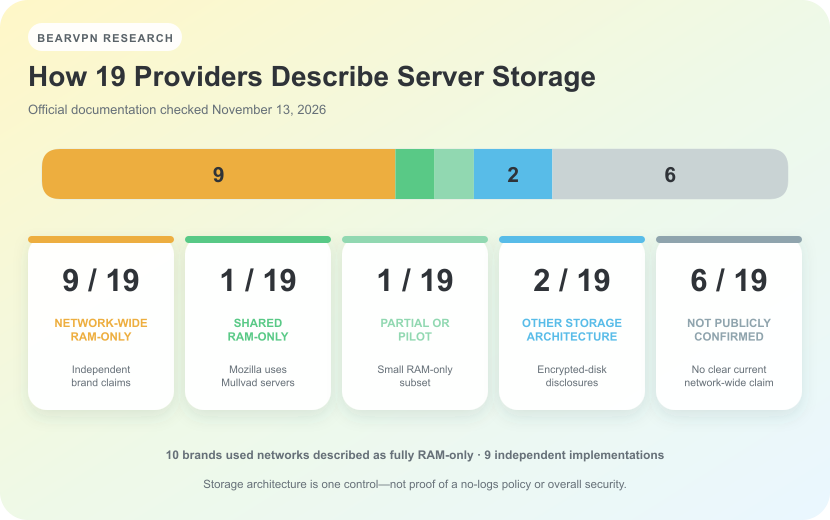
The remaining disclosures did not fit a simple RAM-only versus disk category. IVPN’s current status material described full-disk encryption across the network and a small number of RAM-only pilot gateways. Proton VPN disclosed full-disk encryption without making a network-wide RAM-only claim. PureVPN explicitly described its current architecture as encrypted hard-drive servers rather than RAM-only servers.
For TunnelBear, VyprVPN, Hotspot Shield, Norton VPN, Avast SecureLine VPN, and Bitdefender VPN, we did not locate a sufficiently clear current official statement to classify the entire network’s storage architecture. That result should be read as missing public confirmation, not evidence that all six use traditional disks.
RAM-only is useful when the question is what may remain on a machine after it restarts or loses power. It does not answer what the server processes while online, whether another system receives telemetry, how deployment images are secured, or whether software contains vulnerabilities. Storage architecture is one part of the logging question. Our separate review compares the public evidence behind 20 VPN no-logs claims.
Virtual Locations Were Often Labeled but Rarely Fully Mapped
Three providers published usable mappings from logical VPN locations to the countries or cities where servers were physically hosted. ExpressVPN maintains a virtual-location page that lists the physical host country for affected locations. Proton VPN’s Smart Routing documentation maps advertised destinations to physical host locations. Private Internet Access publishes a virtual-server location table with the corresponding physical exit location.
Windscribe and IVPN took a different approach: both said they did not use virtual locations. Windscribe separately identified its “Fake Antarctica” location as an exception physically hosted in Toronto. Together, these three mapping disclosures and two explicit non-use statements formed the five strongest virtual-location disclosures in our coding.
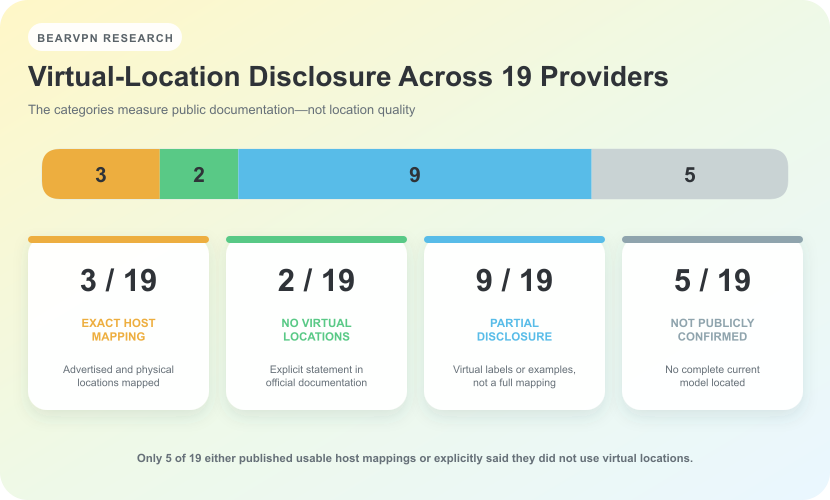
Nine providers offered partial information. Some labeled locations as virtual or physical without publishing a complete actual-host map. Others explained the concept, supplied isolated “via” examples, or published figures that conflicted with another current page. Norton’s city table was particularly useful because it included a Physical Server Yes/No field, but it did not say where every No location was physically hosted.
For Mullvad, TunnelBear, Mozilla VPN, Astrill VPN, and Avast SecureLine VPN, the reviewed materials did not establish a complete virtual-geolocation model. Mullvad’s server list provides granular city, provider, and ownership information, but the reviewed documentation did not separately define a virtual-location scheme. Mozilla uses the same underlying servers, so it inherits access to that list without creating a separate mapping system.
Virtual locations are not automatically unsafe or lower quality. They can be used where local infrastructure is unreliable or where operating local hardware would conflict with a provider’s policies. The disclosure matters because the advertised IP location and the VPN endpoint’s physical host location may differ. A server location also changes the IP address websites see, but it does not make a user impossible to track. See our separate review of VPN IP and location leak evidence.
Per-Server Ownership and Hosting Details Were Rare
Mullvad and IVPN were the only independent networks in the sample with server- or gateway-level ownership and hosting-provider fields. Mullvad’s live list can distinguish Owned and Rented servers and identify the provider. IVPN’s status page identifies gateways and data-center partners, while its documentation says the gateways are rented dedicated bare-metal servers.
Mozilla VPN points users to Mullvad’s same server network. This gives Mozilla users access to the underlying list, but counting Mozilla as a third independent disclosure system would duplicate the same infrastructure.
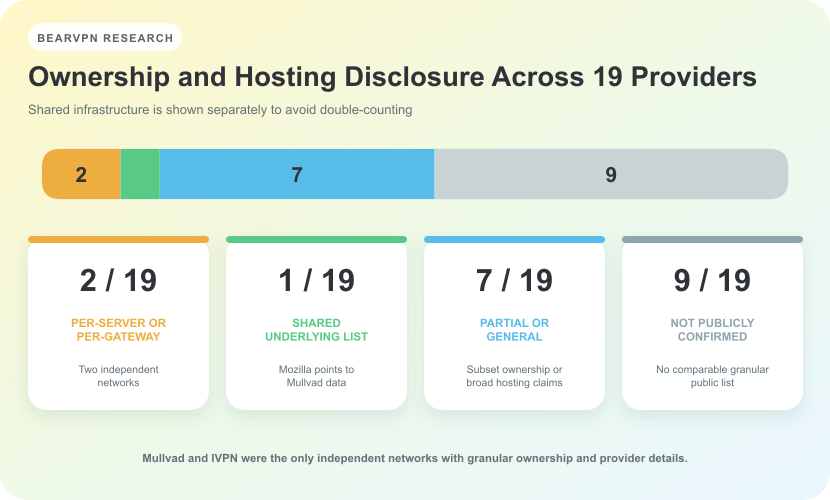
Seven other providers supplied some ownership or hosting information without a complete per-server model. NordVPN used broad language about a substantial in-house-managed portion alongside partner-hosted infrastructure. Proton VPN described ownership for Secure Core and portions of selected markets. CyberGhost published claims about its NoSpy and colocated subsets. VyprVPN said it owns or controls its servers and hardware. Private Internet Access described dedicated bare-metal infrastructure without establishing hardware ownership. Avast said dedicated servers were rented in certain locations. Bitdefender’s official material named a partner VPN platform without providing a current per-server list.
The remaining nine providers did not publish ownership or provider details at a level we could consistently compare. This does not establish that they lack controls over their servers. It means those controls could not be confirmed through the same kind of public, granular list.
Corporate ownership is a separate layer. A parent-company relationship does not by itself prove that two VPNs share technical infrastructure or customer data. Our company mapping explains who owns popular VPN brands.
Published Assessments Varied in Scope and Accessibility
Ten of the 19 providers supplied downloadable public material that touched server infrastructure or related controls. That group included full reports, assurance material, letters, and executive summaries. The number is useful only when the differences in scope remain visible.
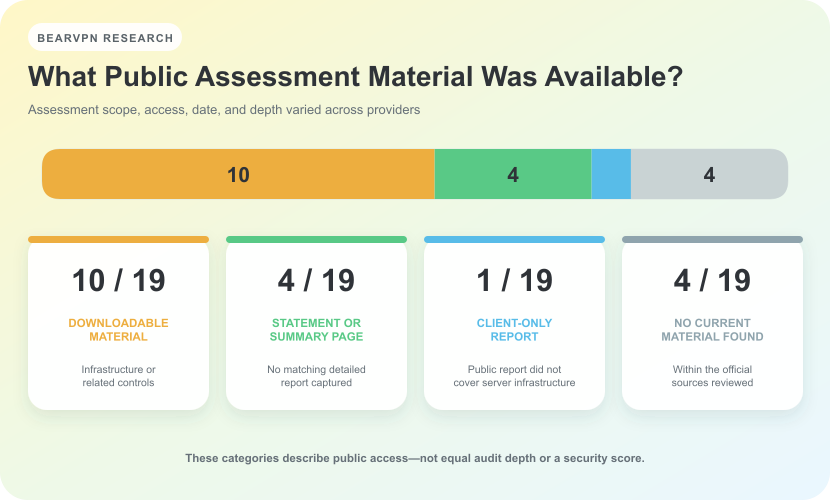
For example, hide.me’s public material described work involving a standardized LXC container sample and related infrastructure configurations. PureVPN’s KPMG material described seven VPN servers and supporting infrastructure across six countries. Norton’s VerSprite executive summary covered deployment scripts and VPN backend data-retention controls while explicitly excluding client testing, performance testing, and a broader penetration test. Hotspot Shield published an Aon summary relevant to privacy and node logging, not a physical ownership or RAM-architecture audit.
IVPN’s 2023 assessment concerned a new gateway configuration and code in a test environment, without access to production infrastructure. VyprVPN’s public no-log assessment was materially older, dating to 2018. These limitations do not make the material useless; they define what the material can support.
Four providers had an official audit statement or summary page for which we did not capture a detailed public report matching the coded infrastructure fields. Mozilla published a downloadable Cure53 client-security report, but its scope did not turn that document into a server-infrastructure audit. For four other providers, we did not locate a current relevant public assessment.
The defensible conclusion is not that ten VPN networks were fully audited. It is that ten providers published downloadable assessment material touching server infrastructure or related controls, with materially different methods, samples, dates, and levels of detail.
Four Providers Had Conflicting Current Official Figures
Current official pages did not always agree with each other. We found four conflicts that affected a server, country, or virtual-location figure.
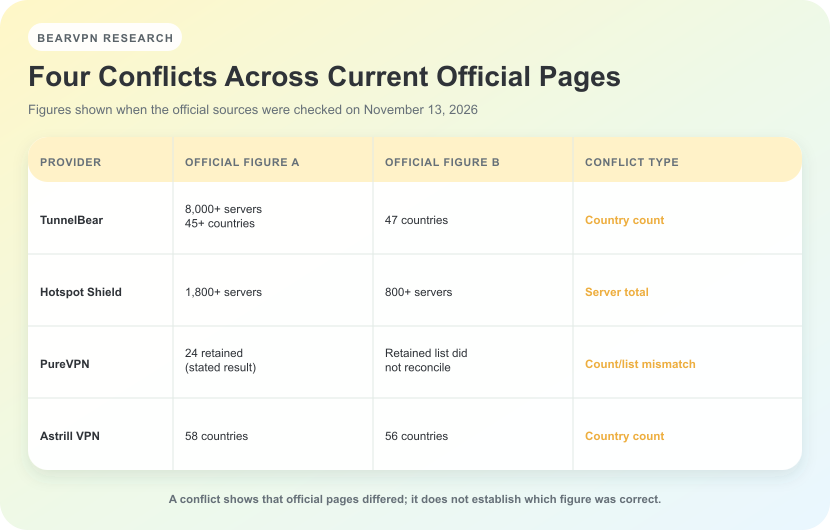
- TunnelBear’s help page showed 8,000+ servers in 45+ countries, while another official page displayed 47 countries.
- Hotspot Shield’s server page showed 1,800+ servers, while its plan page showed 800+ servers and 125+ virtual locations.
- PureVPN’s virtual-location announcement described 88 original virtual locations, 64 removals, and 24 retained locations, but the retained list did not align cleanly with that count and the page also described physical-to-virtual conversions.
- Astrill’s current network page showed 58 countries, while its features page showed 56.
VPN networks change, and pages may be updated on different schedules. A conflict does not prove which figure is wrong or why the difference exists. It does show why a network-size claim needs a source date and a definition. We retained both figures instead of selecting the larger number.
Provider-by-Provider Disclosure Notes
NordVPN
NordVPN documented a network-wide RAM-only design and labeled physical and virtual locations in its server material. Its ownership language covered a substantial in-house-managed portion while acknowledging partner-hosted infrastructure, but it did not provide a complete per-server ownership or physical-host mapping in the reviewed sources.
ExpressVPN
ExpressVPN documented TrustedServer as an all-RAM design and published direct virtual-location-to-host-country mappings. It also released third-party assurance material relevant to infrastructure controls. The reviewed public pages did not provide a per-server ownership or hosting-provider list.
Surfshark
Surfshark documented a network-wide RAM-only system and explained virtual locations. Its Trust Center stated that infrastructure had been audited, but we did not capture a detailed public report covering every coded field or a complete physical-host map for virtual locations.
Proton VPN
Proton VPN published separate server, country, and location counts and mapped Smart Routing destinations to physical hosts. It disclosed full-disk encryption and ownership of Secure Core plus portions of selected markets. Those subset claims do not establish whole-network ownership.
Mullvad
Mullvad provided the most granular live ownership data in the sample: server-level Owned/Rented status, provider, city, and other fields. It documented an all-RAM network and published infrastructure assessment material. The reviewed sources did not establish a separate virtual-geolocation model.
Private Internet Access
Private Internet Access documented network-wide RAM-only infrastructure and published a usable virtual-location-to-physical-host table. It described dedicated bare-metal servers and released Deloitte material, but “dedicated” alone does not establish that PIA legally owns every machine.
CyberGhost VPN
CyberGhost documented network-wide RAM-only servers and labeled virtual locations. Its strongest ownership language applied to NoSpy or colocated subsets, not the whole network. Audit statements covered VPN network or operational controls, but a complete host map was not located.
IPVanish
IPVanish remained in the planned 20-brand sample, but current official Trust Center and supporting materials were incomplete or unstable during collection. We did not fill the gaps from third-party reviews, so IPVanish was excluded from percentage denominators.
Windscribe
Windscribe documented an all-RAM VPN node fleet and said it did not use virtual locations, while naming “Fake Antarctica” as an exception physically hosted in Toronto. It also published assessment material, but no per-server ownership or hosting-provider list was located.
IVPN
IVPN published gateway-level status and data-center partner information and said it did not use virtual locations. Its network used full-disk encryption with a small RAM-only pilot. Its 2023 infrastructure assessment used a test environment rather than production access.
TunnelBear
TunnelBear published 8,000+ servers, but its official country totals differed between two current pages. Annual Cure53 work included backend systems and server configurations. RAM architecture, virtual-location mapping, and server ownership were not sufficiently confirmed in the reviewed sources.
hide.me
hide.me described its entire VPN exit-server infrastructure as RAM-only and published a Securitum assessment. The public material used a standardized LXC container sample; it should not be described as an inspection of every node. A complete virtual-host map was not located.
VyprVPN
VyprVPN published server, location, and IP-address counts and acknowledged both physical and virtual locations. It said it owns or controls every server and piece of hardware, wording that should not be reduced to legal ownership. Its public assessment dated to 2018.
Hotspot Shield
Hotspot Shield disclosed virtual locations and some “via” hosting examples, but current official pages showed conflicting server totals. It published an Aon privacy and node-logging summary, not a complete ownership, physical-host, or RAM-architecture assessment.
PureVPN
PureVPN explicitly documented encrypted hard-drive servers rather than RAM-only infrastructure and published KPMG material covering a limited server sample. Its 2026 virtual-location announcement contained count and list inconsistencies, so the conflicting information remains visible in the dataset.
Mozilla VPN
Mozilla stated that Mozilla VPN uses the same servers and infrastructure as Mullvad. Users can therefore consult Mullvad’s granular server list and RAM-only documentation. Mozilla’s Cure53 report covered client features and code, not a separate physical audit of the shared server network.
Astrill VPN
Astrill’s 2026 article claimed that its entire infrastructure runs on RAM-only servers. Its network page described physical infrastructure, but did not provide a per-location physical/virtual or ownership table. Current official pages also differed between 58 and 56 countries.
Norton VPN
Norton published 140+ locations across 100+ countries and marked each listed city as Physical Server Yes or No. That classification was useful, but actual host locations for No entries were not mapped. Its public VerSprite material was an executive summary with defined exclusions.
Avast SecureLine VPN
Avast documented 100+ locations and stated that dedicated servers were rented in certain locations. It did not identify those locations, providers, or the rest of the ownership model. RAM architecture and a complete virtual-location classification were not publicly confirmed.
Bitdefender VPN
Bitdefender listed 110 countries and selected city options. Its documentation used virtual-location terminology without a complete physical-host map. Official material referenced a partner VPN platform and a 2025 infrastructure assessment, but we did not locate a detailed public 2025 report.
What This Infrastructure Data Can—and Cannot—Tell You
This dataset can show whether a provider publishes definitions, separates server and location units, labels virtual locations, identifies actual host countries, distinguishes owned and rented infrastructure, names hosting partners, and makes assessment material available. It can also reveal when current official pages use inconsistent figures.
It cannot determine live server behavior, real-world speed, streaming access, software vulnerabilities, or whether every current node follows a stated policy. It cannot prove that one brand is safer because it operates more servers, uses RAM-only architecture, owns a subset of hardware, or publishes an audit. Each of those facts answers a narrower question.
Performance is especially separate from disclosure. Routes, congestion, distance, protocol, test method, and client hardware can all change results. Our speed research explains how routes and test methods affected VPN speed-retention results. For the broader privacy boundary, see what a VPN hides—and what it does not.
Limitations
This was a purposive review of 20 consumer VPN brands, not a random or complete survey of the VPN market. We relied on official material that was publicly retrievable during collection. We did not install the apps, scan endpoints, capture traffic, inspect data centers, contact hosting companies, or reproduce third-party assessments.
Provider networks and documents change. Counts are a snapshot, and a missing statement may be published later or available in material we did not locate. Some assessment documents were summaries, limited samples, older reports, or reviews of specific controls rather than the entire network. IPVanish was excluded from percentages because its current evidence chain was incomplete. Mozilla VPN and Mullvad were separate brands but shared underlying infrastructure.
Finally, disclosure is not a security score. A provider can publish extensive documentation and still have risks that this method does not test. Another provider may operate sound infrastructure without publishing the same level of detail.
Conclusion
RAM-only claims were common in this sample, but detailed ownership and physical-host information remained rare. The most useful infrastructure disclosures were not the largest headline server counts. They were definitions, current server lists, physical-host mappings, ownership and provider fields, assessment scope, and visible update dates.
Readers should treat infrastructure transparency as one part of VPN evaluation. Logging policy, client security, protocol support, corporate ownership, actual performance, and legal context require separate evidence. This report is designed to make one layer—the public server-infrastructure record—more comparable without turning it into a winner or safety ranking.
FAQ
RAM-only architecture can reduce the risk that session data remains on a server after shutdown or restart. It does not by itself prove that a provider keeps no logs, prevents online data processing, secures every external system, or has no software vulnerabilities. It is one control among many.
A virtual location normally gives the user an IP address associated with one country or city while the physical server is hosted elsewhere. It should not be confused with the broader concept of a virtual machine. Useful disclosure identifies both the advertised location and actual host location.
Practices differ. A provider may own hardware, place owned equipment in a colocation facility, rent dedicated bare-metal servers, use a hosting partner, or combine several models. Public claims should be read at their stated scope rather than extended to the entire network.
No. “Dedicated” generally means the server or its resources are assigned to one customer rather than shared with unrelated customers. The hardware may still belong to a data-center or hosting company. Ownership requires separate evidence.
Not necessarily. Published counts may use different units, and performance depends on capacity, load, routing, distance, protocols, maintenance, and demand. A smaller well-managed network can outperform a larger network for a particular user or route.
There is no universal interval, but providers and publishers should update material when the network architecture, hosting relationships, virtual locations, storage model, or major counts change. Every report should show when the evidence was checked so readers can judge its age.
Sources and Reproducibility
The comparison is based on official materials checked on November 13, 2026. Each provider row in the main table links to a primary official page.
Data download: VPN Server Infrastructure Evidence Workbook
Additional materials used for the coded fields include:
- NordVPN: Trust Center and server-list guidance.
- ExpressVPN: virtual server locations and Trust Center.
- Surfshark: virtual locations and Trust Center.
- Proton VPN: Smart Routing and Secure Core.
- Mullvad: server-list guide, RAM-only migration, and infrastructure assessment announcement.
- Private Internet Access: virtual server locations, no-logs infrastructure, and 2025 security audit announcement.
- CyberGhost VPN: NoSpy servers and 2025 privacy audit.
- IPVanish: Trust Center and audit announcement.
- Windscribe: server-count explanation, virtual-location statement, and FreshScribe infrastructure.
- IVPN: infrastructure assessment and infrastructure answers.
- TunnelBear: country and server list, VPN overview, and annual security audit announcement.
- hide.me: RAM-only architecture and Securitum report.
- VyprVPN: server-address list, location selection, and public assessment.
- Hotspot Shield: plan comparison, virtual locations, and Aon summary.
- PureVPN: virtual-location changes, RAM-only explanation, and KPMG assessment page.
- Mozilla VPN: server-network explanation, service terms, and 2023 Cure53 audit.
- Astrill VPN: features and 2026 security-stack article.
- Norton VPN: no-log assessment announcement and VerSprite executive summary.
- Avast SecureLine VPN: FAQ, location troubleshooting, and VPN policy.
- Bitdefender VPN: no-log policy and 2025 assessment statement, Pango platform assessment, and Windows VPN guide.
For corrections, contact BearVPN and identify the provider, field, current official source, and requested change. Verified corrections should update both the article and accompanying dataset with a new review date.