No—porn is not banned in the USA as a general matter for adults. The United States has federal and state laws that prohibit specific categories of material and conduct, including obscenity and child sexual abuse material. Separately, a growing number of states require certain adult websites to verify that visitors are at least 18. These rules can lead to age gates or a website declining to operate in a particular state, but they do not create a nationwide prohibition on all adult content.
The phrase “porn ban in USA” therefore hides several different questions: Is a category of content illegal? Is a state requiring an age check? Did a platform choose to block a location? Or is a network or device filter preventing access? This article answers those questions in plain language, focuses on privacy and lawful adult access, and does not provide ways to evade age verification, geographic restrictions, or other safeguards.
The U.S. legal picture in one view
The easiest way to understand the law is to separate four categories that are often mistakenly treated as one.

The answer is therefore not “everything is legal” or “everything is banned.” Context matters: the type of material, the age of the people involved, consent, the purpose and method of distribution, applicable federal law, the state where access occurs, and a platform’s own policy can all change the analysis.
What federal law actually prohibits
Federal law does not use the everyday term “porn” as a single legal category. The Department of Justice explains that obscenity is not protected by the First Amendment and that federal law prohibits a range of activities involving its distribution, transportation, sale, mailing, importation, and commercial transfer. Whether material is legally obscene is not determined solely by a viewer’s reaction or by a website label.
The constitutional framework is commonly called the Miller test, from *Miller v. California*. In simplified form, material may be treated as obscene if, taken as a whole, it appeals to prurient interest under contemporary community standards, depicts specifically defined sexual conduct in a patently offensive way, and lacks serious literary, artistic, political, or scientific value. This is a legal standard applied to facts and context, not a checklist for users to apply to individual images or sites.
The distinction is especially important for adults: sexually explicit material is not automatically “obscene” in the legal sense. But no adult-rights discussion applies to illegal categories. The Department of Justice’s guidance states that visual depictions involving a minor engaged in sexually explicit conduct are illegal contraband under federal law. Federal law also addresses exploitation, coercion, nonconsensual conduct, and other harms through different statutes. This article does not describe, host, link to, or recommend unlawful material.
Why access can look different from one state to another
In recent years, states have increasingly adopted online age-verification laws aimed at preventing minors from seeing material defined as harmful to minors. These laws generally do not say that an adult may never view lawful adult material. Instead, they impose obligations on certain commercial entities—often websites with a substantial portion of covered material—to check that a visitor is 18 or older.
State rules vary in at least five ways:
- Scope: Some use a content threshold, often around one-third of a website; others use different language or reach related services.
- Verification method: A law may permit or require a government-issued ID, a digital ID, a transaction-data check, or a third-party age-verification service.
- Enforcement: Depending on the state, an attorney general, a parent, a minor, or another party may have a route to enforce the law.
- Privacy requirements: Some statutes specify retention, deletion, or third-party safeguards; others address them differently.
- Status: A rule can be enacted but not yet effective, temporarily limited by a court, amended, or interpreted differently over time.
The Congressional Research Service has noted that “age verification” has no single, universally recognized legal definition and that a state’s specific text must be consulted. That is why claims such as “porn is banned in every red state” or “a VPN makes state rules irrelevant” are inaccurate and unhelpful.
The 2025 Supreme Court case *Free Speech Coalition, Inc. v. Paxton* is the major recent federal constitutional development. The Court upheld Texas’s age-verification requirement for certain commercial sites under intermediate scrutiny. It recognized adults’ right to access at least some covered speech while holding that a state can require proof of age before access in order to protect minors. The ruling was about Texas’s age-verification law; it was not a nationwide law banning adult content.
State-by-State Guides
Age-verification laws differ significantly by state. For more detailed explanations, see:
– Texas: How HB 1181 affects adult website access
– Florida: How Florida’s age-verification law works
These guides explain individual state requirements, platform responses, and privacy considerations.
Why some websites block an entire state
When a site sees a visitor from a state with an age-verification law, it has business choices. It can build a verification flow, contract with a vendor, implement data-security processes, and remain available. Or it can choose not to serve that state. The latter produces a block notice that many users mistake for a legal ban.
It is more accurate to say: “The platform has restricted access from this location.” Unless an official notice establishes otherwise, it is not accurate to say that the government has prohibited every adult from viewing any lawful adult material. A platform might also be unavailable for unrelated reasons, such as an outage, account enforcement, employer or school filtering, family-device controls, or network configuration.
Never treat a block notice as an invitation to search for unofficial mirrors, leaked accounts, copied subscriptions, or “unblock” downloads. Those routes can expose people to phishing, malware, payment fraud, identity theft, copyright claims, and nonconsensual material. They do not create a lawful alternative.
Age verification and privacy: what adults should check

Age checks can involve sensitive data, including identity documents, a facial or other biometric process, or information evaluated by a third-party provider. A rule intended to protect minors does not erase the privacy risk of an unsafe or poorly understood implementation.
Before using an official, lawful verification process, take these steps:
1. Confirm the site is genuine. Type the domain yourself or use a verified bookmark. Be cautious of pop-ups, ads, and links sent through messages.
2. Read both relevant privacy notices. The website and the verification provider may be different companies with different data practices.
3. Look for purpose and retention limits. Check what is collected, why, whether it is shared, how it is secured, and when it is deleted.
4. Decline unexpected requests. A demand to install unrecognized software, send an ID through email, or pay an unfamiliar verification fee is a warning sign.
5. Protect the rest of the account. Use a unique password and available multi-factor authentication. Do not share an account or provide another person’s document or payment data.
The Federal Trade Commission’s February 2026 policy statement offers helpful privacy principles for certain age-verification practices under COPPA: information should be used solely for age determination, retained only as long as needed, deleted promptly, disclosed only to capable third parties, and protected with reasonable safeguards. This is not a promise that every service has those practices, but it is a useful standard against which to evaluate a provider’s public disclosures.
Where BearVPN Helps—and Where It Cannot

A VPN does not change federal or state law, remove age-verification requirements, or make restricted activity lawful. It is a network privacy tool designed to protect the connection layer.
For lawful browsing, BearVPN provides several privacy-focused features:
- AES-256 encryption helps protect traffic between your device and the VPN server.
- IP address masking helps reduce exposure of your original IP address to websites.
- DNS leak protection helps keep DNS requests inside the encrypted VPN connection.
- Kill Switch helps reduce accidental exposure if the VPN connection drops.
- No-logs policy states that BearVPN does not collect browsing history, traffic destination, data content, DNS queries, IP addresses, or connection timestamps as activity logs.
- RAM-only and bare-metal servers support a privacy-focused infrastructure approach.
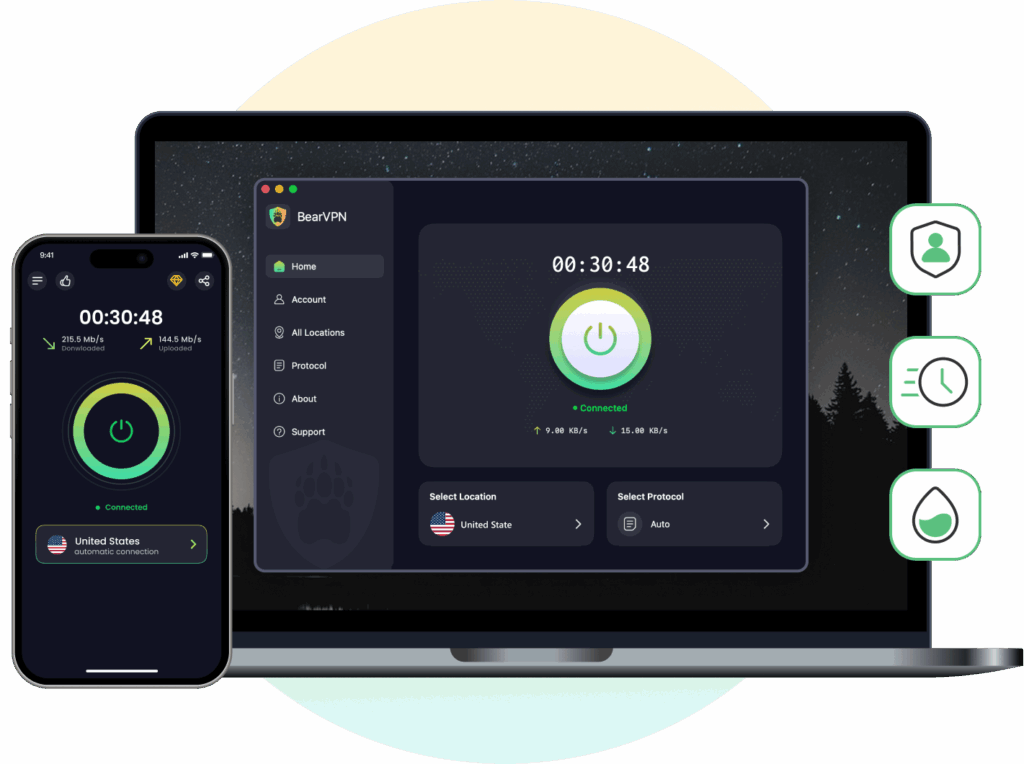
These features can help reduce network-level exposure when using public Wi-Fi, shared networks, or unfamiliar connections.
However, BearVPN cannot hide a logged-in account, remove cookies, prevent websites from processing information users submit, erase age-verification records, or guarantee complete anonymity.
A VPN should be viewed as one layer of privacy protection—not a replacement for following laws, securing accounts, or making careful decisions about personal information.
How to assess a “porn ban” claim responsibly
If you see a headline or social post claiming that adult content has been banned in the United States, use this quick fact-check sequence:
1. Identify the jurisdiction. Is the claim about federal law, a state statute, a city rule, a school network, or a private platform?
2. Read the source text. Look for the official statute, regulation, court decision, or platform announcement—not only a reposted summary.
3. Check who is regulated. Does the measure target a website, an app store, a device, a commercial entity, or an individual user?
4. Check the date and status. Bills, effective laws, injunctions, appeals, and policy announcements are not interchangeable.
5. Separate access from legality. A site’s decision to block a state can reflect its own compliance choice rather than a general criminal ban.
This approach helps keep legal reporting accurate without minimizing the very real privacy and access effects of age-verification requirements.
Conclusion
There is no blanket federal ban on lawful adult content for adults in the USA. Federal law draws hard boundaries around obscenity, child sexual abuse material, and other unlawful conduct, while states increasingly regulate access to certain adult websites through age verification. The result is a patchwork: the same website may be available, age-gated, or voluntarily unavailable depending on where a user is located and what the platform chooses to do.
Adults should follow applicable laws, verify the legitimacy of any age-check process, and avoid unsafe or unlawful workarounds. For adults who want additional network privacy on shared Wi-Fi or unfamiliar networks, BearVPN can provide a connection privacy layer through encryption and IP masking. A VPN improves network privacy; it does not create a legal exception or make account-based activity anonymous. Just keep the boundary clear: a VPN improves connection privacy; it does not create a legal exception or make an account-based activity anonymous.
FAQ
Lawful adult content is not subject to a nationwide blanket ban. Federal and state laws do prohibit certain categories, including obscenity and child sexual abuse material, and states may impose age-verification obligations on covered websites.
No general federal ban prohibits all lawful adult content for adults. Federal obscenity and child-exploitation laws address specific unlawful material and conduct instead.
The site may have chosen to restrict access in response to a state age-verification law. It could also be a technical, account, network-filtering, or device-control issue. Check the official notice before assuming a legal ban.
A VPN does not change the law or make it acceptable to evade verification, platform restrictions, or other safeguards. It should be used for lawful connection privacy only.
Safety depends on the specific website and verification provider. Read their current privacy notices, use only official workflows, and look for clear limits on collection, retention, sharing, and security.
Several U.S. states have enacted or implemented age-verification requirements for certain adult websites, but the rules vary by state. These laws generally require covered platforms to verify that users are 18 or older before providing access to material considered harmful to minors.
States with active or recently enacted adult website age-verification requirements include Texas, Florida, Louisiana, Utah, and several others. The exact requirements can differ in areas such as covered websites, verification methods, privacy protections, enforcement, and current legal status.
Because these laws continue to change through legislation, court decisions, and platform responses, users should check the current state statute and official platform notices for the most accurate information.
For adults only. This article is not legal advice and does not encourage age falsification, identity misuse, circumvention of protective controls, unlawful access, or copyright infringement.