No—porn is not banned in Texas as a general rule for adults. Texas does, however, enforce an online age-verification law that affects certain commercial websites containing a substantial portion of sexual material harmful to minors. That legal difference explains why an adult in Texas might encounter an age check or find that a particular platform has decided not to serve Texas users.
The law is commonly called HB 1181 and is now codified in Chapter 129B of the Texas Civil Practice and Remedies Code. In June 2025, the U.S. Supreme Court upheld the challenged age-verification requirement in \*Free Speech Coalition v. Paxton\*. The ruling did not turn lawful adult expression into an across-the-board crime. It confirmed Texas’s authority to require age verification from covered businesses to restrict minors’ access.
This article separates the legal rule from the practical result, including platform blocks and privacy questions. It is written for adults, provides general information rather than legal advice, and does not explain how to circumvent age gates, location controls, or platform terms.
Start with the distinction: a verification rule is not a total ban
When someone searches “is porn banned in Texas,” they may have seen a block notice or a news headline. A website that is unavailable from Texas can feel like evidence of a ban, but the source of the restriction matters.
Texas’s law is directed at commercial entities that publish or distribute covered material, rather than at every adult internet user. Under Texas Civil Practice and Remedies Code Chapter 129B, a commercial entity must use reasonable age-verification methods when it knowingly and intentionally publishes or distributes material on a website, including a social-media platform, if more than one-third of the site’s material is sexual material harmful to minors. The rule is designed to verify that a person seeking access is at least 18.
That is a meaningful burden on access, but it is not statutory language saying that adults may never view lawful adult material. Texas also has separate laws addressing obscenity, child sexual abuse material, nonconsensual content, exploitation, and other unlawful conduct. Those are distinct issues and should not be collapsed into the question of adult access to material governed by HB 1181.
What HB 1181 covers—and what it leaves out
Chapter 129B uses a threshold: a site is covered when more than one-third of its material fits the statute’s definition of sexual material harmful to minors. The law also includes a separate provision for publicly accessible tools or apps that create artificial sexual material harmful to minors. It does not make internet service providers, search engines, or cloud providers liable merely for supplying a connection, storage, or other services for content they did not create.

Here is a plain-language map of the rule:
The Texas Attorney General’s public consumer guidance likewise says that a digital service provider knowingly publishing or distributing harmful or obscene content must use a commercially reasonable method to verify that a user seeking access is 18 or older. The guidance is a useful overview, but the statute is the primary source for the exact legal text and exceptions.
Why the Supreme Court decision matters
The central constitutional challenge reached the U.S. Supreme Court as Free Speech Coalition, Inc. v. Paxton. The Court issued its decision on June 27, 2025. It held that HB 1181’s age-verification requirement was subject to intermediate scrutiny and survived that review, affirming the Fifth Circuit’s judgment.
The Court recognized two points at once. First, adults have a First Amendment right to access at least some material that is not protected for minors. Second, Texas may require proof of age as part of its effort to prevent minors from obtaining that material online. The majority described government-issued identification and transactional-data verification as established methods and concluded the law was appropriately tailored to the state’s interest in shielding children from sexually explicit content.
That ruling is why outdated articles claiming the Texas rule was permanently blocked are unreliable. In 2023, a federal district court had enjoined the law, and later litigation changed the landscape. The Supreme Court’s 2025 decision is the controlling high-level development for the HB 1181 age-verification dispute. It is still sensible to check for later amendments, implementing actions, and case-specific orders before publishing or acting on legal information.
Why platforms block Texas users instead of verifying age
The law does not require every covered platform to operate in Texas. A company may decide that building a verification process, managing sensitive data, and addressing legal risk are not workable for its business. It can therefore restrict visitors it identifies as being in Texas. That is a platform decision in response to the legal environment, not the same as a Texas order that all adult content be unavailable.
Other services may operate with an age-verification workflow. Their procedures, credentials, privacy notices, retention practices, and third-party vendors can differ. Do not infer the legality or safety of one platform from another platform’s availability.
This is also where misleading “unblock” advice becomes dangerous. Lookalike domains, unofficial mobile clients, leaked materials, copied subscriptions, and browser extensions advertised as workarounds can expose users to scams, malware, copyright violations, account theft, and nonconsensual content. They are not legitimate substitutes for a service’s official access policy.
Privacy questions adults should ask before age verification

Age verification can involve highly sensitive information. The fact that a process is legally permitted or required does not eliminate the need to evaluate the individual service. Before submitting information, adults should check the following:
- Is this the official site and official flow? Verify the domain carefully. Do not follow age-verification links from unsolicited emails, ads, or direct messages.
- What method is being used? Chapter 129B describes government-issued identification and a commercially reasonable method relying on public or private transactional data as reasonable methods. Read the site’s current explanation rather than guessing.
- Which companies receive information? Identify the platform, payment processor, and any third-party verification provider. Each can have separate terms and privacy notices.
- What does the policy say about retention and deletion? Look for specific answers about how identification or verification data is used, secured, and deleted. A vague privacy statement is a reason to share less, not a reason to assume no records exist.
- What else identifies the session? An account login, cookies, browser fingerprinting, IP address, payment record, and device identifiers can each create additional linkage even if age verification is separate.
Avoid giving a website more information than its official flow requires. Never use someone else’s ID, lie about your age, submit another person’s information, or attempt to defeat an age gate. These actions create legal, privacy, and security risks and are not covered by any general discussion of adult access rights.
Where BearVPN Fits—and Where It Does Not

BearVPN does not change Texas law, remove age-verification requirements, or provide a way to bypass platform safeguards. A VPN is a network privacy tool that helps protect the connection layer when adults are using lawful online services.
For users who want additional connection privacy, BearVPN provides several privacy-focused features:
- AES-256 encryption helps protect traffic between your device and the VPN server.
- IP address masking helps reduce exposure of your original IP address to websites and online services.
- DNS leak protection helps keep DNS requests within the VPN connection instead of exposing them outside the encrypted tunnel.
- Kill Switch helps reduce accidental exposure if the VPN connection drops unexpectedly.
- No-logs policy states that BearVPN does not collect logs of browsing history, traffic destination, data content, DNS queries, IP addresses, or connection timestamps as activity or connection logs.
- RAM-only servers and bare-metal servers support a privacy-focused infrastructure approach by reducing reliance on persistent storage and shared virtual environments.
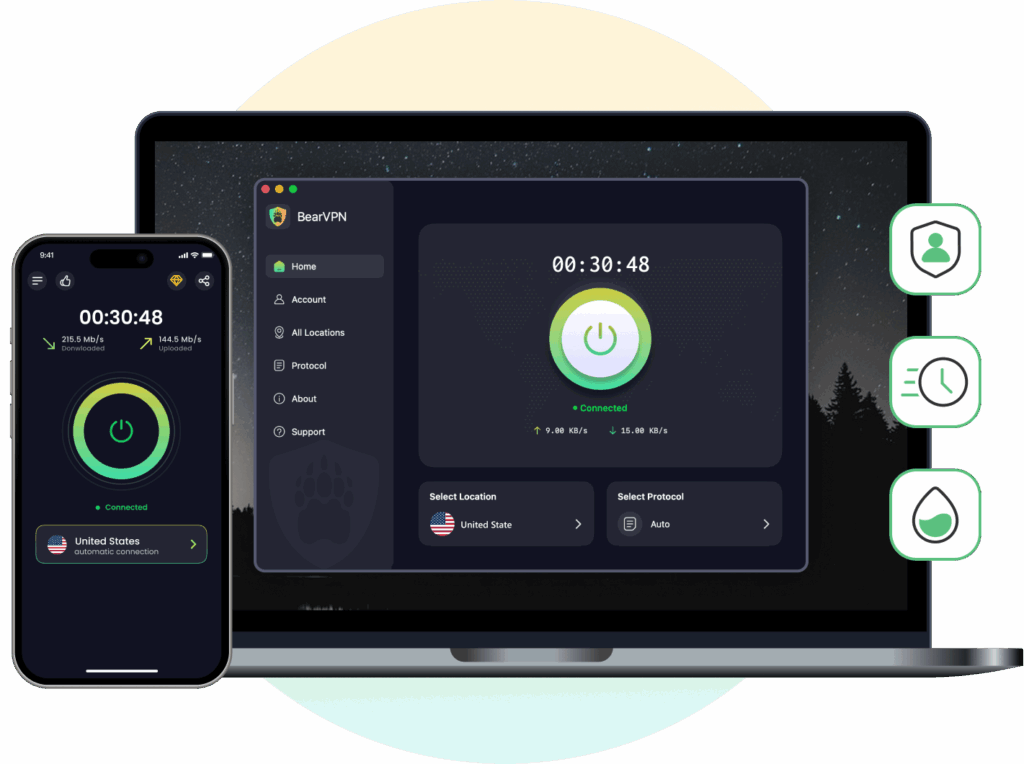
These protections can be useful for ordinary network privacy, especially when using public Wi-Fi or shared networks where users want to reduce local network exposure.
However, BearVPN only protects the network layer. It cannot hide a logged-in account, remove cookies, erase age-verification records, prevent websites from processing information users submit, or guarantee complete anonymity.
Use BearVPN as one part of a broader privacy approach—not as a way to bypass Texas age-verification requirements or platform rules.
A lawful, privacy-conscious response to a Texas block or age gate
If a legitimate website shows an age-verification screen or is unavailable in Texas, pause before treating it as a technical problem to solve. First, read the site’s notice and current privacy policy. If it offers an official verification path and you are an adult who wish to proceed lawfully, decide whether the provider’s stated data practices meet your personal comfort level. If they do not, leaving the site is a valid privacy choice.
Keep the rest of your browsing setup secure: update your browser and device, use a unique password for each account, enable multi-factor authentication if offered, and avoid unknown downloads or extensions. On a public or shared network, use an encrypted connection such as BearVPN to reduce local-network exposure. These measures help protect privacy without misrepresenting age or location.
Remember that availability is fluid. A platform may change its approach after a policy update, legal advice, or product change. A single website’s notice cannot settle the legal status of all adult content in Texas.
Conclusion: regulated access, not a blanket prohibition
Texas has not categorically banned lawful adult content for adults. HB 1181 instead places age-verification obligations on certain commercial services with a substantial portion of sexual material harmful to minors. The U.S. Supreme Court upheld that requirement in 2025, so it is inaccurate to describe Texas’s age-verification rule as merely proposed or permanently enjoined.
For adults, the practical consequences vary: some platforms verify age, and others restrict Texas access. The safe course is to follow the law and the service’s official rules, understand what data a verification process involves, and avoid unauthorized or unsafe workarounds. For public-Wi-Fi privacy, download BearVPN and use its encryption and Kill Switch where available, while recognizing that a VPN cannot change legal obligations or hide an account-based interaction from the service itself.
FAQ
Texas has not enacted a blanket ban on lawful adult content for adults. However, Texas law regulates access to covered online material by requiring covered commercial entities to verify that visitors are 18 or older. Other laws can apply to unlawful categories of content.
A platform may decide not to serve Texas visitors rather than implement or maintain an age-verification system. That is a business and compliance decision by the platform; it does not by itself mean Texas has made all adult content illegal.
The Supreme Court upheld HB 1181’s challenged age-verification requirement in Free Speech Coalition v. Paxton on June 27, 2025. The decision concerned age verification for certain covered websites, not a universal ban on adult expression.
No. A VPN does not change the law or make it acceptable to evade age verification, platform restrictions, or other safeguards. This article does not provide bypass instructions.
Not automatically. Review the official website’s and verifier’s current privacy notices, including their stated collection, security, use, sharing, and retention practices. Separate account, device, and payment data may also identify or link activity.
Not necessarily.
Texas law allows covered platforms to use reasonable age-verification methods, and the exact process depends on the website and verification provider. Before submitting any personal information, review the platform’s official verification process and privacy policy to understand what information is collected, how it is used, and how long it may be retained.
This article is for adults and is not legal advice. It does not encourage false age declarations, identity misuse, evasion of verification or geographic restrictions, unlawful access, or copyright infringement.