No, Telegram does not automatically show your phone number to everyone you message. By default, it is visible to people you have added to your phone contacts. Strangers who find you through a username, private message, group, or channel normally see your display name, username, and permitted profile information—not your phone number.
There is one important exception: Telegram states that people who already know your number and saved it in their address book will still see it. Choosing “Nobody” limits what Telegram displays, but it cannot erase a number someone already has.
Here is the quick answer for the most common situations:
Next, check both Telegram controls: who can see your number and who can find your account using it.
How to Hide Your Phone Number on Telegram
Telegram separates phone-number privacy into two controls:
- Who can see my phone number? controls whether the number appears on your profile.
- Who can find me by my number? controls who can connect a known number with your Telegram account.

- Open Telegram and go to Settings.
- Select Privacy and Security.
- Tap Phone Number.
- Under “Who can see my phone number?”, choose Nobody.
- Review “Always Share With” and remove anyone who should not see your number.
- Under “Who can find me by my number?”, choose My Contacts if that option is available for your selected visibility setting.
- Review the exceptions before leaving the page.
Choosing Nobody does not delete your number from Telegram or from another person’s address book. It also does not stop people from finding you through a public username, mutual group, forwarded profile link, or an existing conversation.
If I Message Someone on Telegram, Does It Show My Number?
No. Sending someone a Telegram message does not automatically reveal your phone number.
If the person found you through your username, a shared group, or a forwarded profile link, they normally see only the profile information your settings allow. Telegram’s official FAQ also confirms that replying to someone who found you by username does not reveal either person’s number unless the applicable privacy settings permit it.

Your number may still be visible when:
- You set “Who can see my phone number?” to Everybody.
- The recipient is included under Always Share With.
- Your setting is My Contacts and Telegram recognizes that person as one of your contacts.
- The recipient already knows and saved your number in their address book.
- You deliberately share your contact card or type the number in a message.
Does Telegram Show Your Number in Groups or Channels?
Merely joining or posting in a Telegram group does not make your phone number visible to every member. The same applies to channels: subscribers and channel administrators do not automatically receive your phone number.
They may still see it if your Phone Number setting permits access, an exception applies, or they already have the number saved. Group administrators can access moderation information and the public parts of your profile, but being an admin alone does not grant access to a hidden phone number.
Can Someone See My Number on Telegram If I Hide It?
Possibly—but not because Telegram publicly reveals it. Telegram warns that someone who already knows and saved your number will still see it.
If one specific person can see the number after you select Nobody, check:
- Whether they already have your number saved.
- Whether they appear under Always Share With.
- Whether your setting was saved on the correct Telegram account.
- Whether you previously sent them your contact card.
- Whether they are identifying you through your name, photo, username, or another account rather than discovering the number through Telegram.
Syncing contacts and displaying your number are related but separate. You can stop contact syncing or delete previously synced contacts under Settings > Privacy and Security > Data Settings, but deleting synced contacts does not remove your number from somebody else’s phone.
If I Call Someone on Telegram, Will It Show My Number?
No. A Telegram voice or video call does not display your phone number as a normal cellular caller ID would. The other participant can see the profile information allowed by your Telegram settings, but calling them does not independently reveal the number.
Phone-number visibility and IP-address privacy are different issues. When Telegram permits a direct peer-to-peer connection, the other participant may be able to determine your public IP address. An IP address can suggest an approximate area or internet provider, but it does not normally reveal an exact home address.
To reduce this exposure:
- Open Settings.
- Select Privacy and Security.
- Tap Calls.
- Open the Peer-to-Peer setting.
- Choose Nobody to relay calls through Telegram’s servers instead of connecting directly.
Relaying calls may affect call quality. You can also restrict “Who can call me?” and add exceptions for specific users.
Does Telegram Show Your Country or Location?
Telegram does not normally display your current country, GPS position, or home address on your personal profile.
However, another person may infer geographic information in several situations:
- Visible phone number: The international calling code may indicate the country associated with the number. It does not prove where you currently live or where you are physically located.
- P2P call: If a direct peer-to-peer connection is permitted, the other call participant may be able to identify your public IP address and estimate an approximate region.
- Shared location: Telegram can process and display a location when you deliberately send a static or live location in a chat.
- External links and Mini Apps: A website or third-party Mini App you open may receive your IP address, as websites normally do.
Telegram removed the People Nearby feature in September 2024, so older instructions telling users to disable People Nearby are no longer current.
Telegram itself may process phone-number, IP-address, device, and other account metadata under its Privacy Policy. Hiding your number from other users does not mean Telegram no longer holds the number connected to your account.
Protect Your IP Address When Using Telegram
Telegram’s Phone Number settings protect your number from other users. They do not change the IP address used by Telegram calls, external websites, or Mini Apps.
Start with Telegram’s own controls:
- Set Phone Number visibility to Nobody.
- Limit who can find you by your number.
- Set Calls > Peer-to-Peer to Nobody if you do not want direct calls to expose your IP to the other participant.
- Avoid sharing live location or opening untrusted links and Mini Apps.
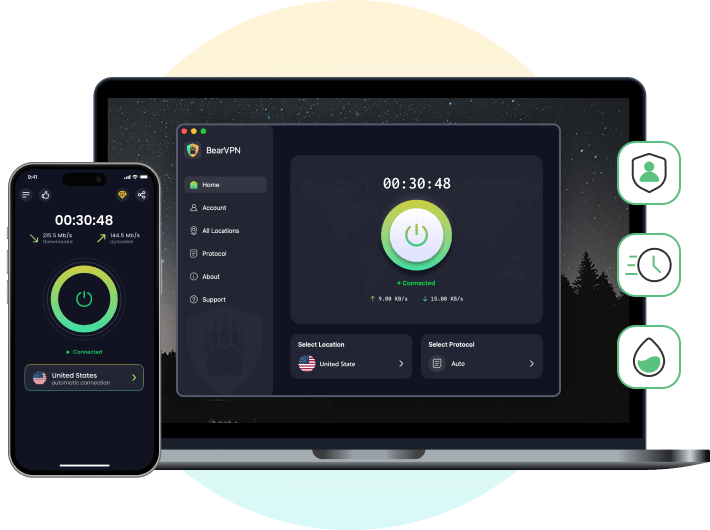
For an additional network-privacy layer, connect to BearVPN before opening Telegram. BearVPN replaces your public IP with the VPN server’s IP, helping prevent a call participant or external website from seeing your normal IP address.
BearVPN does not hide the phone number stored in your Telegram account, change your calling code, or make your Telegram profile anonymous. Those protections still depend on Telegram’s privacy settings.
Conclusion

Telegram does not show your phone number to every user. By default, it is visible to people you have added to your contacts, while messages, groups, channels, and calls do not automatically publish it.
For stronger privacy, set “Who can see my phone number?” to Nobody, limit “Who can find me by my number?”, and review all exceptions. Remember that someone who already knows and saved your number may still recognize it.
If IP privacy also matters, disable P2P calls or connect to BearVPN before using Telegram. A VPN can mask your public IP, but only Telegram’s own settings control whether your phone number appears.
FAQs About Telegram Phone Number
Not everyone can see it. By default, Telegram says your number is visible to people you have added to your contacts. Strangers, group members, and people who find you through a username do not automatically see it. Your visibility setting, exceptions, and whether the other person already saved your number can change the result.
No. Sending a private message does not automatically display your number. If the recipient found you through a username or shared group, they normally see your permitted profile information. They may see the number if your privacy settings allow it or if they already know and saved it.
A Telegram call does not display your number as cellular caller ID. However, if your Phone Number settings permit the person to see it, they may find it on your profile. A permitted P2P connection may also expose your public IP address, which is separate from phone-number visibility.
Someone who already knows and saved your number may still see or recognize it. Also check the Always Share With exception list and confirm that “Who can see my phone number?” is set to Nobody. Hiding the number does not delete it from another person’s contacts.
Not simply because they are an administrator. Group members, channel subscribers, and admins do not automatically receive your phone number. They may see it only when your privacy setting permits it, an exception applies, you share it directly, or they already have it saved.
Telegram does not normally display your current country on a personal profile. If your phone number is visible, its international calling code may suggest the country associated with that number. A P2P call or external website may also expose an IP address that suggests an approximate region, not an exact address.
Telegram uses a phone number as an account identifier and to support login and contact discovery. Providing a number for account creation does not mean it must be publicly visible. Telegram also supports accounts registered with blockchain-based anonymous numbers obtained through Fragment, but this is different from relying on disposable verification-number websites.
Telegram states that it does not pass your phone number to advertisers. Its Privacy Policy says it may use the country or area code of a number—or an IP-derived location—to approximate an area for sponsored-message selection. It also says IP addresses and phone numbers may be disclosed to authorities following a valid judicial order in qualifying criminal cases.