People looking for Candy AI alternatives often want a different kind of control: clearer privacy terms, a different account model, or simply to find safe AI companions like Candy AI that better match their personal boundaries. When exploring these options, the sensible comparison is not about explicit content. It is about what each service says it collects, how it uses chats, what happens when an account is deleted, and what information a user still reveals by logging in or paying.
This guide compares Candy AI with several adult-oriented AI companion services using their published policies as of July 28, 2026. It does not test the apps, create accounts, assess generated content, or rank platforms. Policies can change, so treat the links as a starting point and re-check them before subscribing or entering sensitive information.
Why people switch from Candy AI
An AI companion can feel more personal than an ordinary chatbot because conversations may include preferences, relationship context, voice or image inputs, and recurring details about a user’s life. That makes a change of platform a privacy decision as much as a product decision. A user may want fewer persistent identifiers, clearer deletion instructions, a different sign-in method, or more confidence about whether conversations are used to improve a service.
Candy AI’s Privacy Notice identifies EverAI Limited as the controller and describes its service as an AI chat application with virtual, fictional characters. Its definition of “Content” includes registration information as well as conversation inputs and outputs. This does not mean the service is inherently unsafe; it means users should understand that chat content is within the scope of data the policy discusses.
BearVPN and AI Companion Privacy: Protecting the Network Layer
For AI companion services, privacy involves multiple layers. While platforms control how they handle account information and conversations, a VPN can help protect the connection layer by reducing exposure of network activity.
BearVPN provides several privacy-focused features that can help users strengthen their network protection:
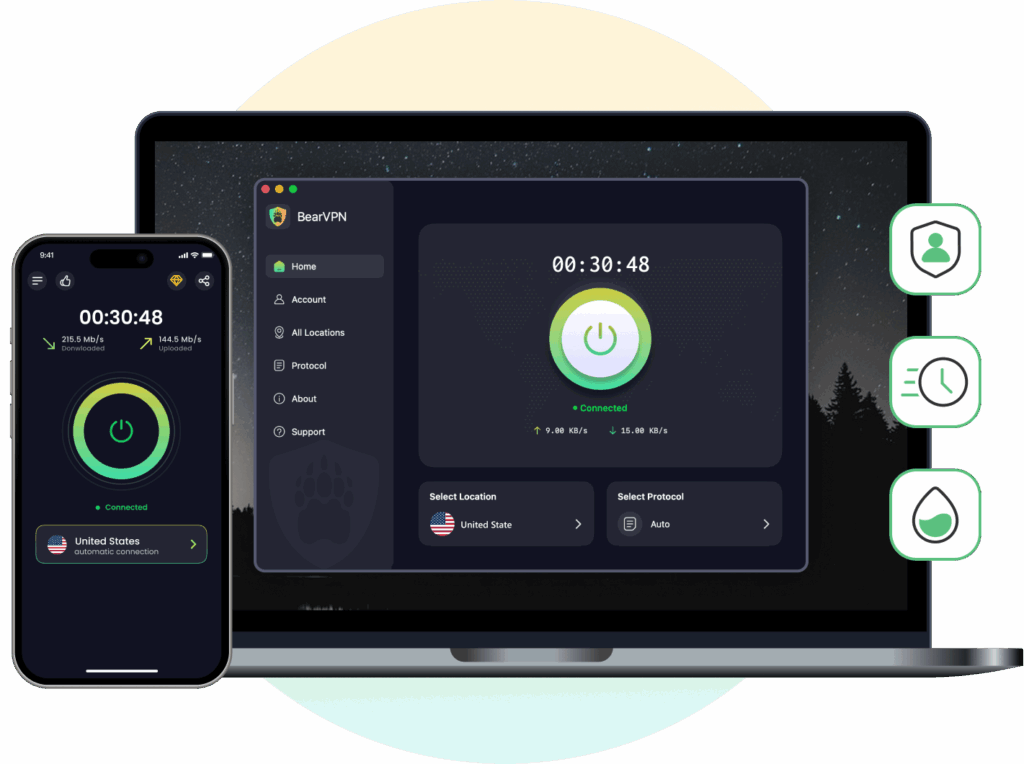
Network Encryption and IP Protection
- AES-256 encryption helps protect traffic between the user’s device and the VPN server.
- IP address masking replaces the user’s original IP address with the VPN server’s IP address when connecting to websites.
- DNS leak protection helps prevent DNS requests from bypassing the VPN connection.
Privacy-Focused Infrastructure
- RAM-only servers are designed so server data is cleared when systems restart, reducing persistent data storage at the infrastructure level.
- Bare-metal servers use dedicated physical hardware instead of shared virtual environments.
- No-logs policy means BearVPN does not retain unnecessary activity logs according to its stated privacy practices.
Additional Connection Protection
- Kill Switch helps reduce accidental exposure if the VPN connection drops unexpectedly.
- Double VPN routes traffic through two VPN servers for users who want an additional layer of connection privacy.
- Strong obfuscation helps make VPN traffic less recognizable in networks where VPN usage may be restricted or monitored.
However, a VPN only protects the network connection layer. It cannot remove browser cookies, hide a logged-in account, prevent an AI companion service from receiving information a user voluntarily submits, or make conversations completely anonymous.
For better privacy, combine network protection with careful account choices, strong passwords, and responsible sharing of personal information.
A privacy-first way to evaluate Candy AI alternatives

There is no meaningful universal “privacy score” for companion apps. Public policies describe intended practices, not a complete technical audit, and a service can revise them. Instead, use the same questions for every platform:
The most revealing language is usually in the privacy notice and terms—not in a landing-page promise. Read the current version before you move a long conversation, upload media, or subscribe. If a policy is unclear about deletion, retention, or third-party processing, assume you need to share less until you obtain a clear answer from the provider.
Candy AI and four alternatives: what the public policies say
The entries below are comparison prompts, not endorsements. They summarize selected disclosures from each provider’s public materials and should not be read as a security finding or a guarantee of privacy.
Candy AI: start with the content definition
Candy AI’s notice says its services may include messages and other media, and it explicitly defines Content to include personal data supplied during registration plus conversation inputs and outputs. It also says that some features may require an account or paid subscription. Before using it, check the current notice’s sections on collection, use, recipients, cookies, retention, and rights for your location. Those sections answer more practical questions than a simple “private” or “not private” label.
For people leaving Candy AI, the key question is not whether another service claims to be more discreet. Ask whether the alternative is clearer about the exact information it needs, whether you can use a pseudonym, and how you request deletion. Avoid transferring old chat transcripts or personal images just to recreate an existing conversation.
Nomi: a policy that discusses pseudonyms and account deletion
Nomi’s Privacy Policy says sign-up uses a Google or Apple account and that it receives the associated email address; users then provide a name or pseudonym and date of birth. The policy encourages people not to put personally identifiable information into interactions or customizations. It also states that, except as otherwise set out in the policy, personal information is not retained after account deletion, while noting that information in training archives would no longer be attributable to the user after deletion.
Those statements may be useful to someone comparing account models, but they are not a reason to treat chat as a private diary. A connected Google or Apple account, billing, device and activity data, and the content someone voluntarily submits can still be sensitive. Read the complete policy and terms, especially if you live outside the United States or want to exercise a formal data-rights request.
Replika: detailed disclosures about messages and personalization
Replika’s Privacy Policy says it processes account information, profile details, messages and content, preferences, device/network data, and usage data. The policy explains that it uses conversation information to provide individualized interactions and to help the companion learn from interactions. It also says conversations and submitted content are not used or disclosed for marketing or advertising, while marketing and profiling cookies may enable advertising partners to collect limited website/device interaction data if a user consents.
For deletion, the policy says users can delete their account in settings and that, where applicable, deletion rights extend to personal data held by third-party AI language-model providers through contractual arrangements. This is comparatively specific language, but it does not erase the need to avoid entering passport details, workplace secrets, medical records, or details about other people. Replika says its services are for people 18 and older; local rules may impose additional conditions.
Kindroid: review terms, content rights, and data requests together
Kindroid’s consolidated Legal page says its services are for people at least 18, or the age of majority in their jurisdiction if higher. Its privacy-policy section lists categories that include data collection, encryption, disclosure, tracking tools, security, retention, and state-law rights. The terms also state that users retain ownership of AI generations while Kindroid retains rights in the underlying models and systems, and describe licenses necessary to operate the service.
That combination is a reminder to read the terms alongside the privacy policy. “You own your content” and “the provider processes content to operate its service” can both be true, but they answer different questions. If you plan to share personal material, look closely at the content license, retention language, third-party services, and the documented procedure for submitting an access or deletion request.
A practical fifth option: choose a non-companion AI when intimacy is not the goal
Sometimes the most privacy-conscious Candy AI alternative is not another relationship-oriented companion service. If your goal is general brainstorming, language practice, or entertainment, consider a mainstream AI service with a use case that does not invite long-term personal disclosure. This is not automatically “safer”—you must still review the provider’s current policy—but reducing the type and volume of sensitive material you choose to share can lower exposure.
The decision is about fit, not purity. A platform with a well-written policy can still receive the information you type, and a platform with fewer requested profile fields may still need enough information to run an account and prevent abuse. Share only what is necessary for the experience you want.
Set up a new account with less unnecessary exposure
These steps are for lawful adult use. They do not bypass age checks, subscription controls, platform rules, or local laws.
- Read the current privacy notice before signing up. Search specifically for “messages,” “training,” “retention,” “delete,” “cookies,” and “payment.” Save the policy’s revision date if the conversation matters to you.
- Use a unique password and enable available account protections. A password manager makes it easier to avoid reusing a password from email, banking, or social accounts.
- Provide the minimum truthful profile information required. Do not invent an age or identity, but do not add optional biographical details merely for convenience.
- Keep sensitive identifiers out of chat. Never paste government ID numbers, financial-account details, login codes, an employer’s confidential data, or another person’s private information.
- Separate browsing context where appropriate. A dedicated browser profile can reduce accidental cross-site sign-ins and makes it easier to clear site data later. Private/incognito mode mainly limits local history on that device; it does not make the chat invisible to the service.
- Check deletion before you need it. Locate the account-close setting or support contact, and understand what the policy says about backups, legal obligations, billing records, and de-identified data.
If you use public Wi-Fi or do not want the network to associate your home IP address with the service, connect through BearVPN first and keep its Kill Switch enabled where available. That protects the network path if the encrypted tunnel drops. It cannot change the data a service receives from your browser, erase a payment trail, or prevent a platform from linking activity to the account you use.
Avoid these “alternatives” entirely
Skip sites that offer copied accounts, leaked conversations, pirated subscriptions, unofficial mirrors, or promises to defeat age verification. These services can create copyright, consent, malware, payment, and identity-theft risks. They are not legitimate substitutes for a paid or account-based platform, and a VPN does not turn unlawful access into lawful access.
Be equally cautious of lookalike domains and unsolicited “premium upgrade” links. Reach a service through its official domain, bookmark it after checking the spelling, and do not install unknown browser extensions or downloadable “clients.”
The better question behind “Candy AI alternatives”
When evaluating the growing market of private virtual AI chat apps, the best alternative is the one whose current data practices you understand and can accept—not necessarily the one that makes the boldest privacy claim. Compare the data requested at registration, what the policy says about chat content, third-party processing, deletion, billing, and adult-use requirements. Then limit what you disclose from the first message.
BearVPN can add a valuable network-privacy layer by encrypting the connection between your device and its VPN server and replacing the IP address presented to the service.
If you want an additional network privacy layer when using AI companion platforms, BearVPN can help encrypt your connection and mask your IP address while keeping expectations realistic about what a VPN can and cannot protect.
FAQ
Not by default. A meaningful comparison requires reading each platform’s current privacy notice, terms, deletion process, tracking disclosures, and payment arrangements. “Private” marketing language is not enough on its own.
Some services may allow a display name or pseudonym, but sign-in, age, payment, device, or usage information can still identify or link an account. Use accurate information where required and do not attempt to defeat age or identity requirements.
Not necessarily. A policy may describe deletion, backup periods, legal-retention obligations, billing records, or data that has been de-identified. Read the specific provider’s current deletion and retention terms before relying on account removal.
Without a VPN, the network may be able to observe connection metadata such as destination domains. A VPN encrypts the connection between your device and the VPN server, which can reduce that visibility, but the companion service still sees activity associated with the account and session it receives.
No. A VPN can mask your original IP address from the website and protect traffic on the local network, but it cannot hide an email login, payment, browser identifiers, or personal information you enter in chat.
This article is for adults and is not legal advice. Laws, age-verification obligations, and platform availability vary by jurisdiction. It does not encourage falsifying age, bypassing protective controls, infringing copyright, or accessing unlawful content.