You might notice that a site works on mobile data but not on hotel Wi-Fi, or that a link loads for friends but not for you. In Thailand, that inconsistency can come from several places: local network rules, ISP filtering, or broader website blocking.
This guide helps you understand which websites are commonly restricted, why blocks happen, and what you can do—legally and safely—when something you need won’t load. You’ll also get a practical checklist for diagnosing the problem and choosing privacy tools that protect you on public networks without crossing legal lines.
Commonly Blocked Website Categories in Thailand
Here are some commonly blocked site categories for your reference.
1. Microblogging & Social Platforms (e.g., Tumblr)
Many users report that Tumblr stopped working in Thailand, showing connection timeouts or app loading errors. Major Thai internet service providers (such as TrueMove) have implemented network-level blocks on Tumblr to comply with local regulations regarding adult and unmoderated content.
2. Adult Content & Adult Games (Pornhub, Rule 34)
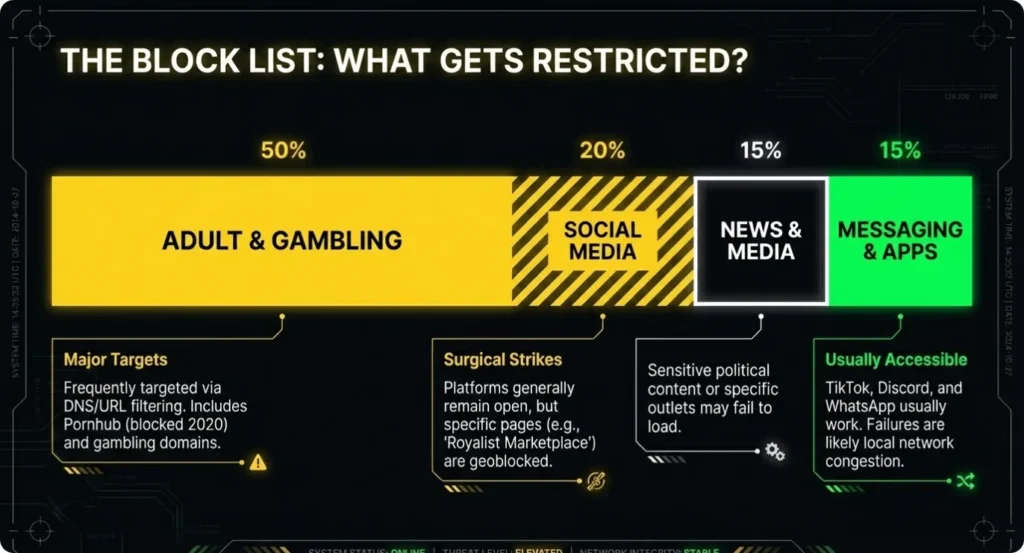
In late 2020, Thailand’s Digital Ministry initiated sweeping blocks on major adult platforms like Pornhub, as well as anime/art sites featuring adult content (like Rule 34). These domains fail to resolve DNS or redirect to official government blocking notices.
3. Specific Pages vs. Platform-Wide Bans (Facebook & YouTube)
Mainstream social media platforms like Facebook, YouTube, and X (formerly Twitter) are not banned in Thailand. However, Thai authorities frequently issue court orders requesting platform-level geoblocking for specific individual URLs, posts, or groups (such as political discussion groups).
4. Gaming & Messaging Apps (Discord, WhatsApp)
If Discord or WhatsApp media calls fail to connect in Thailand, it is rarely a national ban. Most often, restrictive Wi-Fi routers in hotels, co-working spaces, or cafes block specific VoIP protocols or ports to save bandwidth.
Popular Websites and Apps Reported Blocked in Thailand
People often search for a list of blocked websites in Thailand because they want quick confirmation: is this site commonly restricted, and is it a permanent ban or something intermittent? The table below focuses on well-documented examples and uses cautious labels (reported/period-specific) because blocks can change.
If a site is blocked, you’ll often see DNS failures (the domain won’t resolve), redirects, or unusual HTTP responses. Measurement projects categorize these signals, which is why network-specific testing can be useful.
Why Are Websites Blocked in Thailand?
If you know why a category is restricted, you can make better decisions about what to do next. Some blocks reflect ongoing policy priorities (like gambling crackdowns), while others are tied to specific cases (like restricting access to a page or group). This section keeps it practical: the goal is helping you understand patterns, not speculating about every individual block.
1) Adult content enforcement
A clear, documented example is the 2020 block affecting Pornhub and many other pornography sites, which was publicly linked to enforcement under Thailand’s Computer Crime Act in reporting.
2) Gambling and illegal web-address crackdowns
Thailand has reported blocking very large numbers of illegal web addresses, including substantial volumes of gambling sites, as part of enforcement campaigns. Between October 2025 and January 2026, Thailand’s Digital Ministry blocked a record 220,486 illegal URLs, with online gambling accounting for 183,977 of those targets. That aligns with regional measurement reporting that pornography and gambling are among the most commonly blocked categories.
3) Speech- and politics-adjacent restrictions (often content-specific)
Rather than blocking an entire platform, authorities may seek the restriction of specific pages or groups within a platform. The “Royalist Marketplace” case is frequently cited because the group was restricted within Thailand following a legal request, while the platform stayed online.
4) Network-level filtering and technical enforcement capacity
Some restrictions are implemented through ISP-level techniques (DNS interference, URL filtering, IP blocking). That’s why “it works for my friend but not for me” can be real—even inside the same country—depending on ISP and network configuration.
What is the 112 Rule in Thailand?
When searching about internet restrictions in Thailand, you will frequently see references to the “112 Rule” (Section 112 of the Thai Criminal Code):
- What it is: Known as the Lèse-Majesté law, Section 112 makes it illegal to defame, insult, or threaten the Thai monarch or royal family.
- Impact on the Internet: Thai authorities strictly monitor online posts, shares, and websites containing content that violates Section 112. Platforms are required to geoblock specific links under court orders.
- Legal Consideration: Merely browsing standard websites is generally not a crime, but sharing, commenting on, or distributing content that violates local cybercrime laws or Section 112 carries significant legal consequences.
How to Access Blocked Websites in Thailand Safely and Legally
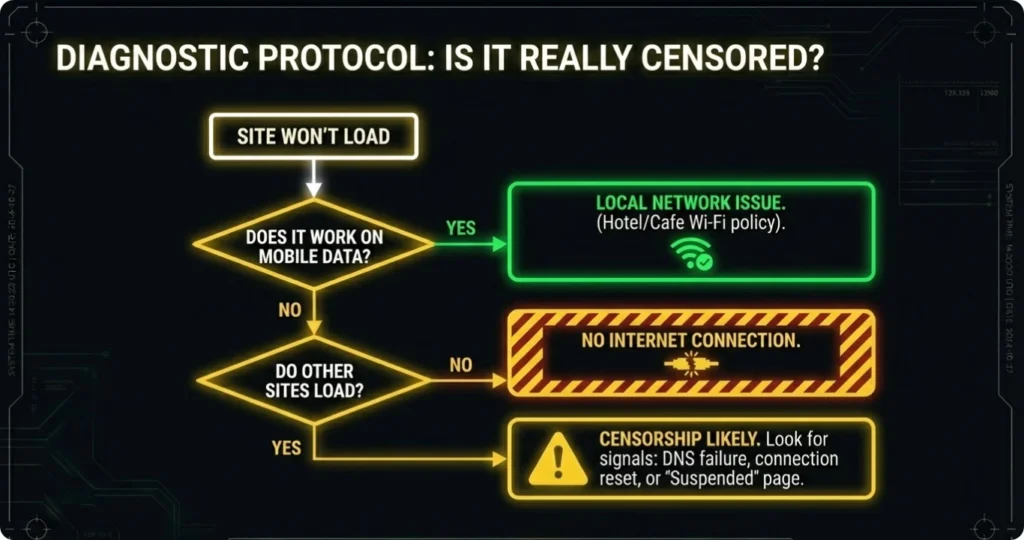
When a website won’t load, your first job is to diagnose the cause. Jumping straight to “it’s censored” can waste time—and sometimes the fix is as simple as changing networks. The steps below focus on legal, low-risk troubleshooting first, then move toward privacy tools that are widely used for security and stability.
Step 1: Rule out ordinary network problems
Try these quick checks before anything else:
- Test the site on mobile data vs Wi-Fi (hotel, cafe, co-working space).
- Try another DNS-capable device (laptop vs phone).
- See if only one service fails (for example, WhatsApp calls drop but browsing works) or if everything is affected.
If it works on mobile data but not on Wi-Fi, you’re often dealing with local network policy, filtering, or weak routing—not a nationwide block.
Step 2: Use official channels when available
If a service has an official app, official mirror, or alternate domain, that’s usually the lowest-risk path. This matters for productivity tools and messaging apps like Discord or TikTok, where failures are frequently caused by restrictive Wi-Fi policies.
Step 3: Consider privacy tools for security and stable routing
If you need consistent access—especially on public Wi-Fi—privacy tools can help protect your connection and reduce exposure to tracking or malicious interception. This is where a VPN is commonly used for legitimate purposes like:
- securing logins on shared networks,
- reducing man-in-the-middle risk,
- keeping your traffic encrypted end-to-end.
If you go this route, keep it responsible: the goal is secure access and privacy, not evading laws around prohibited content.
Securing Your Connection in Thailand with BearVPN
When traveling or working remotely in Thailand, maintaining stable routing and protecting your sensitive data on public Wi-Fi is essential. BearVPN serves as a reliable security companion for your daily mobile and desktop browsing:
- Protect Public Wi-Fi Activity: Encrypts your connection with AES-256 standards, preventing hotel or cafe networks from snooping on your logins and financial data.
- Prevent Unintended Exposure: Features an automated Kill Switch and DNS leak protection, ensuring your real IP address remains protected even if public Wi-Fi drops.
- 100% Free Mobile Tier: iOS and Android users can secure their devices instantly without providing credit card details or signing up for auto-renewing subscriptions.
VPNs should be used responsibly for privacy, security, and stabilizing legitimate network connections in compliance with local regulations.
Now, you can click the button below to download BearVPN.
Conclusion
Blocked websites in Thailand are best understood as a mix of category-based enforcement (especially gambling and adult content), content-specific restrictions, and network-level filtering that can vary by ISP or Wi-Fi provider. When something won’t load, you’ll save time by diagnosing the cause first—switch networks, verify whether it’s a local restriction, and use official channels where possible. If you need reliable access for work, travel, or everyday communication, a security-focused VPN can help by improving routing stability and protecting you on public networks. Just keep your use responsible and lawful.
FAQs
To access blocked sites safely in Thailand, use a security-focused VPN like BearVPN on public Wi-Fi to encrypt your connection, prevent tracking, and maintain stable routing while ensuring your online activities remain responsible and lawful.
Thailand’s Digital Ministry enforces strict online anti-pornography regulations under the Computer Crime Act. Major ISPs automatically block DNS requests or redirect traffic away from major adult platforms and websites.
Yes, Thailand’s legal framework prohibits hosting, viewing, or distributing pornography, including anime or art-based adult content (Rule 34). These domains are subjected to nationwide ISP-level filtering and access bans.
No, mainstream platforms like YouTube, Facebook, and Discord are not banned nationally. If Discord or YouTube fails to load, it is usually caused by restrictive hotel Wi-Fi networks, local congestion, or specific court-ordered URL geoblocking.
Free VPNs often impose tight daily data caps, slower speed ceilings, and limited server choices. Low-quality free apps may also show invasive ads or lack strict privacy policies.
Tumblr is restricted by several major Thai telecom operators (like TrueMove) due to network-level filtering aligned with local digital content regulations.
References
- Freedom House. Freedom on the Net 2025 — Thailand.
- OONI (Open Observatory of Network Interference). Thailand — OONI Explorer (measurements & blocking signals).
- Bangkok Post. 220,000 illegal web addresses blocked since October (incl. gambling websites).
- Human Rights Watch. Thailand: Cyber Crime Act Tightens Internet Control.


![How to Change YouTube TV Location [Still Works in 2026]](/_next/image/?url=https%3A%2F%2Fcms.bearvpn.com%2Fwp-content%2Fuploads%2F2026%2F06%2Fhow-to-change-location-youtube-tv.webp&w=640&q=75)