Are you trying to torrent safely with Avast VPN, only to find that your downloads are stuck on “connecting to peers” or your speeds have suddenly dropped to zero?
When dealing with Avast VPN not working during a P2P session, the issue usually isn’t a broken internet connection. It means something within Avast’s network architecture—or its aggressive built-in firewalls—is actively blocking your torrent client. Whether you are using the standalone Avast SecureLine VPN or the newer Avast One application, the service has strict limitations when it comes to peer-to-peer file sharing.
In this guide, we will break down the reality of using Avast for P2P, explain why your downloads are failing, and provide the exact troubleshooting steps to get your torrents moving again.
Is Avast VPN Good for Torrenting? (The Reality)
While Avast is a globally recognized name in the antivirus industry, its VPN services are not optimized for heavy torrenting. If you are wondering whether Avast is the right tool for P2P file sharing, you need to understand its structural limitations and privacy policies.
Here is the reality of torrenting on Avast’s network:
- Extremely Limited P2P Server Support: Unlike VPNs that support torrenting across their entire global network, Avast restricts P2P traffic to just a handful of designated data centers. You can only torrent if you are connected to 8 specific cities: Prague, Frankfurt, Amsterdam, Miami, New York, Seattle, London, and Paris. If you connect to any general-use server outside of these locations, Avast will immediately block your BitTorrent traffic.
- The 30-Day Connection Log (Privacy Risk): The primary reason users run a VPN while torrenting is to hide their IP address and avoid tracking from ISPs or copyright trolls. However, Avast clearly states in its privacy policy that it retains connection logs for 30 days. While they do not log the specific files you download, keeping connection timestamps and data usage logs is a major red flag for privacy-conscious users who require a strict “no-logs” policy.
- No Port Forwarding: Port forwarding is a critical feature for serious torrenters because it allows your client to connect to more peers, significantly boosting your download and upload speeds. Avast SecureLine VPN does not offer port forwarding, resulting in the inconsistent speeds and “stuck” downloads that many users complain about on Reddit and tech forums.
- Lack of SOCKS5 Proxy: Avast VPN does not offer SOCKS5 proxy support. A SOCKS5 proxy is a common feature in purpose-built torrenting VPNs, allowing users to route only their torrent client’s traffic through a secure server while leaving the rest of their web browsing unaffected by VPN speed drops.
Why is Avast VPN Blocking Your Torrent Downloads?
When your VPN is active but your torrents refuse to download, the issue is rarely a broken internet connection. Based on recent community reports on Reddit and Avast’s own support forums, the problem usually stems from how Avast handles P2P traffic routing and application permissions.
Here is exactly why your downloads are failing and what those specific errors mean:
1. Avast One vs. Standalone SecureLine (The Silent Block)
Many users do not realize there is a massive difference between the standalone Avast SecureLine VPN app and the newer Avast One all-in-one security suite.
If you are using the older standalone SecureLine app, your torrents will simply fail to connect if you are not on one of their 8 designated P2P servers. However, if you recently subscribed and are using Avast One, the situation is much worse. Avast One features an aggressive built-in firewall and Web Shield that actively disrupts P2P applications by default. Users frequently report that Avast One silently blocks popular clients like qBittorrent and uTorrent in the background without sending a notification, making it impossible for the software to establish an outbound connection.
2. The “Stuck at Connecting to Peers” Error (Speed Drops to 0)
If you are staring at your torrent client and seeing the dreaded “stuck at connecting to peers” status, or if your download starts but immediately drops to 0 kb/s, your traffic is being intercepted.
This specific behavior—widely discussed in the r/qBittorrent community—happens for two reasons:
- You are connected to a general-use Avast server that actively filters out BitTorrent protocols.
- The lack of Port Forwarding in Avast means your client cannot actively “ping” other seeders. If the seeders are also behind firewalls, your client will remain stuck at the connecting phase indefinitely because neither side can initiate the handshake.
3. IPv6 Leaks and Aggressive ISP Throttling
Sometimes the block isn’t coming from Avast, but from your Internet Service Provider (ISP). Avast SecureLine has a known limitation where it may not consistently route or block IPv6 traffic effectively.
If your torrent client attempts to communicate via an IPv6 address, that data might “leak” outside of the encrypted Avast VPN tunnel. Once your ISP detects raw BitTorrent traffic bypassing the VPN, they will immediately trigger smart network throttling. Your ISP will throttle your bandwidth specifically for that application, dropping your P2P speeds to a crawl while your regular web browsing remains perfectly fast.
How to Fix Avast VPN Torrenting Issues (5 Workarounds)
If you are determined to stick with Avast, you need to manually configure your software to bypass its aggressive filters and structural limitations. Before giving up and switching to a dedicated P2P VPN, try these five troubleshooting steps to get your torrents moving.

Step 1: Switch to a Dedicated P2P Server (Miami, Frankfurt, Amsterdam, etc.)
The most common reason for a stalled download is connecting to a standard Avast server. Avast strictly limits BitTorrent traffic to a fraction of its network.
Open your Avast VPN client and navigate to the server list. You must manually select a server that is specifically designated for P2P data. Currently, Avast only permits torrenting in these eight locations:
- United States: New York, Miami, Seattle
- Europe: Prague, Frankfurt, Amsterdam, London, Paris
If you are connected to any other city, disconnect, switch to one of the servers listed above, and completely restart your torrent client.
Step 2: Configure Split Tunneling (Crucial for Avast One users)
As highlighted in recent community forum threads, the newer Avast One suite actively disrupts clients like qBittorrent. To stop the built-in security shields from blocking your P2P traffic, you must configure Split Tunneling.
Split tunneling allows you to explicitly dictate how specific apps interact with the VPN.
- Open your Avast One dashboard and locate the VPN or Split Tunneling settings.
- Enable the feature and manually add your torrent client (e.g.,
qbittorrent.exeorutorrent.exe) to the list of applications that must be routed through the VPN tunnel. - This forces Avast One to stop treating the torrent client as a rogue background process, allowing it to establish connections with peers.
Step 3: Bind Your Torrent Client (qBittorrent/uTorrent) to the VPN IP
If your download starts but frequently drops to zero, or if you are worried about Avast’s kill switch failing, you need to “bind” your torrent client directly to the VPN’s network adapter. This ensures your client physically cannot download or upload unless the VPN is active.
If you are using a lightweight, privacy-oriented client like qBittorrent:
- Open qBittorrent and go to Tools > Options > Advanced.
- Look for the Network Interface drop-down menu.
- Change it from “Any interface” to the specific Avast SecureLine virtual adapter (often labeled as a TAP-Windows Adapter or Avast VPN).
- Click Apply and restart the client.
Step 4: Disable IPv6 to Prevent ISP Throttling
Avast SecureLine can occasionally fail to route IPv6 traffic, meaning your raw P2P data leaks directly to your Internet Service Provider, triggering instant throttling. Disabling IPv6 at the system level forces all traffic through the older, fully encrypted IPv4 tunnel.
To disable IPv6 on Windows:
- Open the Control Panel and go to Network and Sharing Center.
- Click on Change adapter settings on the left menu.
- Right-click your active internet connection (Wi-Fi or Ethernet) and select Properties.
- Scroll down the list and uncheck the box next to Internet Protocol Version 6 (TCP/IPv6).
- Click OK and restart your PC.
Step 5: Configure Firewall & Antivirus Exceptions
Sometimes, the conflict is happening on your local machine before the traffic even reaches the VPN server. Aggressive local firewall rules or Windows Defender can block the encrypted VPN tunnel or the torrent client itself.
To rule this out:
- Open your Windows Security settings or third-party antivirus.
- Add both the Avast SecureLine VPN application and your torrent client as trusted exceptions.
- Ensure that your torrent client is allowed through both Public and Private networks in the Windows Defender Firewall menu.
- Temporarily disable your antivirus web-shields for a few minutes to see if the “connecting to peers” error resolves. If it does, you know the local antivirus is the culprit.
When to Switch: Avast SecureLine vs. BearVPN for P2P
Even if you successfully configure split tunneling or bind your IP to bypass the “connecting to peers” error, you are still dealing with the fundamental limitations of Avast’s network.
The workarounds above cannot fix the service’s two biggest structural flaws: server congestion and privacy risks. Being forced to share just 8 P2P-allowed data centers with thousands of other users inevitably leads to bandwidth throttling. More importantly, as highlighted in the latest SERP data, Avast retains connection logs for 30 days. For users who rely on torrents and require absolute anonymity, this 30-day logging policy is a dealbreaker.
If you are tired of manually configuring firewall exceptions, fighting silent app blocks, and dealing with slow speeds, it is time to switch to a VPN infrastructure built specifically for unrestricted, high-speed P2P sharing.
Feature Comparison for Torrenting
Here is how Avast’s general-purpose VPN compares to a privacy-first, P2P-optimized network like BearVPN:
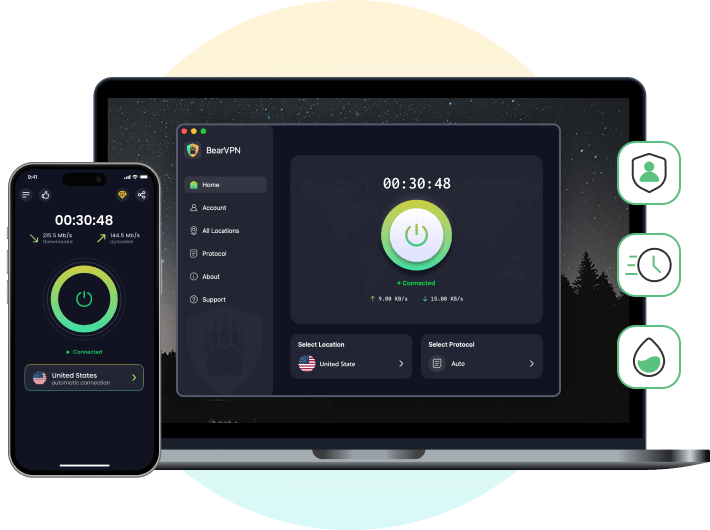
Protect Your Digital Identity & Download Speeds
Do not let restrictive firewalls throttle your bandwidth or expose your 30-day connection logs to third parties. Upgrade to a network built for absolute privacy and maximum speed.
Download the BearVPN app to lock down your P2P sessions:
- ✅ Military-Grade Security: Fortify your connection with AES-256 encryption and a Double VPN architecture, ensuring your P2P traffic remains completely invisible to your ISP.
- ✅ Ultimate Privacy Infrastructure: Our network runs entirely on RAM-Only servers and strictly adheres to a verified No-logs policy. Your connection timestamps and IP address are never tracked or stored.
- ✅ Uncompromised Streaming & P2P: Powered by high-performance Bare-Metal servers across 50+ global locations, we guarantee lightning-fast speeds for massive file downloads without frustrating buffering.
- ✅ Fail-Safe Protection: The built-in Smart Kill Switch instantly severs your internet if the connection drops, ensuring your real IP is never accidentally exposed to peers or public trackers.
FAQ About Avast VPN Torrenting
Yes, but with severe restrictions. Avast only permits P2P traffic on 8 specific server locations (including Miami, New York, Frankfurt, and Amsterdam). If you connect to any other general-use server, your BitTorrent traffic will be immediately blocked. Additionally, if you are using the newer Avast One suite, its built-in firewall may actively block torrent clients by default until you configure split tunneling.
Absolutely. When you download a torrent without a VPN, your real IP address is publicly visible to every other peer (seeder and leecher) in the swarm. This exposes you to ISP bandwidth throttling, targeted cyberattacks, and copyright monitoring. A VPN encrypts your traffic and replaces your real IP address with a server IP, keeping your identity and download activity completely private.
While Avast uses strong encryption to hide your activity from your ISP, its internal privacy policy states that it retains connection logs (timestamps and data usage) for 30 days. For general web browsing, this may be acceptable for some. However, for torrenting—where absolute anonymity and zero digital footprint are paramount—a 30-day logging policy is a significant privacy risk.
The safest VPNs for P2P file sharing are those built on RAM-Only infrastructure with a strict, verifiable no-logs policy and network-wide P2P support. BearVPN is highly recommended for this exact use case. It allows unrestricted torrenting across its entire global network of Bare-Metal servers, utilizes Double VPN encryption to hide your traffic, and guarantees that your connection history is never recorded or stored.
Final Thoughts: Torrent Smarter, Not Harder
Dealing with a VPN that actively fights against your torrent client is a frustrating waste of time. If your Avast VPN is not working for torrenting, it is rarely a glitch—it is a result of the software’s structural limitations, the 8-server P2P restriction, and the aggressive background blocking introduced in Avast One.
While you can patch the problem by manually configuring split tunneling, binding your IP in qBittorrent, and disabling IPv6, these workarounds do not fix Avast’s biggest flaw: the 30-day connection log.
Privacy should never be an afterthought when sharing P2P files. If you want to torrent securely, anonymously, and at maximum speed, you need a network built for the job. Switching to a zero-log, high-performance infrastructure like BearVPN ensures your downloads are fast, your IP is hidden, and your data is never tracked.

![How to Change YouTube TV Location [Still Works in 2026]](/_next/image/?url=https%3A%2F%2Fcms.bearvpn.com%2Fwp-content%2Fuploads%2F2026%2F06%2Fhow-to-change-location-youtube-tv.webp&w=640&q=75)