SEO title: Are VPNs Legal? Laws in 12 Countries (2026)
Meta description: Are VPNs legal? We reviewed official sources for 12 countries and separated personal use, provider rules, service blocking, and illegal conduct.
Suggested URL: /research/are-vpns-legal/
Byline: BearVPN Team
Research baseline: October 16, 2026
VPN laws are rarely a simple yes-or-no question. In several countries in this review, we did not identify a general ban on ordinary VPN use. But a country may allow an employee to connect to a company network, regulate public VPN providers, block a particular service, and punish illegal conduct carried through the connection—all at the same time.
BearVPN reviewed official laws, regulator guidance, government cybersecurity publications, and current legal texts for 12 selected countries. We recorded four questions separately: ordinary individual use, provider and service rules, technical accessibility, and conduct performed through a VPN.
This is a source-checked guide to those 12 countries, not a global legal database or a live VPN connectivity test. Laws and network restrictions can change, so each country entry includes a review date and links to the underlying sources.
Key Findings at a Glance
- 12 countries reviewed. The sample was selected to compare different regulatory approaches; it is not a worldwide estimate.
- 4 baseline countries. In the United States, the United Kingdom, Canada, and Australia, we found no general prohibition in the official sources reviewed. Government cybersecurity guidance in all four also recognizes normal VPN uses.
- 3 unclear cases. The official material for Iran, Oman, and Myanmar did not support an unqualified answer for ordinary end users.
- Provider rules are not automatically user bans. Several important rules applied to service providers, network operators, cross-border connectivity, or access to restricted content.
- Legal status is not technical availability. A VPN service may be blocked where legitimate VPN uses exist, while a service that still connects is not necessarily lawful for every purpose.
These counts describe the 12 selected countries in this review. They do not estimate how many countries worldwide allow or restrict VPNs.
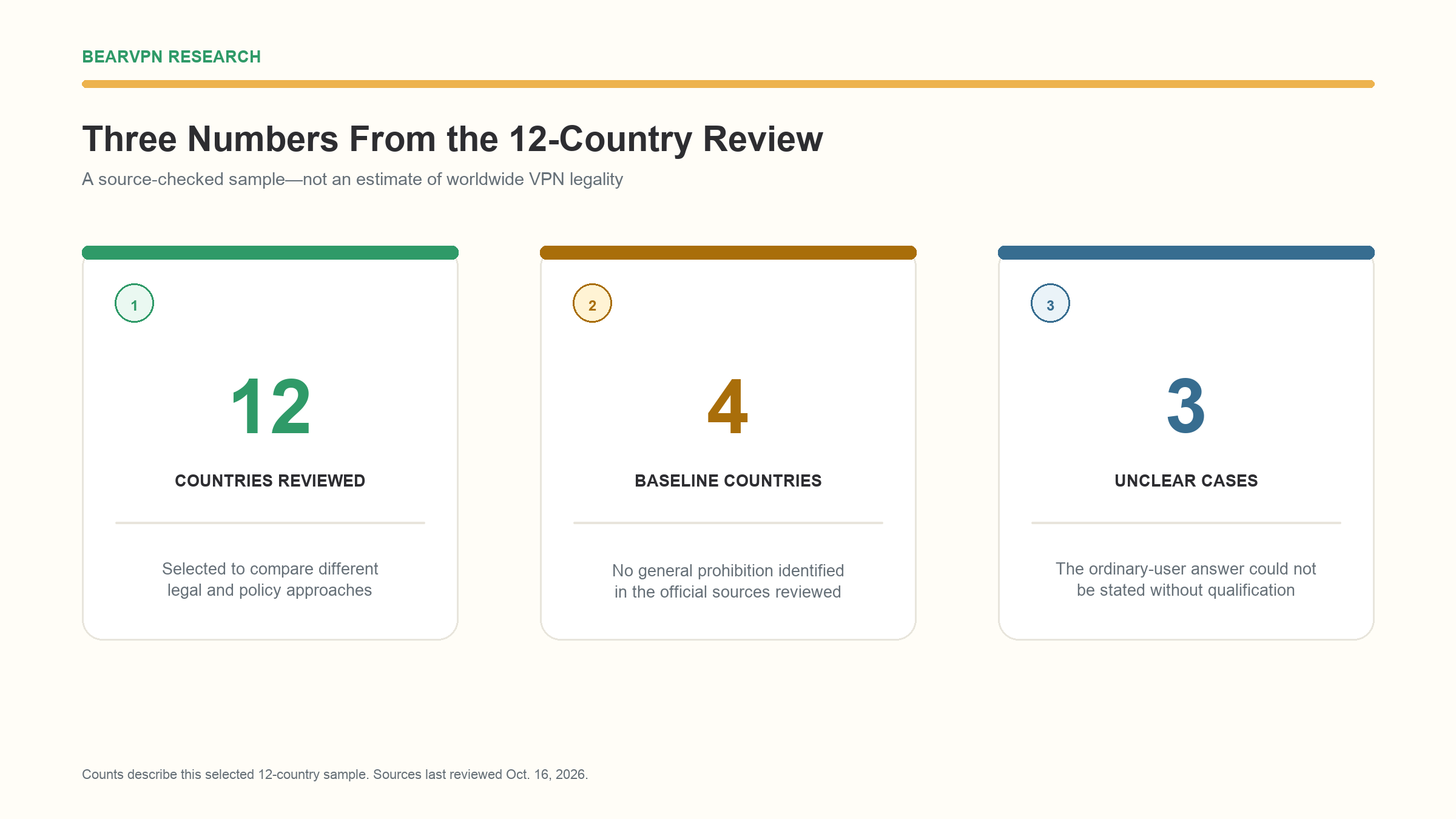
Figure 1. Three numbers from the 12-country review. The sample compares regulatory approaches; it is not a worldwide estimate.
What VPN Laws Actually Regulate
A VPN is not automatically illegal simply because it changes the network path or public IP address. The more useful question is what a particular rule regulates.
Some rules address individual use, such as whether an ordinary person may use an unauthorized circumvention tool. Others address providers, including who may operate a public VPN service, what customer records a provider must retain, or whether a company needs a telecommunications licence. A third group concerns technical access, such as blocking a non-compliant service. Finally, the underlying activity still matters: fraud, unauthorized access, copyright infringement, or other prohibited conduct does not become lawful because it is routed through a VPN.
The word “VPN” also covers different systems. It may describe a company’s private remote-access network, a licensed telecommunications service, or a consumer privacy app. A rule written for one category should not be copied to another without checking its definitions and covered actors.
How to Read the Country Table
We used four separate fields rather than one red-or-green label:
- Individual use: Did the reviewed official sources identify a general prohibition on ordinary personal VPN use?
- Provider and service rules: Are there licensing, registration, recordkeeping, network-establishment, or cross-border connectivity requirements?
- Technical accessibility: Do official sources establish that services may be blocked, or was availability not verified?
- Conduct: Does the cited rule concern VPN use itself, or an activity performed through the connection?
“No general prohibition identified” means that our defined official-source review did not locate a broad ban. It is not a guarantee that every use is lawful, that no regional rule applies, or that a particular service will work.
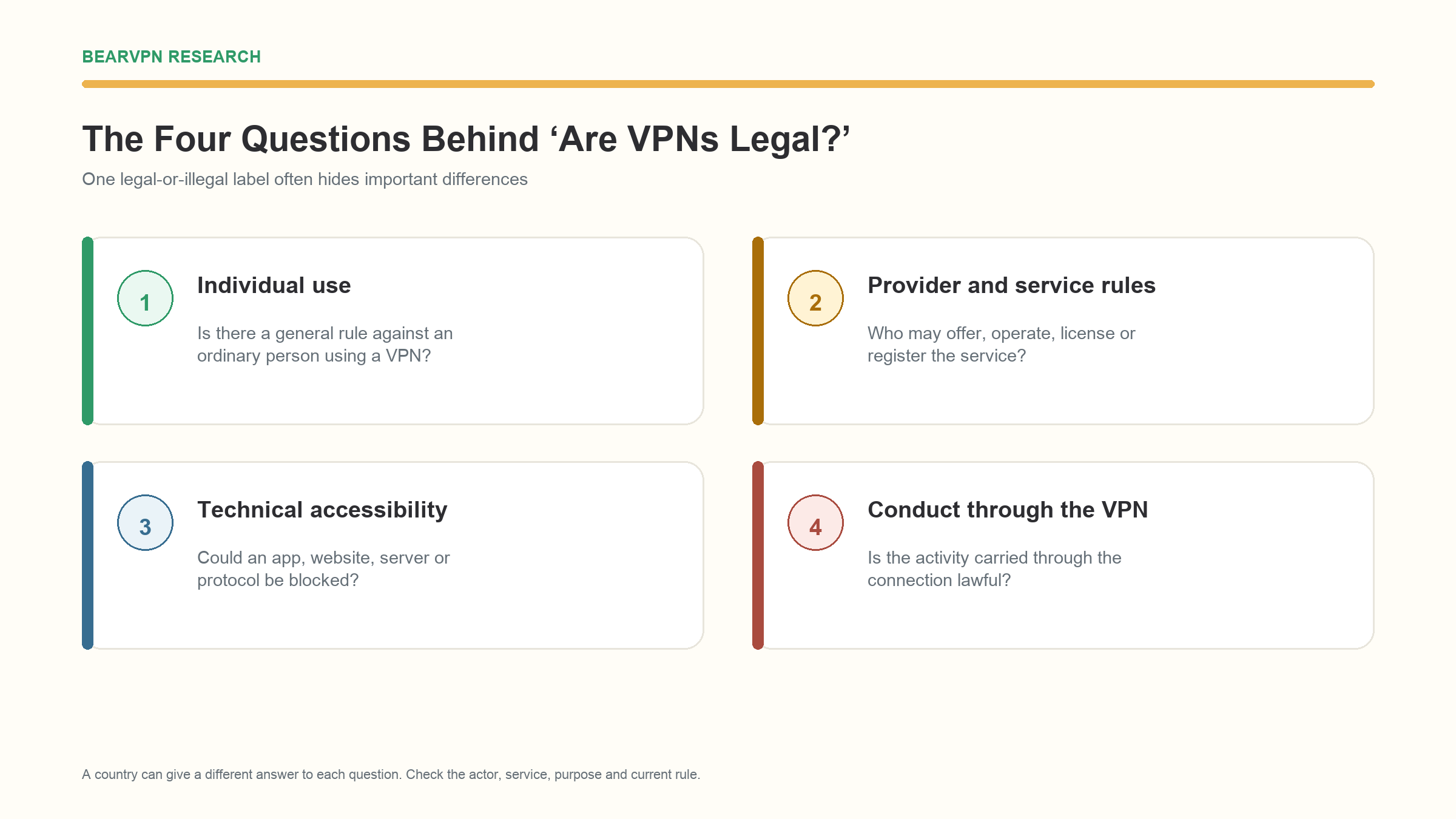
Figure 2. The four questions behind “Are VPNs legal?” Each is recorded separately rather than collapsed into one label.
VPN Laws in 12 Countries: Comparison Table
This table summarizes the official sources reviewed and is not legal advice. “Not verified” means BearVPN did not perform live connectivity testing or locate sufficient official evidence for a technical availability conclusion. All entries were last checked on October 16, 2026.
Country Notes
Countries Where We Found No General Prohibition
United States
We found no general federal prohibition on VPN use in the official sources reviewed. U.S. government cybersecurity material instead treats VPNs as a normal secure-connectivity technology.
CISA’s July 2025 TIC 3.0 Remote User Use Case describes a VPN as a secure communications mechanism across unprotected or public networks. CISA’s communications infrastructure guidance also tells organizations how to harden VPN gateways.
Those documents establish recognized government and enterprise uses; they are not an exhaustive review of every federal, state, or local rule. Conduct that violates another law remains unlawful when a VPN is used.
Last checked: October 16, 2026.
United Kingdom
We found no general prohibition on VPN use in the official UK source reviewed. The National Cyber Security Centre’s VPN guidance explains how organizations can select, deploy, configure, and operate VPN infrastructure to connect devices securely across different locations.
That is strong evidence of a recognized institutional use. It is not a legal opinion covering every consumer activity, so our conclusion remains “no general prohibition identified” rather than “every use is legal.”
Last checked: October 16, 2026.
Canada
We found no general VPN-use prohibition in the official Canadian source reviewed. The Canadian Centre for Cyber Security’s Virtual private networks guidance, modified on February 5, 2025, discusses gateway-to-gateway, host-to-gateway, and host-to-host VPNs.
It also expressly discusses a third-party privacy VPN, where a person connects from a public access point to a third-party VPN provider. That makes it one of the clearest government sources in this sample acknowledging consumer privacy VPNs as a normal category. It still does not make every activity conducted through one lawful.
Last checked: October 16, 2026.
Australia
We found no general prohibition on VPN use in the official Australian source reviewed. The Australian Signals Directorate’s September 2026 Information Security Manual guidance for enterprise mobility discusses organizational VPN gateways, split tunnelling, always-on VPN configurations, and using a VPN to encrypt mobile communications.
The material recognizes VPNs as a normal security control. Because it is primarily organizational cybersecurity guidance rather than a comprehensive consumer-law review, we do not treat it as an unlimited legal guarantee.
Last checked: October 16, 2026.
Countries With Provider, Licensing, or Content Restrictions
China
China cannot be described accurately with either “all VPNs are legal” or “all VPN technology is illegal.” The official material distinguishes authorized enterprise connectivity, unlicensed telecommunications activity, and unauthorized circumvention.
A 2017 Ministry of Industry and Information Technology market-cleanup notice restricted organizations and individuals from using private lines, including VPNs, to conduct unlicensed cross-border telecommunications business. In an official explanation, the ministry distinguished that activity from office connectivity: foreign-trade and multinational companies could lease cross-border connections from authorized telecommunications operators for their own use. A 2019 MIIT response repeated that distinction.
More recent official legal-education material is more direct about individual circumvention. A November 2025 article attributed to the Ministry of State Security’s WeChat account and reproduced by the Ministry of Justice Smart Legal Education Platform described “wall-crossing” software use as unlawful and directed people with academic or business needs toward approved channels.
The safe conclusion is that authorized enterprise connections exist, while unauthorized consumer circumvention carries material legal risk. This report does not test which VPN services connect in China or explain how to bypass restrictions.
Last checked: October 16, 2026.
India
India’s 2022 cybersecurity directions impose obligations on certain VPN service providers, not a general ban on individual VPN users.
The official CERT-In Directions and FAQ are especially important because they define the covered actors. FAQ Q7 says individual citizens are not covered by the directions. Public VPN providers offering internet-proxy-like services must retain specified customer registration information, including verified names, assigned IP information, registration timestamps, stated purpose, addresses, and contact information. The required retention period is five years after registration is cancelled or withdrawn, or longer where required by law.
FAQ Q34 excludes enterprise and corporate VPNs from the relevant VPN service-provider definition. The five-year requirement concerns specified customer records; it should not be rewritten as a requirement to store everyone’s browsing history for five years.
Last checked: October 16, 2026.
United Arab Emirates
The UAE recognizes legitimate business VPN use while restricting certain services and criminal purposes.
The Telecommunications and Digital Government Regulatory Authority’s current Internet Guidelines say companies, institutions, and banks may use VPN technology to access their internal networks. The same guidance says hosting VPN connections and services that allow UAE-based users to bypass ISP filtering is strictly restricted and may lead to ISP blocking. TDRA’s earlier VPN statement also distinguished lawful use from misuse.
Article 10 of Federal Decree-Law No. 34 of 2021 applies where someone circumvents an information-network protocol address by using another person’s address or another method with the intent to commit a crime or prevent its detection. A UAE Ministry of Justice explanation confirms that purpose element. The article should not be summarized as a penalty triggered whenever any VPN changes an IP address.
Last checked: October 16, 2026.
Russia
Russia heavily regulates access to restricted information and can block non-compliant VPN services. The reviewed provisions do not, however, establish that merely possessing any VPN app is automatically illegal.
Article 15.8 of Federal Law No. 149-FZ covers networks, websites, information systems, and software that can provide access to information resources restricted in Russia. Covered resource owners must prevent access to restricted resources and interact with Roskomnadzor. Access to non-compliant resources may be restricted. The underlying framework was introduced through Federal Law No. 276-FZ.
A 2026 Ministry of Digital Development letter reproduced by ConsultantPlus states that Roskomnadzor may block VPN services that do not comply with the legislation.
Those sources support conclusions about service obligations and blocking. Any claim about liability for a specific individual use still needs to be tied to the relevant conduct and current legal provision.
Last checked: October 16, 2026.
A Broad Access-Blocking Framework Without a Verified General VPN Ban
Türkiye
Türkiye has a broad legal framework for removing online content and blocking access, but the official sources reviewed did not establish a general prohibition on ordinary VPN use.
Law No. 5651 provides the core framework for regulating online publications and blocking access. A January 2024 Constitutional Court press release discusses content removal and access-blocking provisions and the annulment of certain amendments.
VPN services may be reported as unavailable or selectively restricted at particular times, but technical availability needs dated measurement evidence or a specific order. BearVPN did not perform a nationwide connectivity test, and we did not locate a public official list that would support a service-by-service conclusion.
Last checked: October 16, 2026.
Countries Where the Ordinary User Boundary Is Unclear
Iran
Iran’s published policy wording and a later official explanation point in different directions, so we classified the ordinary-user answer as unclear.
A resolution from the Supreme Council of Cyberspace’s 96th session, reproduced in the Persian legal-resolution database Nezamat, says the use of filtering-circumvention tools is prohibited unless legally authorized. It also calls for mechanisms to manage and authorize relevant services.
The council’s secretary subsequently said the resolution was a policy document directed at agencies and sector regulators rather than the general public, according to an ISNA report reproduced by Arman Eghtesadi. Because that explanation does not remove the prohibition wording from the published text, neither a categorical personal ban nor an unrestricted-use conclusion is sufficiently supported.
The Persian sources were reviewed using machine-assisted translation. We do not state a personal penalty without a clear current provision and covered actor.
Last checked: October 16, 2026.
Oman
Oman regulates telecommunications networks and services, but the official material we reviewed does not by itself prove that every ordinary user of a consumer VPN app must obtain a personal permit.
The Telecommunications Regulatory Act framework applies licensing rules to public and private telecommunications networks and the provision of telecommunications services. The Ministry of Justice and Legal Affairs publishes Decision No. 18/2015 on private telecommunications networks intended for personal use and not connected to the public network. Gov.om also provides a permit service for establishing or operating that type of network.
Those materials establish a licensing framework for networks and services. A private telecommunications network that is not connected to the public network is not automatically the same thing as a consumer privacy VPN app carried over an internet connection. Without a clearer official consumer-app rule, the ordinary-user conclusion remains unclear.
The Arabic sources were reviewed using machine-assisted translation.
Last checked: October 16, 2026.
Myanmar
Myanmar’s 2025 Cybersecurity Law clearly requires permission to establish a VPN or provide VPN services. The uncertain question is how the phrase “establishing a VPN” applies to an ordinary person who installs and connects through a third-party app.
The Ministry of Information’s English publication of Cybersecurity Law No. 1/2025 defines a virtual private network. The official Myanmar-language law is listed on the Myanmar National Portal. Section 70, published in the state-owned Global New Light of Myanmar, provides that a person convicted of establishing a VPN or providing VPN services without ministry permission may face one to six months’ imprisonment, a fine of one million to ten million kyats, or both; separate organizational penalties apply. Government reporting confirms that the law came into effect on July 30, 2025.
Legal commentary differs on whether “establishing” reaches an ordinary app user. An Allen & Gledhill summary describes the rule as a permission requirement for VPN providers. A Lincoln Legal Services analysis argues that the wording may create broader enforcement risk. We therefore do not describe the final law as a clear ban on merely possessing a VPN app, but ordinary users should not treat that uncertainty as an assurance of safety.
Last checked: October 16, 2026.
Legal Status Is Not the Same as Technical Availability
At least five different questions are often collapsed into “Is this VPN legal?”
- Does the law prohibit ordinary use?
- May a company provide the service?
- Is the website or app listed in an app store?
- Can the protocol or server connect on a particular network today?
- Is the activity conducted through the connection lawful?
One answer does not settle the others. The UAE recognizes business VPN use while TDRA says services designed to bypass ISP filtering may be blocked. Russia requires covered services to restrict access to prohibited resources and allows non-compliant services to be restricted.
The reverse inference is also unsafe: a VPN that still connects is not proof that every way of using it is lawful. App-store availability only shows that an app is listed in that storefront; it is not a legal opinion from the country where the user is located.
BearVPN did not measure live VPN availability in the 12 countries. In particular, this report does not publish connection-success rates for China, Türkiye, Iran, or Myanmar.
Business VPNs and Consumer Privacy VPNs Are Different Categories
“VPN” is a technical description, not one universal legal category. Three countries in this review show why the distinction matters:
- China: Official sources distinguish compliant enterprise cross-border connectivity from unlicensed cross-border telecommunications business and unauthorized circumvention.
- India: The CERT-In FAQ excludes enterprise and corporate VPNs from the VPN service-provider definition used for the customer-record requirements.
- United Arab Emirates: TDRA recognizes VPN access to internal company, institutional, and banking networks while restricting services designed to bypass ISP filtering.
These distinctions do not mean enterprise networks are unregulated or consumer VPNs are automatically prohibited. They mean the actor, network type, service model, and purpose must be checked before a rule is summarized.
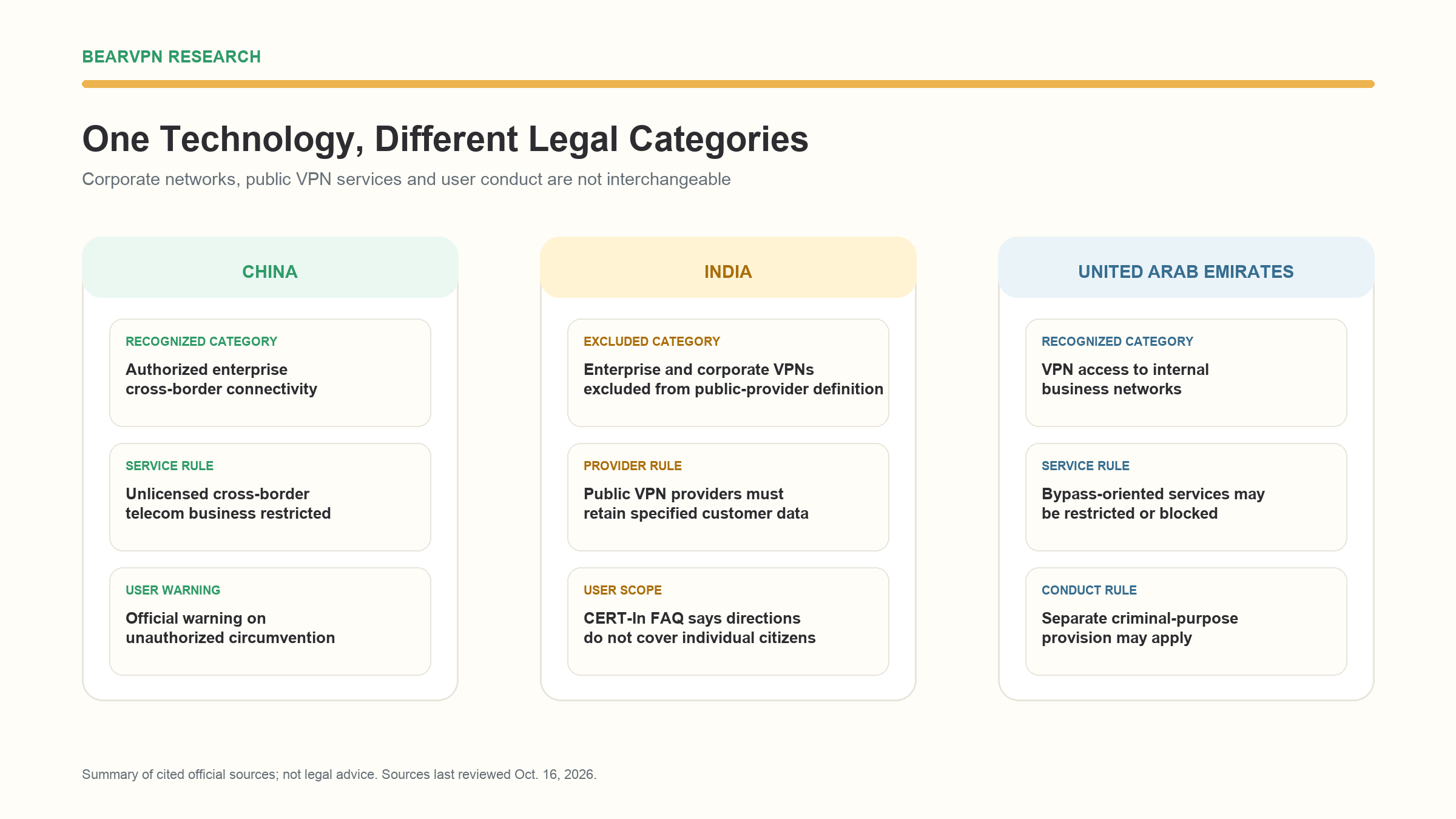
Figure 3. One technology, different legal categories: China, India, and the UAE.
Common Questions
There is no single worldwide answer. In the four baseline countries in this review—the United States, the United Kingdom, Canada, and Australia—we found no general prohibition in the official sources reviewed. Other countries may regulate public providers, cross-border connectivity, access to restricted content, or unauthorized services.Check the country, covered actor, purpose, and review date rather than relying on a global red-or-green map.
Potentially, depending on the country, whether the service is authorized, what content is accessed, and what the user does through the connection. A VPN does not make fraud, unauthorized access, copyright infringement, or another prohibited act lawful.Penalties should only be quoted after checking the current provision and whether it applies to a user, provider, company, or another actor. A maximum penalty attached to a crime-purpose provision should not be presented as the consequence of opening any VPN app.
The answer may involve both law and contract. Copyright and regional licensing rules are legal questions; a streaming platform’s geographic-access policy is a contractual question. Violating a platform’s terms may lead to account or access consequences, but it is not automatically the same as committing a crime.This report does not provide instructions for bypassing geographic restrictions. Users should review local law and the platform’s current terms.
Yes. Legitimate enterprise or security uses can coexist with restrictions on particular public services. UAE guidance recognizes internal business VPNs while warning that certain bypass-oriented services may be blocked. Russia can restrict non-compliant VPN services while regulating access to prohibited resources.That is why “legal” and “available” need separate fields.
Often. China distinguishes authorized enterprise connectivity from unlicensed cross-border telecommunications business. India excludes enterprise and corporate VPNs from the provider definition used for its customer-record rule. UAE guidance expressly recognizes internal company, institutional, and banking VPN use.The definitions in the relevant law or guidance matter more than the shared word “VPN.”
No. A listing only shows that an app is available in a particular storefront at that time. Local law, provider authorization, network availability, and the user’s activity remain separate questions.An app may be downloadable but technically blocked, unavailable in a local store but accessible elsewhere, or subject to rules that the storefront description does not explain.
Iran, Oman, and Myanmar. This conclusion applies only to the 12-country sample and the sources reviewed.Iran had a conflict between published policy wording and a later official explanation. Oman’s official materials addressed private telecommunications networks and services rather than clearly addressing every consumer VPN app. Myanmar’s final law regulates establishing a VPN and providing VPN services, but the ordinary app-user boundary remains disputed.
Research Methodology
BearVPN selected 12 countries to compare different regulatory approaches. The sample included four baseline countries with government cybersecurity guidance recognizing VPN uses and eight countries with provider obligations, licensing rules, access restrictions, or material legal disputes. It was not designed to estimate worldwide prevalence.
For each country, we recorded four dimensions:
- ordinary individual use;
- provider and service rules;
- technical accessibility;
- conduct performed through a VPN.
We prioritized current laws, regulations, official gazettes, and regulator material. Government cybersecurity guidance was used to establish recognized normal uses where a comprehensive legal rule was not located. Reliable legal commentary or reporting was used only where needed to explain a translation, effective date, or disputed interpretation.
We used “no general prohibition identified” when our defined official-source review did not locate a broad ban. The phrase is deliberately narrower than “fully legal.” It does not prove that no other national, state, provincial, regional, or local rule could apply.
We only recorded a penalty when the source identified the covered conduct and actor. We did not convert penalties into U.S. dollars, combine provider rules with user rules, or treat service blocking as proof of a personal-use offence.
BearVPN did not install products, test local networks, compare app-store availability, or measure protocol blocking in these countries. Persian and Arabic sources were reviewed with machine-assisted translation, and categorical local-law conclusions would require native-language legal review.
Publisher disclosure: This report was produced by BearVPN, a VPN provider. The legal and policy classifications were based on the cited public sources, not on BearVPN product claims. BearVPN did not test live VPN connectivity in the 12 countries.
Limitations
This report provides general information, not legal advice. The 12 countries are a purposeful sample and do not represent the worldwide legal status of VPNs.
“No general prohibition identified” reflects the defined sources and search scope. In the United States, the United Kingdom, Canada, and Australia, government cybersecurity guidance demonstrates normal uses but is not a complete review of every law or jurisdiction.
Iran, Oman, and Myanmar require particular caution because of conflicting explanations, the difference between telecom-network rules and consumer apps, or disputed statutory wording. The legal and network environments in China, Russia, Iran, Türkiye, and Myanmar may also change quickly.
We did not test connectivity, app-store access, individual VPN services, or protocol blocking. A service being available does not establish that every use is lawful; a service being blocked does not by itself establish that possessing a VPN is illegal.
Anyone facing a specific compliance, enforcement, employment, or travel question should consult a qualified professional in the relevant jurisdiction.
Conclusion
VPN legality is rarely answered accurately with one worldwide yes or no. In the countries reviewed, important rules often applied to providers, network licensing, cross-border connectivity, restricted content, or specific conduct rather than to the technology alone.
Legal status, technical availability, and app-store listing are separate questions. Enterprise remote-access systems and consumer privacy apps may also fall into different regulatory categories.
The safest way to read a VPN rule is to ask four questions: Who is using or providing the service? What kind of VPN is involved? What activity is being carried through it? Is the cited rule still current? A single green or red label cannot answer all four.
Source Index
United States
United Kingdom
Canada
Australia
China
- MIIT market-cleanup notice, 2017
- MIIT official explanation, 2017
- MIIT public response on cross-border office connectivity, 2019
- Ministry of Justice Smart Legal Education Platform material, 2025
India
United Arab Emirates
- TDRA Internet Guidelines
- TDRA statement on VPN use
- Federal Decree-Law No. 34 of 2021
- UAE Ministry of Justice explanation of Article 10
Russia
- Federal Law No. 149-FZ, Article 15.8
- Federal Law No. 276-FZ, official publication
- 2026 Ministry of Digital Development letter
Türkiye
Iran
- Supreme Council of Cyberspace resolution reproduction
- Reported official explanation of the resolution’s audience
Oman
- Oman Telecommunications Regulatory Act framework
- Decision No. 18/2015
- Gov.om private telecommunications network permit