Corporate VPN pricing often looks simple until a company tries to calculate its actual bill. A pricing page may advertise a per-user rate, while the checkout requires five seats, annual payment, a gateway subscription, or a separate dedicated server. Some providers sell fixed user bundles instead of individual seats. Others do not publish enough information to calculate a small-team total at all.
We reviewed the official pricing and support pages of 12 corporate VPN and secure-access products on November 18, 2026. For each product, we recorded the public seat price, billing term, minimum purchase, required gateway or server fee, free tier, and any limitation that prevented an exact calculation. We then calculated the cost of a selected paid plan for teams of two, five, and ten wherever the published evidence allowed it.
This is a pricing-disclosure study, not a product ranking. The selected plans are not feature-equivalent, and the lowest price is not necessarily the best fit. For consumer subscriptions, see our introductory and renewal VPN price study.
Quick Answer
Among the 12 products reviewed, nine provided enough public information to calculate all three team-size scenarios, one supported only a ten-seat calculation, and two did not publish enough detail for exact team-size totals.
Among the eight products with complete, exact USD pricing for a five-person team, the selected paid-plan cost ranged from $25 to $84 per month. For a ten-person team, the range was $50 to $119 per month. NetBird was listed separately in euros and cost €30 per month for five active users or €60 for ten on its selected Team plan.
These figures are not a market average. They compare selected paid plans using public list prices and required fees. Free tiers and free trials were recorded but excluded from the paid-plan cost comparison. A monthly equivalent based on annual billing also does not mean that a provider permits month-to-month payment at that rate.
Key Findings
- The advertised per-user price was insufficient to calculate the bill for several products. Minimum seats, fixed packages, and required gateway fees materially changed what a small team would pay.
- Five-person selected paid-plan costs ranged from $25 to $84 per month across eight products with complete USD pricing.
- Ten-person selected paid-plan costs ranged from $50 to $119 per month across the same eight products.
- Windscribe and Twingate produced the lowest five-person paid-plan total in the complete USD comparison at $25 per month, but the products use different models and are not interchangeable.
- GoodAccess produced the highest five-person total in this comparison at $84 per month, because its published Essential calculation included both five seats and a required gateway.
- A two-person company could still face a five-seat minimum. On the selected plans, Windscribe cost $25 rather than $10, NordLayer cost $40 rather than $16, and UTunnel cost $35 rather than $17 after its seat minimum and gateway fee.
- Public pricing was incomplete for a five-person scenario at Surfshark, PureVPN, and OpenVPN CloudConnexa. We did not estimate missing totals.
- Tailscale, Twingate, and NetBird published free tiers, but those tiers were excluded from the selected paid-plan comparison to keep the paid scenarios explicit.
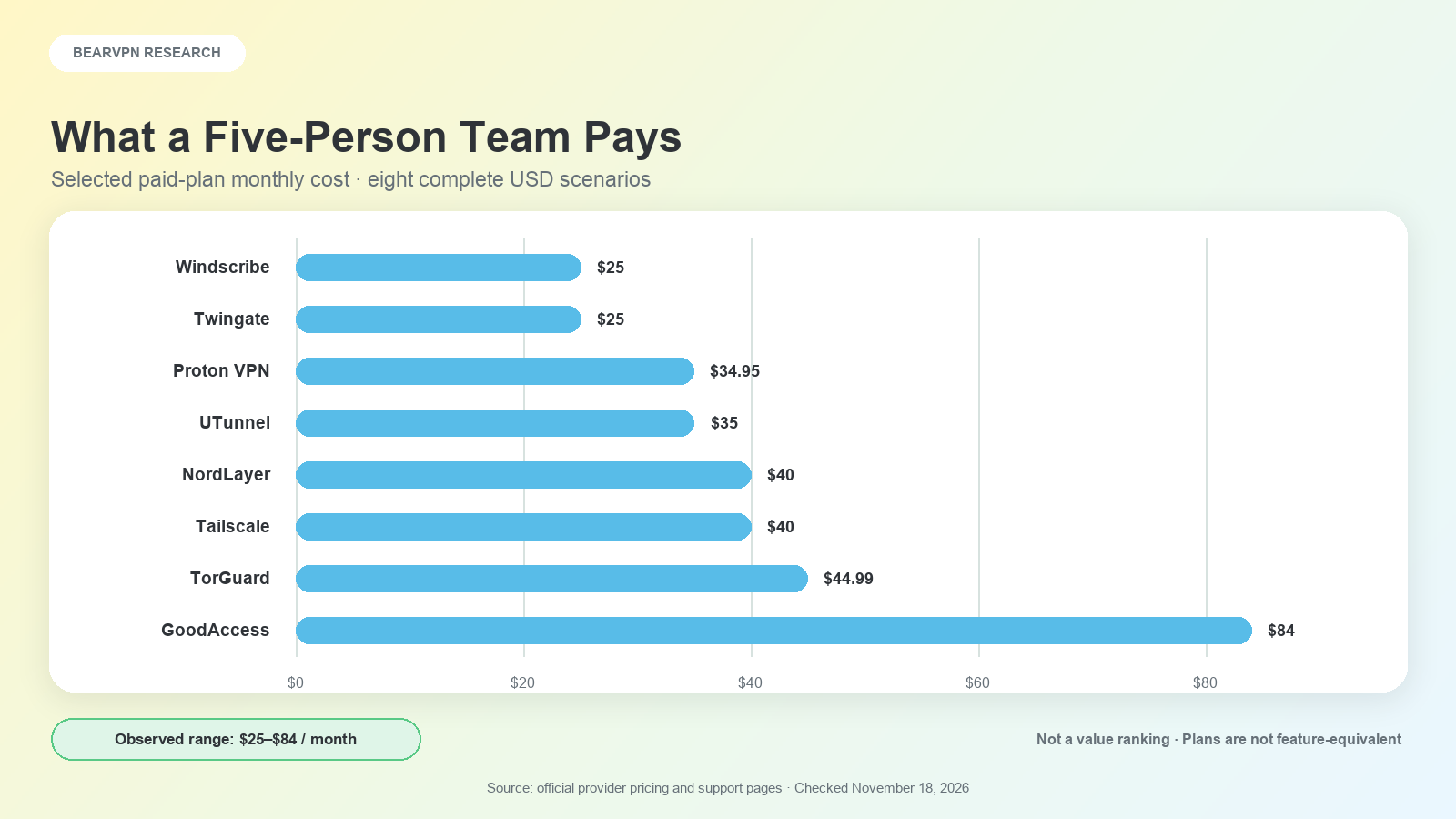
Figure 1. Selected paid-plan monthly cost for a five-person team across eight products with complete public USD pricing. The chart does not compare feature equivalence. Surfshark and PureVPN lacked complete public scenario pricing, OpenVPN did not provide a confirmed five-seat total, and NetBird was listed in euros.
Corporate VPN Pricing Table
The table below uses the lowest paid plan for which we could build a reasonably comparable team-access scenario from official public information. “Annual monthly equivalent” means that the annual charge was divided by 12; it does not indicate monthly billing. “Quote required” and “not publicly calculable” both mean that the published evidence did not support an exact total for that team size.
Prices and plan details were checked on November 18, 2026.
Why the Per-User Price Is Not the Amount a Company Pays
A per-user rate is useful only when it is combined with the billing rules around it. In this sample, three pricing mechanics repeatedly changed the final amount: minimum seats, required infrastructure fees, and fixed packages.
Minimum Seats
A provider can publish a low seat price while requiring a business to buy more seats than it needs. Windscribe advertised $5 per seat per month, but ScribeForce required at least five seats. A two-person company therefore reached a $25 monthly total rather than $10.
NordLayer Lite showed the same effect at a higher seat rate. Two seats at the advertised $8 annual monthly equivalent would equal $16, but the five-user minimum produced a $40 monthly equivalent. This is why minimum purchase rules should appear next to the headline price rather than in a separate note.
Required Gateway or Server Fees
Some business-access services combine user licenses with a network component. GoodAccess Essential added a $49 monthly gateway to its user charges. With a five-user minimum at a $7 annual monthly equivalent, a two- or five-person scenario reached $84 per month:
5 billed users × $7 + $49 gateway = $84 per month
UTunnel also combined seats with a gateway. Its published minimum scenario used five users at $6 each and a minimum $5 gateway:
5 billed users × $6 + $5 gateway = $35 per month
The UTunnel figure should be treated as a published minimum. Hosting choices or external cloud infrastructure can increase the operating cost.
Package Pricing
TorGuard did not require a seat-by-seat calculation for the selected plans. Its Starter package covered up to five users for $44.99 per month, while the Small package covered up to ten for $82.99. A two-person team and a five-person team therefore produced the same selected-plan price.
For products with per-seat pricing, our main calculation was:
Selected paid-plan monthly cost = billed seats × published seat price + required gateway or server fees
For a fixed package, we used the smallest published package that covered the team size. We did not create estimated totals from “from” pricing when the provider said the final rate depended on a quote, user count, or needs assessment.
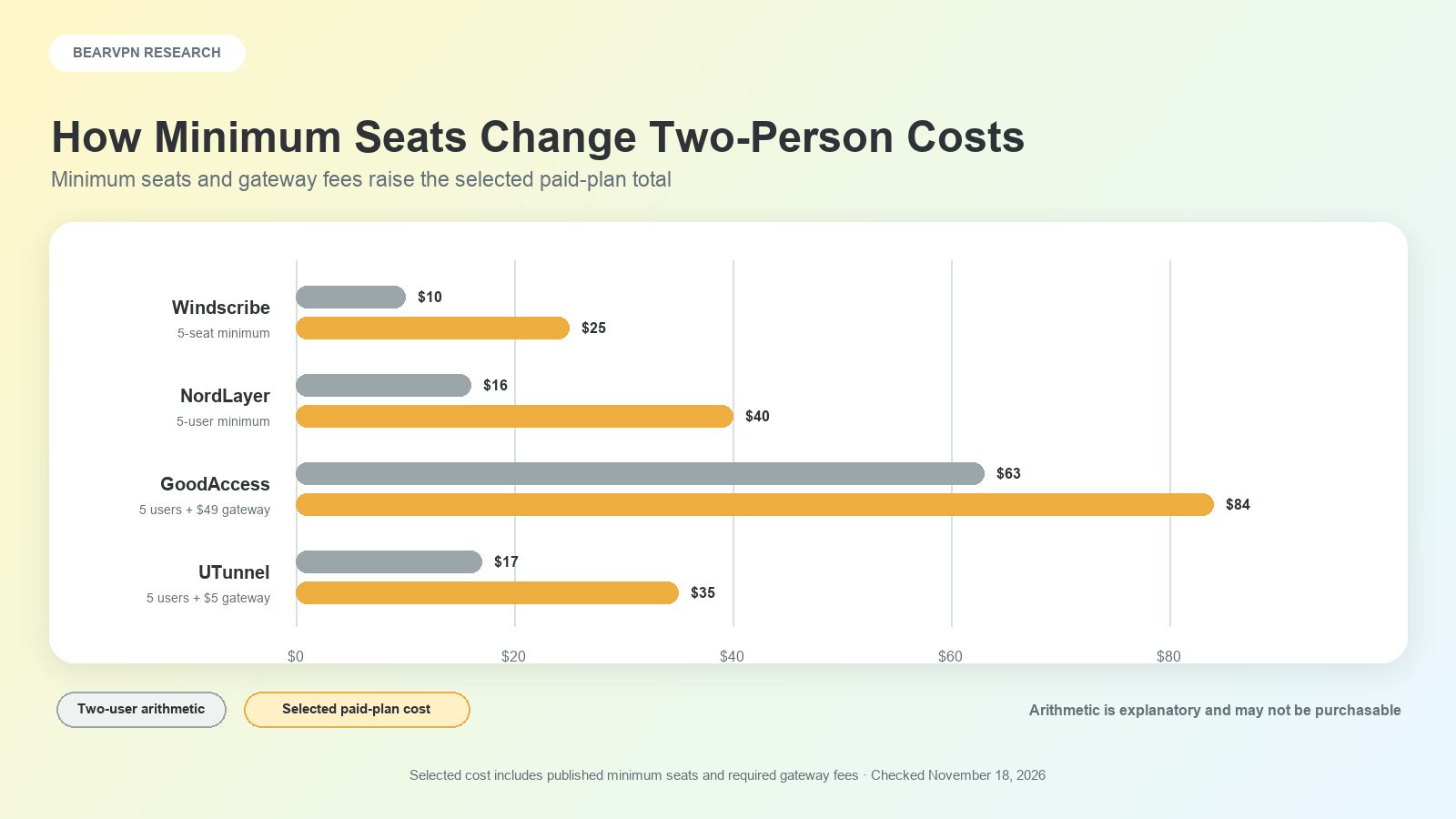
Figure 2. For four selected plans, minimum seats and required gateway fees made the payable paid-plan total higher than simply multiplying the user rate by two. “Two-user arithmetic” is explanatory and may not represent a purchasable configuration.
Costs for Teams of Two, Five, and Ten
Team size did not affect every product in the same way. Per-user plans generally rose in a straight line, minimum-seat plans stayed flat until the team exceeded the minimum, and package plans changed only when a team crossed into the next bundle.
Two-Person Teams
For a two-person business, the lowest selected paid-plan total in the complete USD data was $10 per month for Twingate Teams. Proton VPN Essentials followed at $13.98, while Tailscale Standard cost $16.
Minimums changed the result for several providers. Windscribe charged the selected five-seat minimum at $25, UTunnel reached a published minimum of $35 after its gateway, and NordLayer reached a $40 annual monthly equivalent. TorGuard’s five-user Starter package cost $44.99 even when only two people were included. GoodAccess was highest in this two-person comparison at $84 because the selected calculation included five seats and a gateway.
NetBird’s selected Team plan cost €12 per month for two active users. We kept it separate because converting currencies on one date would add exchange-rate noise and would not make the underlying products more comparable.
Five-Person Teams
Five users produced the cleanest common comparison because several providers set their minimum at five seats. Among eight complete USD scenarios, the selected paid-plan costs were:
- Windscribe ScribeForce: $25
- Twingate Teams: $25
- Proton VPN Essentials: $34.95
- UTunnel Access Gateway Basic: $35
- NordLayer Lite: $40
- Tailscale Standard: $40
- TorGuard Business VPN Starter: $44.99
- GoodAccess Essential: $84
The range was therefore $25 to $84 per month, a difference of $59 between the lowest and highest selected totals. That difference should not be read as a value ranking: the plans package different access models, administrative controls, gateways, and support arrangements.
NetBird cost €30 per month for five active users on its Team plan. Surfshark, PureVPN, and OpenVPN CloudConnexa were not included in the five-person range because the public evidence did not support an exact total under our rules.
Ten-Person Teams
At ten users, the eight complete USD selected-plan totals ranged from $50 to $119 per month:
- Windscribe ScribeForce: $50
- Twingate Teams: $50
- UTunnel Access Gateway Basic: $65
- Proton VPN Essentials: $69.90
- NordLayer Lite: $80
- Tailscale Standard: $80
- TorGuard Business VPN Small: $82.99
- GoodAccess Essential: $119
OpenVPN CloudConnexa also supported a ten-seat calculation of $70 per month on an annual billing basis, based on its official example. It was not placed in the eight-product common range because the two- and five-person scenarios could not be confirmed from the same public evidence.
NetBird cost €60 per month for ten active users on its Team plan.
Three Different Products Often Appear in the Same Search
“Corporate VPN pricing” does not describe one standardized product category. Search results can combine at least three different models, which is one reason that a single market average would be misleading.
Consumer VPN Team Plans
Windscribe, Surfshark, PureVPN, and TorGuard sell team or business access that is closely related to a conventional commercial VPN service. These plans can be useful when an organization mainly wants centrally purchased accounts, user management, or shared access to the provider’s VPN network.
Their pricing models still vary. Windscribe uses a per-seat rate with a five-seat minimum, TorGuard uses fixed packages, and Surfshark and PureVPN present starting prices whose exact team totals may depend on the selected offer or tier.
Managed Business VPN and Gateway Services
NordLayer, Proton VPN, GoodAccess, OpenVPN CloudConnexa, and UTunnel place more emphasis on organizational network access. Depending on the plan, the bill can include user licenses, gateways, servers, connectors, dedicated resources, or policy controls.
This group also illustrates why the plan name matters. NordLayer Lite, for example, does not include the private gateway and dedicated IP configuration found in higher tiers. Proton VPN Essentials was calculated without adding the dedicated server associated with its Professional offering. A reader comparing features should therefore start with the organization’s access requirements, not only the lowest listed price.
VPN Replacements and Mesh Access
Tailscale, Twingate, and NetBird describe modern private-access or mesh-network approaches that can replace some traditional remote-access VPN deployments. Their billing units can include active users, devices, resources, or machines rather than only a conventional VPN account.
We included them because businesses searching for corporate VPN pricing commonly evaluate these alternatives. However, their presence makes a feature-blind price ranking less meaningful. A $5 user license and an $8 active-user license may cover different architecture, allowances, and administrative functions.
Which Prices Could Not Be Calculated Exactly?
Missing totals are part of the result. We marked a scenario unavailable when the official public pages did not provide enough evidence, rather than filling the gap with a multiplication that might not match the actual offer.
Surfshark
Surfshark’s team page advertised pricing from $5.90 per user per month, a minimum of five users, and a one-year plan. It also indicated that the rate varies with the number of users and the organization’s needs. Because “from” pricing does not prove that every team size can buy at that rate, we did not turn it into unsupported two-, five-, or ten-person totals.
PureVPN
PureVPN for Teams published a starting annual rate of $5 per user per month, stated that paid access starts at three users, and described lower volume pricing that could reach $3. The public material did not expose a sufficiently clear tier schedule for all three scenarios, so the exact totals remained uncalculated.
OpenVPN CloudConnexa
OpenVPN published enough information to support a ten-seat Essential example at $70 per month billed yearly. We did not find equally clear official evidence for a lower paid quantity, so the two- and five-person fields were marked “not publicly confirmed.”
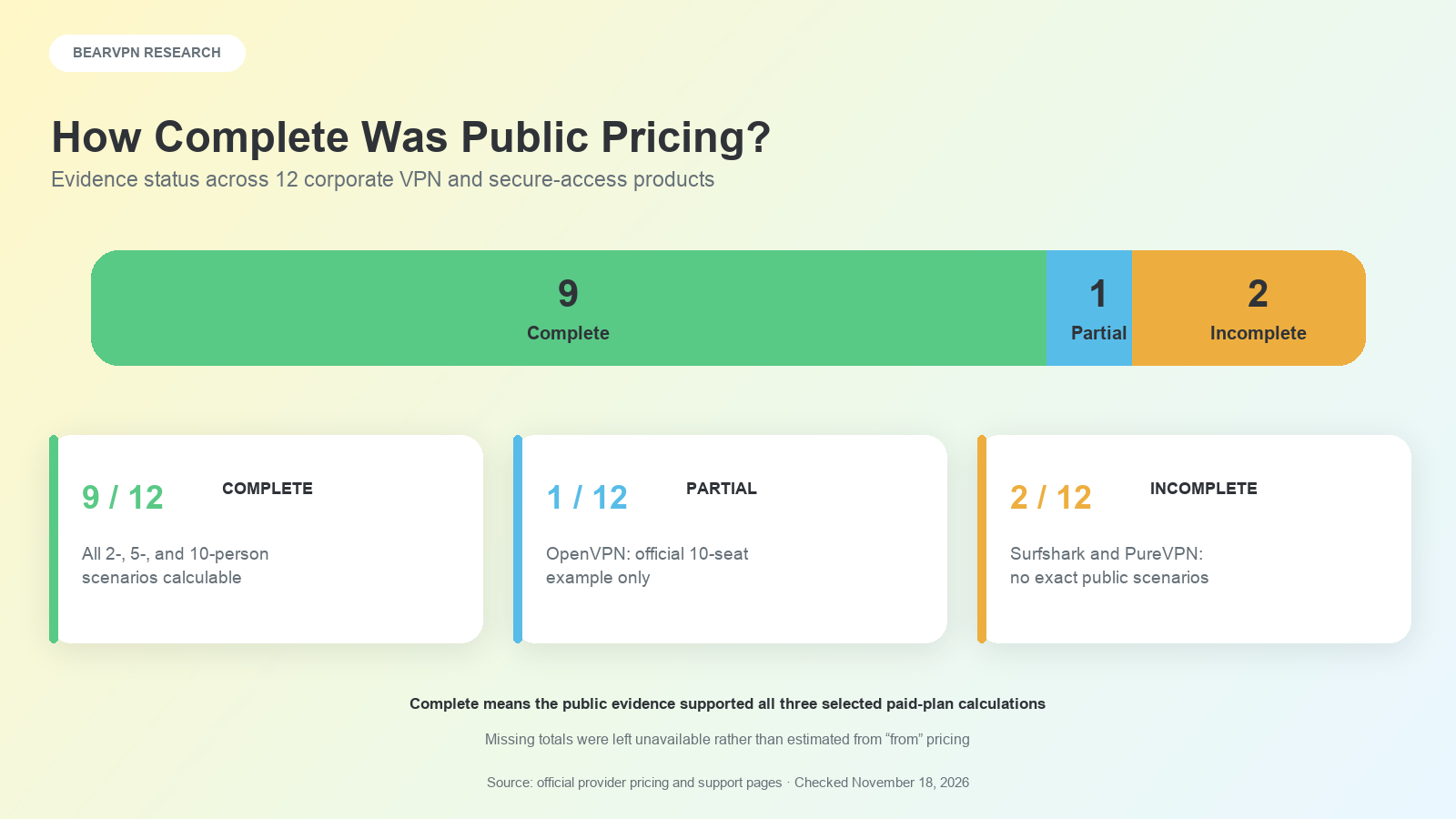
Figure 3. Nine products supported all three team-size calculations, OpenVPN CloudConnexa supported only the ten-seat scenario, and Surfshark and PureVPN did not provide enough public detail for exact scenario totals under our method.
What This Comparison Does Not Tell You
Price alone cannot show whether a product is suitable for a company’s network, risk model, or compliance obligations. This study did not compare:
- encryption implementations or protocol security;
- independent audits, logging practices, or incident history;
- application performance, latency, or connection reliability;
- identity-provider integrations and device-posture controls;
- administrator experience, deployment time, or support quality;
- regulatory suitability or contractual data-processing terms;
- taxes, negotiated discounts, promotions, or reseller pricing;
- the cost of a company’s own cloud server, staff time, or migration work unless a required public fee was explicitly included.
The selected plans are also not feature-equivalent. A consumer-oriented team account, a managed private gateway, and a mesh-access platform can all appear for the same query while solving different problems. Readers should use the calculations as a billing-structure audit, then compare the features that matter to their deployment.
For a separate review of how VPN providers document physical, virtual, rented, and RAM-only servers, see our VPN server infrastructure transparency study.
Methodology
Sample Selection
We selected 12 products representing three types of service found in corporate VPN and business remote-access searches:
- consumer VPN team plans;
- managed business VPN or gateway services; and
- VPN replacements or mesh-access services.
The sample was designed to compare pricing models, not to represent every corporate VPN vendor. Inclusion does not constitute an endorsement, and exclusion does not indicate a negative assessment.
Source Priority
We used provider-controlled sources in the following order:
- official pricing or order page;
- official plan documentation or knowledge-base article;
- official FAQ or support page.
We did not use affiliate roundups or third-party price summaries to fill missing values. When an official page did not support an exact total, the field was left unavailable or marked for a quote.
Calculation Rules
For each product, we recorded the displayed currency, per-user or package rate, billing period, minimum seats, required gateway or server fee, free tier, and material calculation note.
We then applied these rules:
- Use the selected paid plan rather than a free tier or free trial.
- Multiply by the billed seat count, not only the number of actual users, when a minimum applies.
- Add a gateway or server charge only when the official evidence identifies it as required for the selected scenario.
- Use the smallest fixed package that covers the team size.
- Convert an annual total to a monthly equivalent only when the annual price is publicly stated.
- Do not describe an annual monthly equivalent as month-to-month billing.
- Do not multiply a “from” rate into a final total when the provider says pricing varies or requires an offer.
- Keep EUR and USD results separate; do not introduce an exchange-rate conversion.
- Do not calculate one market-wide average because the products and billing models are not equivalent.
The selected paid-plan calculation was:
Billed seats × published seat price + required gateway or server fees
Annualized figures, where used in the underlying data, were calculated as:
Selected monthly cost × 12
Evidence Date
All prices and plan descriptions in this report were checked on November 18, 2026. Pricing pages can change without notice. Readers making a purchase decision should confirm the current checkout price, taxes, currency, renewal terms, and plan inclusions directly with the provider.
Limitations
This study has five main limitations.
First, it is a 12-product sample rather than a complete market census. Second, it relies on public provider documentation and does not reproduce private sales quotes or negotiated enterprise contracts. Third, some pages present annual rates as monthly equivalents, so the cash-flow requirement can be larger than the displayed monthly number. Fourth, the plans are not functionally equivalent and should not be ranked on price alone. Fifth, pricing and plan details may change after the evidence date.
The calculations were checked against the cited public terms, but they were not validated by purchasing every plan. Any field without adequate official evidence was left incomplete rather than estimated.
Publisher Disclosure
This report was produced by BearVPN, a VPN provider. BearVPN was not included in the sample because it does not currently publish a directly comparable corporate VPN plan. The study compares public pricing and billing disclosures; it does not rate product security, performance, or overall value.
Frequently Asked Questions
In this sample, published paid-plan rates included $5, $6, $6.99, $7, and $8 per user or seat per month, with different billing terms. The per-user figure is not always the final cost. A minimum seat count, gateway fee, fixed package, dedicated resource, or annual billing commitment can change the amount a company pays.
Among eight selected paid plans with exact public USD pricing, a five-person scenario ranged from $25 to $84 per month. NetBird’s selected Team plan was €30 per month for five active users. The products are not feature-equivalent, and three other sampled services did not provide an exact public five-person total under our method.
Some providers set a minimum purchase of five users or seats. A two-person company can therefore be billed for five. Windscribe, NordLayer, GoodAccess, and UTunnel all produced this effect in the selected-plan calculations, although GoodAccess and UTunnel also included gateway charges.
Both models exist. Some providers publish true monthly prices, while others advertise a monthly equivalent that is billed annually. A displayed price such as “$8 per user per month, billed annually” generally requires payment for the annual term. The billing note should be checked before comparing it with a month-to-month plan.
Not always. Some plans include a gateway or dedicated resource, some sell it separately, and some entry plans omit it. In this study, NordLayer Lite did not include the private-gateway and dedicated-IP configuration available in higher tiers. Proton VPN’s selected Essentials calculation did not include the dedicated server associated with Professional. A buyer should verify both the feature and the required fee for the exact plan.
Not necessarily. A personal VPN normally protects an individual device’s internet connection through the provider’s server network. A business service may add centralized user administration, identity-provider integration, private gateways, connectors, access policies, device controls, or links to company resources. Team versions of consumer VPNs and modern mesh-access products can also appear in the same search results, so the product model should be confirmed before prices are compared.
Conclusion
The public headline rate is only the first line of a corporate VPN bill. Across the 12 products reviewed, minimum seats, required gateways, fixed packages, annual commitments, and incomplete quote-based pricing all affected what a company could calculate from the pricing page.
For five-person teams, the eight complete USD selected-plan scenarios ranged from $25 to $84 per month. For ten-person teams, the same group ranged from $50 to $119. Those ranges describe public paid-plan calculations, not a universal market price or a quality ranking.
The most useful comparison is therefore not “Which provider has the lowest per-user number?” but “What must this company actually buy for its team size and network design?” A realistic budget should combine the billed seat count, required infrastructure, billing term, currency, and features of the exact plan being considered.
Sources and Reproducibility
The calculations in this report can be reproduced from the following official provider pages. Because pricing is dynamic, use the evidence date above when comparing later versions.
- Windscribe: ScribeForce and What is ScribeForce?
- Surfshark: Surfshark for Teams
- PureVPN: PureVPN for Teams
- TorGuard: Business VPN plans
- NordLayer: Pricing and getting-started plan information
- Proton VPN: Business VPN pricing and business plan explanation
- GoodAccess: Pricing and order page
- OpenVPN: CloudConnexa pricing
- UTunnel: VPN and ZTNA pricing and product site
- Tailscale: Pricing
- Twingate: Pricing and FAQ
- NetBird: Pricing and plans and billing documentation