The digital landscape has become increasingly hostile toward personal data privacy. Whether you are attempting to stream your home library while traveling, bypass institutional network blocks at school or work, or securely access geo-restricted adult platforms, simply hiding behind a standard Virtual Private Network (VPN) is no longer enough. Modern websites, streaming platforms, and network firewalls deploy highly sophisticated detection algorithms designed to hunt down and blackhole commercial VPN traffic.
For users who prefer the lightweight agility of browsing via Google Chrome or Microsoft Edge, finding an un-trackable extension is essential. However, the market is flooded with low-tier proxies that claim to offer absolute anonymity but actually leak your real location behind the scenes. To stay truly under the radar, you must understand the underlying technology that separates standard commercial traffic routing from elite, anti-detection stealth extensions.
The Mechanics of Stealth: Why Do You Need an Undetectable Extension?
Standard VPN extensions simply reroute your IP address. While this works for basic geo-spoofing, it completely fails against modern, aggressive network monitors. Upgrading to a truly undetectable VPN extension is critical for three specific operational reasons:
- Evading Deep Packet Inspection (DPI): Advanced corporate firewalls and government censors do not just block IP addresses; they use DPI to look inside your data packets. If they detect the cryptographic signature of a VPN protocol, they sever the connection. Undetectable extensions utilize obfuscation, wrapping your VPN traffic inside a normal HTTPS envelope so it looks exactly like an ordinary Google search or online shopping session.
- Preventing WebRTC and DNS Leaks: Browsers like Chrome are notorious for bleeding user data through WebRTC (a protocol used for real-time video/audio). A premium undetectable extension actively blocks WebRTC communications at the browser level, ensuring your real-world IP address never bypasses the proxy tunnel.
- Bypassing Advanced Streaming Firewalls: Streaming giants and restricted adult platforms deploy aggressive proxy-blocking scripts. To stay under the radar, you need a tool capable of masking its proxy behavior entirely, allowing you to access restricted content without triggering the dreaded “You seem to be using an unblocker or proxy” error.
The Big Brand Flaw: Why Popular VPNs Frequently Get Blocked
It might seem counterintuitive, but industry giants like ExpressVPN and NordVPN are often the absolute worst choices if you need to remain strictly undetectable. While they excel at raw speed and general encryption, their massive scale is their biggest stealth vulnerability.
There are two primary reasons these mainstream tools are easily blackholed by streaming platforms and local firewalls:
- Data Center IP Pollution: Major VPNs lease massive server farms and assign tens of thousands of users to the exact same IP addresses. When a streaming service notices 5,000 different accounts trying to log in from a single IP within an hour, they immediately flag that IP as a commercial proxy node and permanently blacklist the entire subnet.
- Recognizable Cryptographic Handshakes: Popular VPNs rely heavily on standardized protocols like standard WireGuard or OpenVPN. While highly secure, these protocols have distinct “handshakes” (the way the client says hello to the server). Strict firewalls are trained to recognize these default handshakes and automatically drop the connection before the tunnel is even established.
To stay truly hidden, you need tools that prioritize stealth architecture—such as RAM-only servers, proprietary obfuscation routing, and clean, unpolluted IP pools.
Editor’s Choice: The Superior Alternative to Chrome Extensions
Before we dive into the top browser extensions, we must address a critical technical reality: Browser extensions are inherently vulnerable to WebRTC data leaks and fingerprinting.
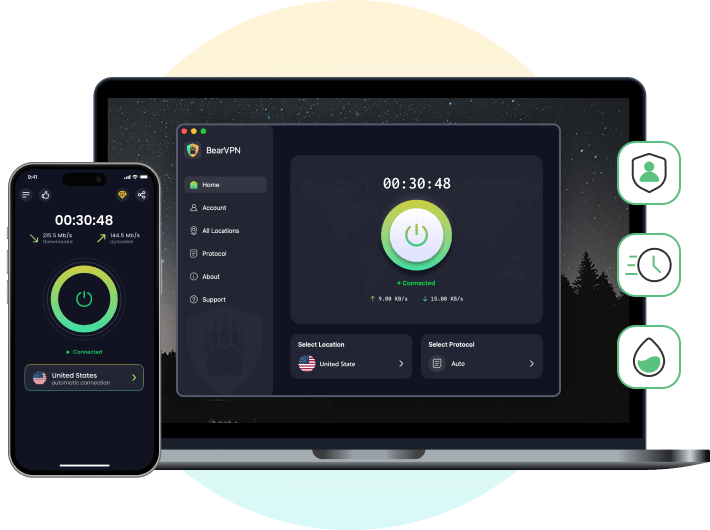
If you want your Google Chrome or Microsoft Edge browsing to be truly undetectable, the safest method is not to use an extension at all. This is why BearVPN intentionally skips flawed browser plugins and exclusively offers a highly secure, system-wide native client for Windows and macOS.
By running BearVPN’s desktop application in the background, you wrap your entire operating system—including all your browsers—in an unbreakable, RAM-only cryptographic tunnel. Featuring advanced obfuscation and a system-level Kill Switch, BearVPN easily defeats Deep Packet Inspection (DPI) without the vulnerabilities of a standard Chrome proxy.
Don’t risk a browser leak. Secure your entire digital footprint with a native client.
Stop relying on leaky browser extensions. BearVPN’s native desktop client encrypts your entire system, bypasses aggressive DPI firewalls, and makes your online traffic 100% undetectable.
- Advanced SCProxy obfuscation to bypass strict network blocks.
- RAM-Only Infrastructure ensuring zero data footprint on physical storage.
- System-wide Kill Switch to protect your real IP address 24/7.
- Enterprise-grade AES-256 encryption with a strict no-logs policy.
Top 5 Undetectable VPN Extensions For Chrome and Edge (2026 Comparison)
If you understand the inherent limitations of browser proxies and still prefer the lightweight convenience of a Chrome extension, you must choose a provider with robust built-in leak protection.
Here are the top 5 true browser extensions available in 2026:
1. Windscribe: The Feature-Rich Underdog

Windscribe is a highly respected technical tool favored by power users due to its advanced proxy capabilities and generous entry-level plans.
- Pros: Features robust “Stealth” and “WStunnel” protocols specifically engineered to bypass aggressive network firewalls. Their Chrome extension is highly customizable, offering built-in ad-blocking (R.O.B.E.R.T.) and advanced location-spoofing capabilities.
- Cons: Speeds on the free tier can be highly inconsistent due to server congestion, and the interface can feel overwhelming for non-technical users.
- The Verdict: An excellent, technical extension for bypassing strict networks, provided you have the patience to configure its advanced settings.
2. Mullvad: Privacy Absolutists

Mullvad operates on a philosophy of absolute anonymity. They offer highly secure apps across all platforms, including a specialized browser extension focused purely on anti-tracking.
- Pros: You do not even need an email address to register—accounts are generated via a random 16-digit number. The extension aggressively blocks trackers, WebRTC leaks, and fingerprinting scripts.
- Cons: Mullvad refuses to play the “cat-and-mouse” game with streaming platforms. If you are looking to bypass Netflix or Hulu geo-blocks via Chrome, Mullvad is not optimized for streaming access.
- The Verdict: The undisputed champion for journalists and privacy purists, but not the right tool for streaming entertainment.
Mullvad is a fantastic undetectable VPN extension choice for privacy enthusiasts who want to stay completely anonymous on Chrome. Its focus on privacy is unparalleled, and the flat pricing is straightforward and fair. However, the lack of mobile apps and limited features might be a downside for some users.
3. Surfshark: The Lightweight Streaming Proxy
Surfshark offers one of the most polished and reliable Chrome extensions on the market, specifically tailored for users looking to bypass streaming geo-blocks.
- Pros: The extension features a clean, intuitive interface with a built-in “CleanWeb” tool to block malicious ads and phishing attempts. It consistently bypasses VPN detection on major streaming sites directly from the browser.
- Cons: The extension requires a paid subscription to function, and it does not offer the same heavy-duty obfuscation options found in their native desktop app.
- The Verdict: A fantastic, user-friendly extension for media streaming and lightweight browsing, though it lacks the absolute stealth required for heavy censorship evasion.
4. IVPN: Open-Source Transparency

IVPN is a highly transparent, open-source provider that prioritizes speed, security audits, and a strictly enforced no-logs policy.
- Pros: Their browser extension integrates seamlessly with their privacy-first network. They offer an advanced Multi-Hop feature, routing your traffic through two separate international jurisdictions for untraceable browsing.
- Cons: They maintain a much smaller global server fleet compared to competitors and do not offer a free tier.
- The Verdict: A premium, hyper-secure option for users who demand open-source architecture and independently audited privacy claims.
5. ProtonVPN: The Swiss Vault

Developed by the scientists behind ProtonMail, ProtonVPN brings strict Swiss privacy laws directly to your Chrome browser.
- Pros: The extension connects to their “Secure Core” architecture, which routes traffic through privacy-friendly countries before hitting your final destination, providing an excellent layer of operational security.
- Cons: The browser extension is generally reserved for paid subscribers; free-tier users must rely on the desktop app and suffer from artificially limited server options.
- The Verdict: A formidable, highly secure ecosystem for users already invested in the Proton privacy suite.
The Bottom Line: Extensions vs. Native Clients
If you are trying to stay under the radar on school Wi-Fi, bypass corporate firewalls, or stream geo-restricted content securely, a standard Chrome extension is merely a band-aid. Because browsers handle complex scripts (like WebRTC, HTML5 geolocation, and DNS resolution), an extension alone can easily leak your true identity to sophisticated detection algorithms.
To achieve a truly undetectable digital footprint, you must pair the convenience of a browser extension with the cryptographic lockdown of a native client. By choosing a provider like BearVPN, you secure your entire operating system with RAM-only servers, impenetrable AES-256 encryption, and advanced stealth obfuscation. Stop settling for easily blocked proxies—upgrade your OPSEC and take absolute control of your privacy today.
FAQs About Undetectable VPN Chrome Extensions
A standard VPN simply changes your IP address, leaving behind a recognizable digital handshake. An “undetectable” VPN utilizes advanced obfuscation (such as SCProxy or Stealth VPN protocols) to strip away this handshake, disguising your encrypted data as ordinary, randomized HTTPS web traffic.
Not always. Browser extensions operate as proxies, meaning they only encrypt the traffic within that specific browser. Furthermore, browsers are prone to WebRTC leaks, which can expose your real IP. For absolute security, you should run a native desktop VPN client (which includes a system-wide Kill Switch) alongside your browser extension.
Streaming giants use massive databases of known commercial IP addresses. If thousands of users access a platform from the same VPN data center IP, the platform flags and blacklists it. Premium undetectable VPNs constantly refresh their IP pools and use obfuscation to bypass these aggressive proxy-blocking scripts.
In most cases, no. Maintaining stealth server infrastructure is incredibly expensive. “Free” extensions often offset their costs by quietly harvesting your browsing data and selling it to third-party marketing brokers. Always use reputable, paid services, or the verified free tiers of premium providers like BearVPN or ProtonVPN.
Yes, slightly. Because obfuscation requires an additional layer of cryptographic wrapping to hide the VPN handshake, it introduces minor processing overhead. However, on premium bare-metal networks, this speed reduction is generally unnoticeable and will not impact HD streaming or standard browsing.