Key Takeaway
- Many schools, workplaces, and public networks block popular music apps like Spotify and Apple Music, but plenty of alternatives remain accessible.
- Browser-based platforms like SoundCloud, TuneIn, and AccuRadio are often unblocked because they’re categorized as radio or community sites rather than entertainment apps.
- When you want your preferred streaming service unblocked — not just a workaround — a VPN is the most reliable solution.
- BearVPN offers a genuinely free mobile tier with no registration required, making it one of the easiest ways to unblock any music service instantly.
- Geo-restrictions lock certain music libraries to specific countries, but a VPN lets you access your full catalog wherever you are.
- VPN use is legal in most countries for personal privacy and accessing geo-restricted content, though it may go against your school or workplace’s acceptable use policy.
You’re studying for an exam, grinding through a work shift, or sitting in an airport lounge — and the one thing that would make it bearable is your playlist. Then you open Spotify and get nothing. A blank screen. Blocked. It’s a frustratingly common situation, and it affects millions of people every day. The good news is that you have real options, whether that means finding unblocked music websites that slip past filters entirely or using a VPN to unlock the streaming service you actually want.
Why Music Streaming Sites Get Blocked
Most people assume their favorite apps are blocked because someone at IT has a grudge against good taste. The reality is a bit more technical — and understanding it helps you work around it more effectively.
Network-Based Restrictions at School and Work
Schools and workplaces use content-filtering software that categorizes websites and apps by type. Platforms like Spotify, Apple Music, and YouTube Music get flagged as high-bandwidth entertainment and blocked automatically — often without anyone manually reviewing them. The same filters apply whether you’re on a school Chromebook, office Wi-Fi, or a campus library network. These restrictions aren’t personal; they’re policy-level decisions designed to conserve bandwidth and reduce distractions.
The practical result is that even the Spotify web player gets blocked alongside the app, which catches a lot of people off guard. If the domain is on the filter list, it doesn’t matter how you’re trying to access it.
Geo-Restrictions and Regional Content Locks
A different kind of blocking happens when you travel or move to a new country. Music licensing agreements mean that streaming catalogs vary significantly by region. Spotify’s library in Japan includes exclusive J-pop releases that don’t exist in other markets; SoundCloud content availability shifts depending on where your IP address is located. When you connect from a different country, the platform may either restrict your access entirely or serve you a reduced library — even if you have an active paid subscription.
Best Music Websites That Are Usually Unblocked
The platforms below tend to stay accessible on restricted networks because they’re categorized differently from mainstream streaming apps — as radio services, community platforms, or educational resources. None of them requires you to do anything special to access them; just open a browser.
SoundCloud is one of the largest audio platforms in the world, built around independent creators, DJ mixes, remixes, and emerging artists. Its web player works smoothly on most restricted networks because it’s categorized more as a social platform than a streaming service. The free tier is generous, though popular tracks occasionally require a paid plan.
TuneIn gives you access to over 100,000 live radio stations from around the world. Because it’s primarily classified as a news and information service, it rarely gets caught in entertainment filters. It’s genuinely useful for live sports, international stations, and talk radio — and for casual music listening when your usual apps are off the table.
AccuRadio is a human-curated internet radio service with nearly 1,000 channels spanning genres from 1950s jazz to modern synthwave. It’s completely free, requires no login, and allows unlimited song skips — which puts it ahead of standard radio. Office workers and students tend to find it one of the most reliable unblocked options.
Jamendo focuses exclusively on independent artists releasing music under Creative Commons licenses. Because it’s categorized as a creative community rather than an entertainment platform, it often bypasses school and corporate filters entirely. The full catalog of over 600,000 tracks is free to stream and download for personal use.
Audiomack specializes in hip-hop, R&B, and electronic music, with a strong focus on trending releases and mixtapes. It offers both a web player and mobile apps, and its indie-driven nature means it doesn’t appear on most standard blocklists. The free tier is quite open, with ads.
Free Music Archive (FMA) is a nonprofit repository of royalty-free and Creative Commons music. It was built for exactly this kind of situation — legally free, browser-accessible, and carrying almost no risk of being blocked. It’s not where you’ll find chart hits, but for focus music, instrumentals, or genre exploration, it’s excellent.
YouTube Music (web) is worth a mention because the web version occasionally slips through filters that block the app. Results vary by network configuration, but if YouTube itself isn’t blocked on your network, the music player often works by default.
When You Want Spotify or Apple Music — Use a VPN
Browser-based alternatives are great for getting through the day, but they’re not the same as having access to your actual playlists, your liked songs, and your curated recommendations. If you want your preferred service back — not a substitute — a VPN is the most effective solution.
How a VPN Bypasses Music Blocks
A VPN works by routing your internet traffic through a server in another location and masking your real IP address. To your school or office network, your connection looks like ordinary encrypted traffic rather than a request to a blocked streaming domain. To the music platform, your traffic appears to come from wherever the VPN server is located — which means geo-restrictions tied to your physical location no longer apply.
The key is that both types of blocking — network filters and regional locks — are based on your IP address and connection behavior. A VPN addresses both at once.
A Free VPN That Doesn’t Compromise on Speed – BearVPN
If you’ve ever tried a free VPN before, you probably know the frustration: data caps that run out mid-playlist, speeds too slow to stream without buffering, or a signup process that defeats the whole point of a quick fix. BearVPN is built differently — and for music streaming specifically, the differences matter.
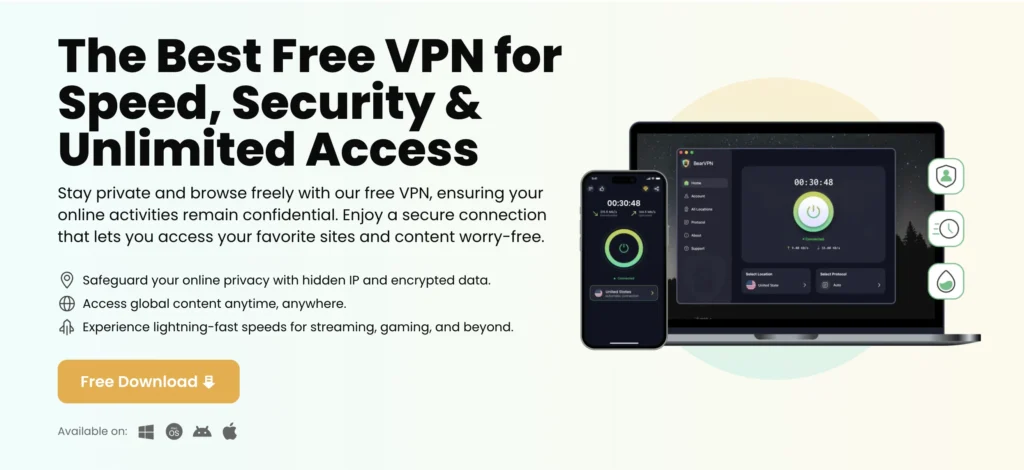
On mobile, BearVPN is completely free with no registration required. You download it, tap connect, and your music app works again. That’s it. Here’s why it holds up specifically for the music unblocking use case:
- No data caps on mobile — music streaming eats through data quickly, and a VPN with a daily or monthly cap will cut out before your commute ends. BearVPN’s free mobile tier has no limits.
- Obfuscated servers — school and office networks sometimes actively detect and block VPN traffic. BearVPN disguises your connection as ordinary browsing, so it keeps working even on networks with strict filtering.
- Smart server recommendation — you don’t have to figure out which server location to pick. BearVPN automatically connects you to the fastest available option, which means less buffering and fewer dropped connections mid-song.
- Kill switch — if your VPN connection drops for any reason, BearVPN cuts your internet immediately rather than letting your real IP slip through. Your session stays private even on unstable school or public Wi-Fi.
- Split tunneling — want BearVPN running for Spotify but not slowing down everything else? Split tunneling lets you route only your music app through the VPN, keeping your other tabs at full speed.
- No-logs policy — BearVPN doesn’t record or store your browsing activity, so your listening habits stay private.
Desktop users on Windows or macOS can access the full Premium feature set, including manual server selection — useful if you want to unlock a specific regional music library, like accessing Spotify’s full US catalog while traveling abroad.
How to Unblock Music Streaming at School or Work
Once BearVPN is installed, getting your music back takes about thirty seconds:
- Download BearVPN — free on iOS and Android, no account needed.
- Tap connect. Smart Recommendation picks the best server automatically — no settings to fiddle with.
- Open your music app or web player — Spotify, Apple Music, YouTube Music, or whichever service you use.
- Start listening. Your traffic is now encrypted, your IP is masked, and the network filter can no longer identify it as a streaming request.
If a geo-restriction is the problem rather than a network block, select a server in the country where your music library is based — your full regional catalog comes right back.
What to Look for in a Music Streaming Service
With so many options available — both unblocked alternatives and mainstream services accessible via VPN — it helps to know what actually distinguishes one platform from another.
Catalog size matters most if you listen across genres or follow specific artists. Spotify and Apple Music both carry libraries of over 100 million tracks. Niche platforms like Jamendo or FMA offer far less mainstream content but far more creative freedom.
Audio quality is the deciding factor for serious listeners. Apple Music and Tidal offer lossless and hi-res audio tiers that outperform standard streaming quality. Spotify added lossless streaming in 2025, though at a lower resolution ceiling than its competitors.
Free tier generosity varies widely. SoundCloud, Audiomack, AccuRadio, and Jamendo all offer substantial free access. Spotify’s free tier includes ads and some restrictions on shuffle and skips. Apple Music has no meaningful free tier.
Cross-device compatibility is worth checking if you move between a phone, a laptop, and a smart speaker. Most major platforms support all four of BearVPN’s compatible platforms — Android, iOS, Windows, and macOS — which means you can stay protected across devices without juggling multiple accounts.
Conclusion
Music access shouldn’t depend on which Wi-Fi network you happen to be on. For quick, hassle-free listening on restricted networks, the browser-based platforms in this guide — SoundCloud, TuneIn, AccuRadio, and others — offer solid alternatives that typically bypass standard content filters. But when you want the real thing — your playlists, your library, your recommendations — a VPN gives you back full access without compromise. BearVPN makes that easy: free on mobile, no signup, and built to handle the kind of network environments that block everything else.
Ready to get your music back? Download BearVPN free on iOS or Android — no registration needed, no strings attached.
FAQs
1. What is the best free music site that works at school?
AccuRadio and TuneIn are among the most reliably unblocked options at school because they’re categorized as radio services rather than entertainment apps. SoundCloud is also frequently accessible. If none of these work on your network, using BearVPN on your phone gives you access to any streaming service you prefer.
2. Can I use Spotify at school without getting caught?
Using a VPN on your personal device to access Spotify doesn’t usually trigger any visible alerts for school IT staff — your traffic appears as encrypted data, not a request to a blocked domain. That said, using a VPN may go against your school’s acceptable use policy, so it’s worth being aware of that. There’s no legal issue with using a VPN for this purpose in most countries.
3. Does a VPN slow down music streaming?
A small reduction in speed is normal with any VPN, but a well-optimized one has a minimal impact. BearVPN’s server network is built for streaming and gaming performance, so in most cases, audio streaming runs without any noticeable buffering or quality drop. Connecting to a geographically closer server helps keep speeds high.
4. Is it legal to use a VPN to unblock music?
In most countries — including the US, UK, Canada, and Australia — using a VPN is entirely legal. If you’re bypassing a geo-restriction, you may technically be going against the streaming platform’s terms of service, which could result in an account warning in rare cases, but it’s not a criminal matter. Using a VPN on a school or work network may violate their usage policy, even if it’s legal, so use your own judgment.
5. Does BearVPN work on school Wi-Fi?
BearVPN’s obfuscated servers are specifically designed to disguise VPN traffic as regular internet activity, which helps it function on networks that actively try to detect and block VPN connections. Running BearVPN on your personal mobile device rather than a school-managed device is the most straightforward approach.