Key Takeaways
Instagram is no longer “globally accessible by default.” As of 2026, the platform faces a fragmented reality shaped by three distinct forces:
- Total or functional bans in countries like Russia and North Korea are driven by political control and data sovereignty,
- Heavy censorship and intermittent blocking in regions such as Iran, and
- A new wave of age-based restrictions in democratic nations like Australia and France focused on child safety and mental health.
As of early 2026, Instagram remains one of the most influential social media platforms globally, boasting over 2.5 billion active monthly users. However, its journey has not been without significant roadblocks. In recent years, the landscape of social media access has shifted from a binary “available or blocked” state to a complex web of geopolitical censorship, age-based restrictions, and administrative compliance orders.
From the “Great Firewall” in the East to the pioneering child-safety bans in the West, the reasons for restricting Instagram vary as much as the countries themselves. Whether you are a digital nomad, a business owner targeting international markets, or a traveler, understanding where and why Instagram is banned is crucial for staying connected.
Global Instagram Restriction Status (2026)
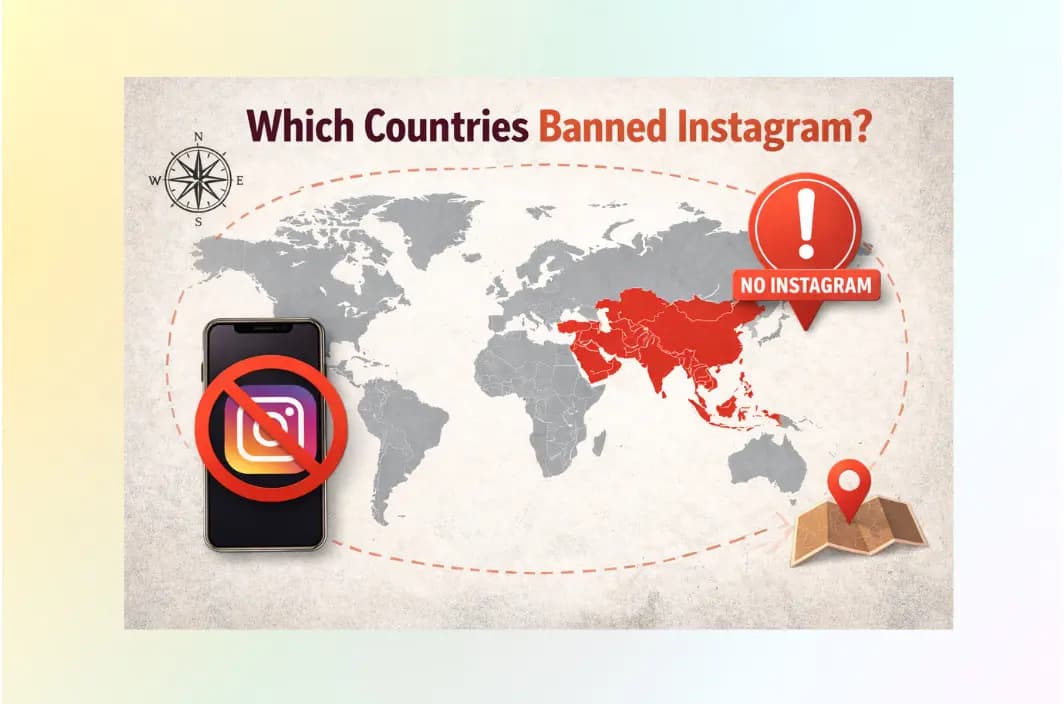
The following table outlines the status of Instagram access across various regions where the platform currently faces significant legal or technical barriers.
| Country/Region | Restriction Type | Timeline | 2026 Current Status |
| Russia | Functional ban | Since 2022 | Instagram is blocked as Russia designates Meta platforms as extremist and restricts access; enforcement continues in 2026. |
| North Korea | Permanent ban | Long-term | Social media platforms are inaccessible under a closed intranet system; ordinary citizens cannot access Instagram. (The Times of India) |
| Turkmenistan | Permanent ban | Long-term | Almost all Western social media, including Instagram, are blocked under strict internet censorship. (newspointapp.com) |
| Iran | Heavily restricted / periodic blocking | Especially since 2022 | Instagram and other social platforms are heavily censored and intermittently blocked by Iranian authorities, with limited white-list exceptions. |
| Australia | Age-based restriction (under 16) | Dec 2025 | From December 2025, social platforms must block account access for users under 16 under child safety laws. |
| France | Planned age-based restriction (under 15) | Expected 2026 | A new law proposes banning social media access for under-15s starting the 2026 academic year, but full implementation is pending legislation. |
| Nepal | Temporary block (2025), now restored | 2025 | Instagram was briefly blocked during a regulatory enforcement action in 2025, but access has since been restored after protests. (The Times of India) |
Detailed Analysis: Why Countries Ban Instagram
The motivations behind blocking a platform as popular as Instagram are rarely singular. Governments often balance national security with cultural preservation or political stability.
1. The Total Blockade: Russia and Iran
Russia: The “Extremist” Designation
Following the events of 2022, a Moscow court officially designated Meta (Instagram’s parent company) as an “extremist organization.” The ban was a direct response to Meta’s temporary policy changes regarding political speech during the conflict in Ukraine. In 2026, using Instagram in Russia remains technically possible via workarounds, but the government has recently cracked down on “intermediary services” that facilitate account verification, treating them as financiers of extremist activity.
Related Article: Blocked Websites in Russia: The Complete Access & Safety Guide >
Iran: The Struggle for Digital Control
Instagram was the last major Western social media platform to remain accessible in Iran until the protests in late 2022. Since then, the government has maintained a strict block, citing “national security” and “protection of moral values.” While there were reports of a temporary lifting of the ban in mid-2025 during diplomatic negotiations, the platform remains largely inaccessible to the general public without specialized tools.
2. The New Wave: Age-Based Bans (Australia & France)
The years 2025 and 2026 have ushered in a new era of “Social Media Protectionism.” Unlike the ideological bans in the East, these restrictions are framed as public health initiatives.
- Australia (December 2025): The Australian government passed landmark legislation prohibiting children under 16 from owning social media accounts. Instagram is a primary target of this law, which requires platforms to implement robust eKYC (Electronic Know Your Customer) age verification.
- France (September 2026): Following the Australian model, France is implementing a ban for those under 15, coinciding with the 2026 academic year. The French government cites rising rates of cyberbullying and the “addictive nature” of the Instagram algorithm as primary drivers for this policy.
What Are the Reasons for Banning Instagram?
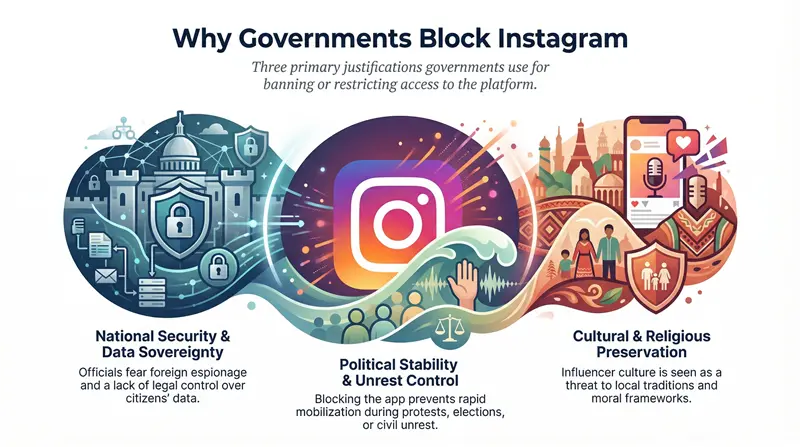
Why would a government risk the public backlash of banning a beloved app? The reasons generally fall into four categories:
National Security & Data Sovereignty
Governments often fear that foreign-owned platforms could be used for espionage or that the data of their citizens is being stored in jurisdictions beyond their legal reach. India’s ban on dozens of apps (though not Instagram yet) sets a precedent that other nations are closely watching.
Political Stability
In many regions, Instagram is a powerful tool for organizing grassroots movements. Its visual nature allows for the rapid spread of symbols and slogans that can bypass traditional text-based censors. To prevent civil unrest, governments may “pull the plug” during elections or protests.
Cultural and Religious Values
In countries with conservative social structures, the “influencer culture” of Instagram—often showcasing luxury, Western fashion, and liberal lifestyles—is seen as a threat to local traditions. Turkmenistan and Afghanistan have cited “morality” as a key factor in their digital restrictions.
Mental Health and Youth Safety
This is the fastest-growing reason for restrictions in democratic nations. Concerns over “Instagram Face” (dysmorphia caused by filters), the impact of likes on self-esteem, and the exposure of minors to predatory behavior have led to the 2025-2026 surge in age-gating legislation.
The Impact of Instagram Bans
When a country bans a platform as central to modern life as Instagram, the ripple effects are profound.
- Economic Disruption for Influencers and Small Businesses: In 2025, the global influencer marketing industry was valued at over $33 billion. A sudden ban in a country like Russia or Iran immediately severs the income of thousands of content creators. Small businesses that rely on Instagram Shops or the visual discovery of “Reels” often see a 30-50% drop in lead generation following a ban.
- Social Isolation and Information Silos: Bans prevent the cross-pollination of ideas. Users are forced into domestic “echo chambers,” making it easier for governments to control the flow of news and information.
- The Rise of Domestic Alternatives: Bans often act as a form of protectionism. In Russia, Rossgram attempted to fill the void, while in other restricted markets, locally developed platforms have combined social networking, short-form video, and e-commerce into tightly controlled ecosystems that operate under domestic regulatory frameworks and are increasingly influencing global platform design.
Solutions for Accessing Instagram in a Restricted Area
For those living in or traveling to countries where Instagram is banned, maintaining access is a matter of both personal freedom and business necessity.
Disclaimer: Laws and regulations regarding VPN usage vary by country. Before using a VPN to access Instagram or other restricted platforms, users should familiarize themselves with applicable local laws and compliance requirements. In some jurisdictions, bypassing state-mandated firewalls or access controls may result in legal penalties.
Using a Reliable VPN (like BearVPN)
A Virtual Private Network (VPN) remains the most widely used solution for navigating geographic restrictions. By encrypting internet traffic and routing it through servers located in other countries (such as Singapore, Japan, or the United States), a VPN can restore access to platforms that are otherwise unavailable locally.
BearVPN is designed for users who need a simple, fast, and privacy-focused solution, particularly in regions with content restrictions.
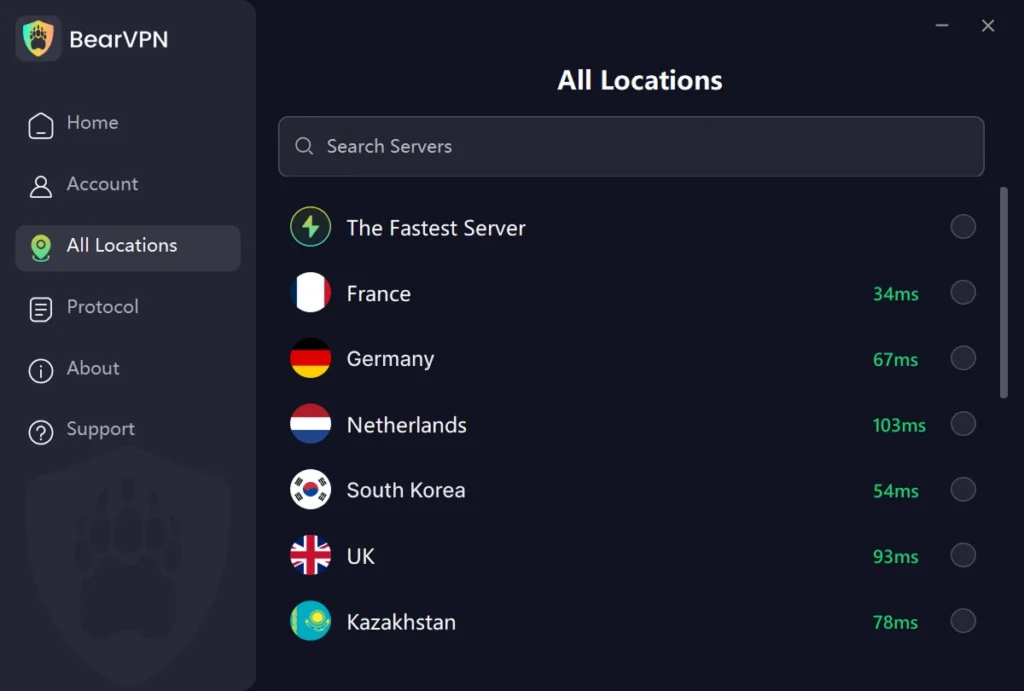
With BearVPN, users can:
- Switch IP addresses with one click: BearVPN offers an intuitive interface that allows users to change their virtual location instantly—no technical configuration required.
- Access a global server network: With 2000+ servers across 50+ regions, users can choose stable, high-speed routes optimized for social media access, streaming, and general browsing.
- Encrypt all internet traffic: Industry-grade encryption helps protect data from local ISPs, public Wi-Fi monitoring, and network surveillance, especially in high-risk regions.
- Browse without data limits: Unlimited bandwidth ensures uninterrupted access without sudden slowdowns or usage caps—particularly important for creators and remote workers.
- Protect privacy with a strict no-logs policy: BearVPN does not record browsing activity, helping users maintain anonymity while navigating restricted or monitored networks.
BearVPN supports Windows, macOS, iOS, and Android, making it suitable for both desktop workflows and mobile use while traveling.
Conclusion
The “splinternet”—the fragmenting of the global internet into regional zones—is no longer a theoretical concept; in 2026, it is a reality. Instagram, as a symbol of globalized social culture, often finds itself at the center of these digital border disputes. Whether the reasons are political, moral, or related to the protection of children, the trend toward more restrictions is clear.
For those who rely on Instagram for their livelihood or social connections, staying informed and using tools like BearVPN is essential to navigate this increasingly restricted digital landscape.
FAQs About Instagram Bans
- Is Instagram banned in Iran in 2026?
Yes, Instagram remains officially blocked in Iran. While access is occasionally eased during specific political windows, the general population must use VPNs or other circumvention tools to access the platform.
- Is Instagram banned in Russia?
Instagram is officially banned in Russia and Meta is designated as an extremist organization. While individual users are generally not prosecuted for simply browsing the app, any form of advertising or “funding” (like paying for Meta Verified) can carry legal risks.
- Which countries have completely banned Instagram?
Countries with long-term or near-total Instagram bans include North Korea, Turkmenistan, and Russia. These bans are typically enforced through nationwide internet censorship systems or legal prohibitions tied to national security and information control.
- Is it illegal to use a VPN to access Instagram?
VPN legality depends entirely on the country. In places like Iran and Russia, using unapproved VPNs to bypass state-imposed restrictions may violate local regulations, though enforcement against individuals varies. In countries such as Australia or France, VPN use itself is legal, but using it to bypass age-based restrictions could result in penalties for the platform rather than the user.
- Can travelers or digital nomads safely access Instagram in countries with internet restrictions?
It depends on local laws and enforcement practices. Many travelers rely on VPNs to access Instagram for personal or business use, but regulations differ widely. Before attempting to bypass restrictions, travelers should understand the legal risks and comply with local internet and cybersecurity laws.
References and Sources:
- Standardizing Online Safety: The 2025 Australia Social Media Act Report.
- Digital Freedom Index: IranWire 2025/2026 Annual Review.
- The Times of India: Nepal’s New Regulatory Framework for Social Platforms.