If you are currently in Russia and staring at a YouTube video that simply refuses to load, you are not alone.
Millions of users across the country are asking the same question: “Is YouTube officially banned in Russia?”
The confusion is understandable. Unlike Instagram or Facebook, which display an immediate “Access Denied” error message, YouTube often looks like it is working. The homepage loads, search results appear, and comments might even update. But the moment you click “Play,” you are met with an endless spinning wheel, buffering at 144p quality, or a black screen.
Here is the short answer: Technically, YouTube is not banned. Practically, it is blocked.
As of late 2025, Russian authorities have implemented severe “throttling” measures that reduce connection speeds to YouTube to near-zero. This makes the platform effectively unusable for video streaming without specialized tools.
In this comprehensive guide, we will explain exactly what is happening to YouTube traffic in Russia, why mobile and desktop experiences differ, the legal implications of watching content, and—most importantly—how you can use BearVPN to bypass these speed limits and watch in 4K immediately.
What is Actually Happening? Blocked vs. Throttled
To understand how to fix the problem, you must first understand the mechanism being used against you.
The “Slowdown” Strategy
In previous years, when Roskomnadzor (the Russian federal agency for censorship) wanted to block a site, they issued a “Hard Block.” This meant adding the website’s IP addresses to a blacklist. ISPs (Internet Service Providers) would then cut the connection entirely.
With YouTube, the strategy is different. Instead of a hard block, authorities are using Traffic Shaping or Throttling.
Using specialized hardware installed at the ISP level—known as TSPU (Technical Means for Countering Threats)—the government can identify data packets coming from YouTube (https://www.google.com/search?q=googlevideo.com). Instead of blocking them, the hardware artificially delays them.
- Normal Speed: 100 Mbps (enough for 4K video).
- Throttled Speed: Capped at ~128 kbps (barely enough for low-quality audio, let alone video).
This allows the government to claim that “YouTube is not banned” while simultaneously making the user experience so miserable that people give up and switch to domestic alternatives.
The “Google Global Cache” Myth
You may have read news reports blaming “Google Global Cache” (GGC) servers. Russian officials have frequently claimed that the slowdown is due to Google’s hardware in Russia degrading and not being updated due to sanctions.
While it is true that Google has stopped supplying new servers to Russia, independent technical analysis confirms that the slowdown is artificial.
- The degradation happened too suddenly to be natural hardware failure.
- Traffic routes are being manipulated at the ISP level.
- When users turn on a VPN, the speed instantly returns to normal—proving that the “pipes” are fine, but the direct route is being choked.
Mobile vs. Desktop: Why the Experience is Inconsistent
One of the most confusing aspects of the YouTube crackdown in 2025 is the inconsistency. You might find that YouTube works okay on your smartphone when you are out walking, but stops working the moment you connect to your home WiFi.
The Desktop “Dead Zone”
Desktop browsers (Chrome, Yandex Browser, Opera) are the primary target of the throttling.
- Deep Packet Inspection (DPI): Desktop traffic is easier to analyze and filter.
- Impact: On most major Russian broadband providers (Rostelecom, MTS, Beeline), desktop YouTube traffic is slowed down by up to 70-90%.
- Result: Desktop users were the first to lose access to High Definition (HD) playback.
The Mobile Anomaly
For a long time, mobile apps (Android and iOS) remained relatively untouched. This is partly because mobile traffic routing is more dynamic and harder to filter without disrupting other critical services (like Google Play Services or Push Notifications).
However, as of late 2024 and throughout 2025, the “squeeze” has moved to mobile.
- WiFi: If your phone is connected to home WiFi, it is subject to the same throttling as your PC.
- Mobile Data (4G/5G): While cellular networks were the last safe haven, users are now reporting massive packet loss on mobile data in major cities like Moscow and St. Petersburg.
Relying on mobile data is no longer a sustainable fix. The throttling is becoming universal.
Is it Legal to Watch YouTube in Russia in 2025?
This is the most common fear stopping users from seeking a solution. With laws regarding “Foreign Agents” and “Extremist Organizations” tightening, users are rightfully worried.
Watching vs. Participating
Current Russian legislation distinguishes between consuming content and participating in banned organizations.
- Meta (Facebook/Instagram): Designated as “extremist organizations.” Even displaying their logos can be legally risky for businesses.
- YouTube: As of now, YouTube itself has not been designated as an “extremist” platform, despite holding content that the government disapproves of.
Simply watching YouTube videos for personal entertainment, education, or news is not illegal. There is no penalty for a private citizen viewing content on the platform.
Is Using a VPN Legal?
Russia has blocked the websites of many VPN providers, and they actively block VPN protocols. However, the act of using a VPN for personal purposes (to secure your data or access content) remains a legal grey area that is not currently criminalized for the individual user.
The government fights the tools (by blocking their servers), not the users.
How to Unblock YouTube with BearVPN
If the problem is that your ISP sees “YouTube Traffic” and slows it down, the solution is to hide the nature of your traffic.
This is where BearVPN comes in. Unlike standard proxies or basic VPNs that often get detected and blocked, BearVPN is designed specifically for high-censorship environments like Russia.
Why BearVPN Works When Others Fail
- Encryption: BearVPN wraps your data in military-grade encryption. Your ISP can no longer see that you are requesting a video from YouTube. They only see a stream of gibberish code. Since they can’t identify it as YouTube, they don’t apply the throttle.
- Obfuscation (Stealth Mode): Sophisticated Russian firewalls try to block VPNs by looking for “VPN signatures.” BearVPN uses advanced obfuscation to make your VPN traffic look like regular HTTPS web browsing (the same traffic used for online banking or shopping). This allows it to slip past the DPI filters unnoticed.
Step-by-Step Guide: Restoring 4K Speed
Step 1: Download BearVPN
Download BearVPN on your devices. It is available on Android, iOS, Windows, and macOS.
Add the download button here.
Note for Android Users: The Google Play Store in Russia is heavily restricted. It is best to download the .APK file directly from the official BearVPN website.
Step 2: Install and Launch
Open the app. You do not need complex technical knowledge. BearVPN is designed for “One-Click” protection.
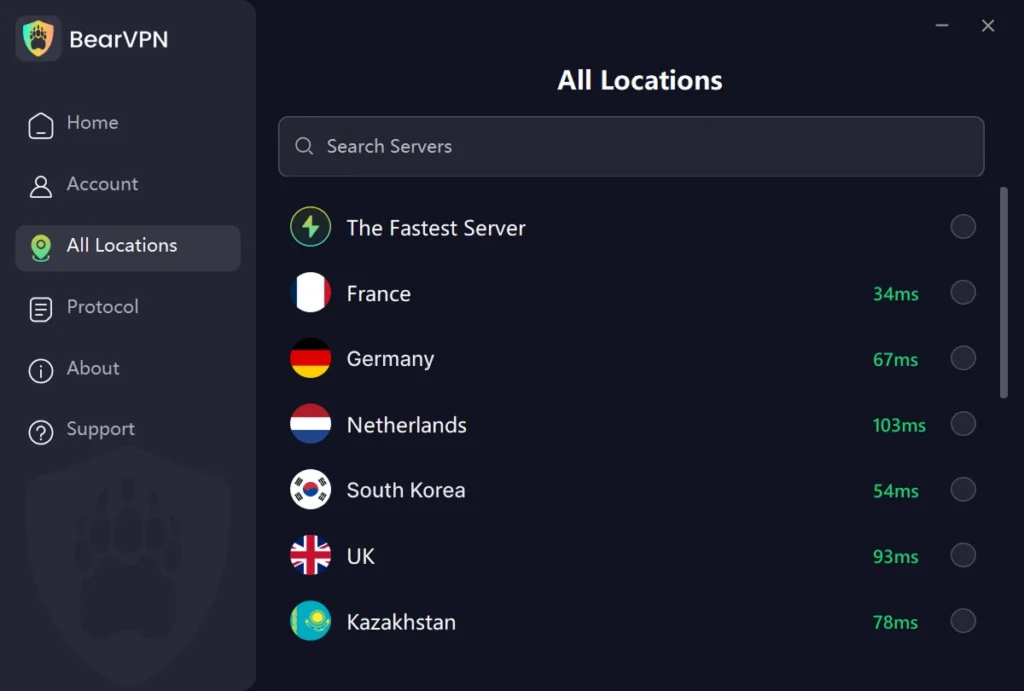
Step 3: Choose the Right Server (Crucial!)
Distance matters for video speed. You want a server that is physically close to Russia but located in a country with free internet. Best Options: Finland, Estonia, Latvia, or Poland.
These countries border Russia. The data travels a very short distance, ensuring your “Ping” (latency) remains low. This prevents the video from stuttering.
Alternative: If you just want it to work without thinking, select “Auto-Connect.” BearVPN will automatically find the fastest available server that is not blocked.
Step 4: Select “Stealth” or “UDP” Protocol
If the connection fails initially, go to Settings > Protocols.
- Try Stealth Mode (sometimes labeled as Obfuscated) first. This is the most effective against Russian firewalls.
- If that fails, try another protocol, SLProxy or SCProxy for maximum speed.
Step 5: Refresh YouTube
Go back to your browser or app and refresh the page. You should see the video load instantly. Change the quality settings to 1080p or 4K to confirm the throttle is gone.
Why “Free” Proxies & Browser Extensions Don’t Work Anymore
In 2022, you could easily bypass blocks using a simple Chrome extension or a free web proxy. In 2025, these methods are largely dead.
The Problem with Browser Extensions
Most “Unblock YouTube” browser extensions are simple HTTP proxies.
- No Encryption: They reroute your traffic, but they don’t encrypt it deeply enough.
- DPI Detection: The Russian DPI systems can “see inside” these proxy packets. They identify the YouTube video data and throttle it, regardless of the proxy.
- Privacy Risk: Many free extensions survive by selling your browsing data to advertisers. In a country with strict surveillance, giving your data to unknown third parties is risky.
The Problem with “GoodbyeDPI”
Tools like “GoodbyeDPI” (software that tries to confuse the DPI system without a VPN) were popular for a while. However, ISPs are constantly updating their filters to recognize and block GoodbyeDPI tricks. It is a constant cat-and-mouse game that requires you to be a programmer to keep up.
BearVPN handles this complexity for you. We update our servers and protocols daily to stay ahead of the blocks, so you don’t have to run command-line scripts just to watch a cooking video.
Comparison: YouTube vs. Domestic Alternatives (VK Video, RuTube)
The government is aggressively pushing users toward domestic platforms like VK Video and RuTube. You might be wondering, “Why not just switch?”
Here is why 80% of Russian users still prefer fighting to keep YouTube:
| Feature | YouTube | VK Video / RuTube |
| Content Library | Limitless global content, tutorials, educational archives, niche hobbies. | Mostly Russian state TV content, pirated movies, and reposts from YouTube. |
| Algorithm | Highly personalized; knows exactly what you want to watch. | Clunky recommendation engines; often suggest irrelevant political content. |
| Monetization | Creators can earn a living (via external sponsorships/patreon). | Very difficult for independent creators to monetize effectively. |
| Censorship | Moderate (removes illegal content, but allows political dissent). | Strict. Any criticism of the government is removed immediately. |
| User Interface | Smooth, intuitive, fast. | Often buggy, slow, and cluttered with unskippable domestic ads. |
The reality is that there is no replacement for YouTube. It is not just a video site; it is a global library of human knowledge. Losing access to it means being cut off from the rest of the world’s culture and information.
Troubleshooting: What to Do If YouTube Is Still Slow?
Even with a VPN, you might occasionally face issues due to the intense nature of the blocking. Here is a troubleshooting checklist for BearVPN users:
- Switch Servers
If the “Finland” server is slow, try “Sweden” or “Germany.” Sometimes specific server IP addresses get flagged and temporarily slowed down. We cycle our IPs regularly, so switching servers usually fixes it.
- Clear Your Browser Cache
Sometimes your browser “remembers” the blocked state.
- Chrome: Settings > Privacy and security > Clear browsing data (Cached images and files).
- App: Clear the cache of the YouTube app in your Android settings.
- Check Your Protocol
If you are using OpenVPN (TCP), switch to WireGuard or IKEv2. Different protocols use different ports. If the ISP is throttling a specific port, switching protocols bypasses it.
- Turn on “Kill Switch”
Ensure the BearVPN “Kill Switch” is ON. This prevents your real IP from leaking if the VPN connection drops for a microsecond. If your real IP leaks, the ISP sees YouTube activity and might apply the throttle again.
Conclusion
The throttling of YouTube is a deliberate attempt to control what information you can access and how you spend your time. But the internet was built to be free, and technology always finds a way around walls.
You do not have to suffer through 144p videos or endless buffering. You do not have to migrate to inferior platforms that censor what you see.
By using BearVPN, you are not just unblocking a website; you are reclaiming your digital freedom. You are ensuring that you can still watch your favorite creators, learn new skills, and stay connected to the global community—all in full HD speed.
Ready to bypass the throttle?
FAQs about YouTube are banned in Russia
Q: Can I pay for YouTube Premium in Russia?
A: No. Google has suspended all payment systems in Russia. You cannot pay for Premium using a Russian card. However, the good news is that Google has also disabled ads for viewers in Russia. If you watch without a VPN, you see no ads. If you watch with a VPN connected to (for example) the USA, you will see ads.
Pro Tip: Connect your VPN to a country like Albania or Moldova. These regions often have fewer ads on YouTube, giving you a near-Premium experience for free.
Q: Is there a free version of BearVPN?
A: Yes. BearVPN offers a robust Free Tier that allows access to basic servers.
Q: Will YouTube ever be fully unblocked?
A: It is unlikely in the near future. The trend in Russia is toward a “Sovereign Internet” (Cheburashka), isolating domestic traffic from the global web. The pressure on Western platforms will likely increase, not decrease. Having a reliable VPN is no longer a luxury—it is a necessity for keeping your internet open.