

In the early days of the internet, there was a silent agreement: the web was a place where you could be anyone, go anywhere, and see anything without showing a passport at every digital street corner. Bluesky, built on the revolutionary “AT Protocol,” was supposed to be a return to that dream—a decentralized home where users, not billionaires or governments, held the keys.
But as we move through 2025, that dream is hitting a very physical wall. If you are a Bluesky user in the UK, Australia, or certain parts of the United States, you’ve likely seen the “Gate.” It’s a sudden, jarring pop-up demanding your government-issued ID or a biometric face scan just to read your DMs or view a sensitive image.
What started as a tool for safety has turned into a digital checkpoint. This guide is not just about “how to bypass a pop-up.” It is a critical analysis of why these borders are being built, why “face scanning” is a privacy disaster waiting to happen, and how you can use advanced tools to restore the internet to its original, borderless state.
Disclaimer
This article is for educational purposes only and does not constitute legal advice. Users are responsible for complying with local laws and platform terms. Use the discussed tools and methods at your own risk.
The Geopolitical Context: Why Does My Internet Have a Border?
It is easy to blame Bluesky’s developers for these intrusive prompts, but the reality is more complex. In 2025, the internet is undergoing a process known as the “Splinternet,” where countries are carving out their own, self-regulated zones.
1. The UK’s Online Safety Act (The “De Facto” Border)
By July 2025, the UK’s regulator, Ofcom, stopped issuing “advice” and began imposing fines. Under the Online Safety Act, platforms like Bluesky must prove with “high confidence” that a user is over 18 before allowing them to access any “Class 2” content (which can include anything from political satire to adult art). If Bluesky doesn’t comply, it risks losing 10% of its global revenue. For a growing platform, that is a death sentence.

2. Australia’s Social Media Ban
In late 2025, Australia took the world’s most aggressive step: a total ban on social media for anyone under 16. To enforce this, they mandated a “hard gate.” If your internet connection shows you are in Sydney or Melbourne, the Bluesky app is legally required to stop you at the door and demand proof of age.
3. The US Patchwork
In the US, the federal government failed to pass a national law, so states took over. Virginia and Tennessee now require “commercially reasonable” verification. This has created a “Mississippi Effect,” where apps simply implement the most restrictive rules for everyone in those states to avoid lawsuits.
The Debate: Governments argue this is for “the safety of the children.” But we must ask: Is it logical to force 100% of adults to surrender their biometric data to protect the 1% of the population that is underage? This is like demanding every citizen wear a GPS tracker to prevent a few people from getting lost. It is a massive overreach disguised as a safety measure.
The Technical Anatomy: How the Gate “Sees” You
To beat the gate, you have to understand how it knows you’re there. Bluesky doesn’t actually know who you are; it only knows where you are.
The AppView-KWS-User Handshake
Most people use the official bsky.app client. When you log in, the app talks to a central server called the AppView.
- The IP Check: The AppView looks at your IP address (your digital home address). If it sees you are in a “regulated zone” (like London or Virginia), it flags your account.
- The KWS Redirect: Instead of your feed, it sends you to Kids Web Service (KWS)—a verification platform owned by Epic Games (the makers of Fortnite).
- The Token: Once you scan your face or ID, KWS sends a “digital token” back to Bluesky. Only then does the gate open.
The problem? You are now relying on a massive gaming corporation to act as the gatekeeper of your social media identity. If their servers are hacked, your “proof of age” (and the data attached to it) becomes public property.
The Biometric Fallacy: Why “Face Estimation” is a Privacy Trap
Verification companies like Yoti claim to be “privacy-first.” They say, “We don’t save your photo; we just use AI to estimate your age and then delete the image.”
This sounds safe, but logically, it is a trap. Here is why:
- The Mathematical “Face-print”
Even if they delete the JPEG of your face, the AI creates a mathematical map of your features—the distance between your eyes, the shape of your jaw. This “hash” is unique to you. In 2025, researchers found that these hashes can be used as a permanent “Identity ID.” If you scan your face for Bluesky today and for another app tomorrow, those two accounts can be linked in a database. You have lost your anonymity forever.
- Hidden Trackers
A 2025 audit of these verification tools found they often contain “trackers.” While they scan your face, they are also collecting your phone’s serial number, your battery level, and your Google Advertising ID. This creates a “digital fingerprint” that allows data brokers to know exactly who is behind that “anonymous” face scan.
- The Bias Problem
AI isn’t perfect. In late 2025, studies showed that “Face Estimation” often fails for people of certain ethnicities, either overestimating or underestimating their age. This creates a form of “Digital Exclusion,” where a legal adult is blocked from their community simply because an algorithm didn’t recognize their face correctly.
The 2025 Arms Race: Why Your Old VPN is Failing
A year ago, you could just turn on a cheap VPN, and the age gate would disappear. In 2025, that doesn’t work. Why? Because the age gates have become “VPN-aware.”
1. The “Datacenter” Problem
Most cheap VPNs use IP addresses from massive server warehouses. Verification systems have a “blacklist” of these addresses. If you try to log in from a known VPN server, the gate simply says: “Please disable your proxy to continue.”
2. Packet Inspection
Governments and big platforms now use Deep Packet Inspection (DPI). This is like a digital X-ray that looks at your internet traffic. Even if your data is encrypted, the shape of the data (the “handshake”) gives away that you are using a VPN.
3. The BearVPN Edge: SCProxy & SLProxy Architecture
The traditional method of using a VPN—just “hiding” behind an encrypted tunnel—is no longer sufficient in the tactical environment of 2025.
To detect traffic patterns associated with common VPN protocols, modern age-verification systems in the UK, Australia, and certain EU regions are increasingly relying on Deep Packet Inspection (DPI). Access is banned before the page even loads if an identifiable VPN fingerprint is found.
You require protocol-level disguise in addition to encryption to get past these gates.
This is where BearVPN‘s SLProxy and SCProxy architecture really shines.
Rather than exposing classic VPN handshakes, BearVPN routes traffic through stealth proxy-based transport layers that closely resemble normal HTTPS and residential browsing behavior. To DPI systems, the connection no longer resembles a VPN session — it appears as an ordinary user visiting a legitimate website.
Global Scale: 2,000+ Servers and 50+ Regions
A VPN is only as good as its network. If a service only has ten servers, regulators can easily blacklist them all in a single afternoon.
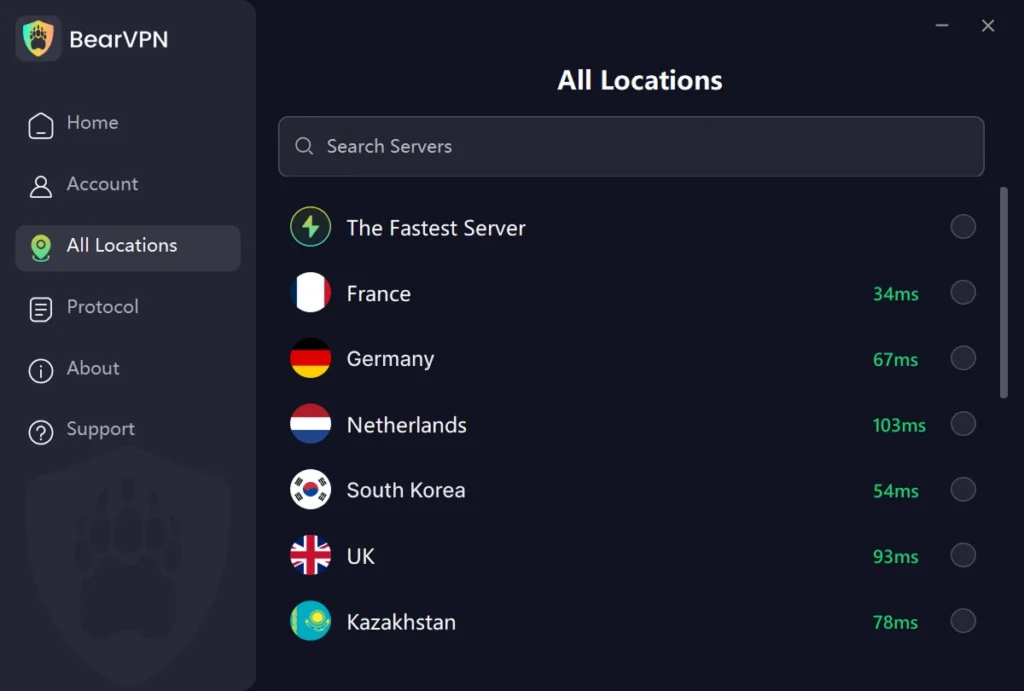
BearVPN counters this with a massive infrastructure of over 2,000 servers covering more than 50 regions worldwide. This scale provides two critical advantages:
- IP Reputation Management: Most of these servers are “High-Reputation” nodes. Unlike the “datacenter” IPs used by cheap services, BearVPN’s nodes in safe zones like Switzerland or Iceland carry a high “Trust Score.” To the Bluesky AppView, you don’t look like a guy in a server warehouse; you look like a legitimate resident sitting in a cafe in Geneva.
- Intelligent Routing: With Intelligent Routing Technology, the app automatically selects the fastest, least-congested path. This ensures that even with heavy encryption and obfuscation, you can stream video, download large files, or scroll through media-heavy Bluesky feeds without a single second of lag.
The “No-Log” Promise: Breaking the Data Chain
The biggest debate in 2025 is about the chain of evidence. If you verify your face on a platform, and that platform links to your IP address, your identity is compromised.
BearVPN’s core philosophy is Privacy Protection. By strictly adhering to a No-Log Policy, BearVPN ensures that your browsing activity is never recorded. Even if a government agency were to ask for your data, there is simply nothing to give. By breaking the link between your real identity and your digital presence, BearVPN provides a clean slate every time you connect.
Zero Friction: One-Click Protection for Every Device
Advanced technology shouldn’t require a computer science degree to use. In a world where age gates appear on your phone, tablet, and laptop, your protection needs to be universal.
BearVPN provides a One-Click Connection experience across all major platforms:
- iOS & Android: For the mobile-first Bluesky experience.
- Windows & macOS: For the desktop power users and developers.
With unlimited bandwidth and a simple, intuitive interface, the technical complexity happens entirely behind the scenes. You don’t have to worry about configuring protocols or managing MTU settings; you simply click “Connect,” and the age gate disappears.
Strategic “Safe Zones”: Where Should You Connect?
If you want to bypass the Bluesky age gate, you shouldn’t just pick a random country. You need a “Safe Zone” with strong privacy laws and no mandatory social media gates.
| Region | Regulatory Status | Why it works |
| Switzerland | The Gold Standard | No mandatory age gates; your data is protected by the world’s best privacy laws. |
| The Netherlands | The Stability Choice | Open internet access and high speeds for European users. |
| Iceland | The Fortress | Zero data retention laws; perfect for users who want total anonymity. |
| Singapore | The Asia Hub | The best choice for users in Australia or Asia who need low latency (fast speeds). |
Practical Tip: If you are in the UK, connecting to the Netherlands will give you the fastest experience. If you are in Australia, Singapore is your best bet to keep the app feeling “snappy” while avoiding the Under-16 ban.
The Philosophical Escape: Taking Back the Protocol
Bluesky is unique because it is built on the AT Protocol. This means you don’t have to use the official app if you don’t want to.
- Self-Hosting (The Ultimate Shield)
For the tech-savvy, you can host your own Personal Data Server (PDS). This is like moving out of a rented apartment and building your own house. Since you own the server, nobody can ask you for your ID. You are the landlord of your own data.
- Third-Party Apps
Apps like Graysky or Tokimeki often have different ways of handling data. While many are being forced to add age gates to stay on the Apple App Store, some “independent” versions (available via sideloading or web) ignore the regional gates entirely.
Conclusion
The push for mandatory age verification isn’t really about “protecting children.” If it were, governments would focus on better education and parental tools. Instead, it is about ending the era of the Anonymous Adult.
When a government forces you to scan your face to see a social media feed, they are asserting ownership over your digital life. Using a tool like BearVPN is more than just a trick to see “sensitive content”—it is a technical protest. It is a way of saying that your identity is your business, and that a “decentralized” social network should remain exactly that: decentralized.
By using advanced protocols and connecting through privacy-respecting nations like Switzerland, you aren’t just bypassing a pop-up. You are reclaiming the original promise of the internet: a place of freedom, privacy, and personal sovereignty.
FAQ: Common Issues in 2025
Q: I have my VPN on, but the age gate is still there. Why?
A: Your browser is “snitching” on you. It has saved “Cookies” or “Cache” from when you were connected without a VPN.
Turn on BearVPN, clear your browser’s cache, and use an Incognito/Private window. This forces the site to look at your “new” Swiss or Dutch identity.
Q: Is “Face Estimation” really that dangerous?
A: Yes. In 2025, your face is your master key. Once that key is digitized and linked to a social media account, you can never “change” that password. If that data is leaked or used for surveillance, the consequences are permanent.
Q: Will I get banned from Bluesky for using a VPN?
A: No. Bluesky’s team generally supports privacy. They added these gates because they were legally forced to, not because they wanted to. They are looking for “compliance,” not a fight with their users. As long as the gate is “satisfied” (or bypassed), they are happy to have you on the platform.


![How to Get Unbanned from Grindr [2026 Guide]](/_next/image/?url=https%3A%2F%2Fcms.bearvpn.com%2Fwp-content%2Fuploads%2F2025%2F12%2Fhow-to-get-unbanned-from-grindr.webp&w=640&q=75)