Key Takeaways
- Thailand blocks some websites, most often targeting adult content and online gambling, and the scope can change over time.
- “Blocked” isn’t always nationwide. A site may fail on one ISP or Wi-Fi network but work on another due to different filtering or routing.
- Legal risk depends on the content and your actions (viewing vs sharing/distributing), not just whether a page loads.
- Start with simple checks: compare mobile data vs Wi-Fi, then use lawful options (official apps/mirrors) before anything else.
- If you need privacy and stable access on public Wi-Fi, a security-focused VPN with Kill Switch, leak protection, and flexible servers can help—use it responsibly and within local law.
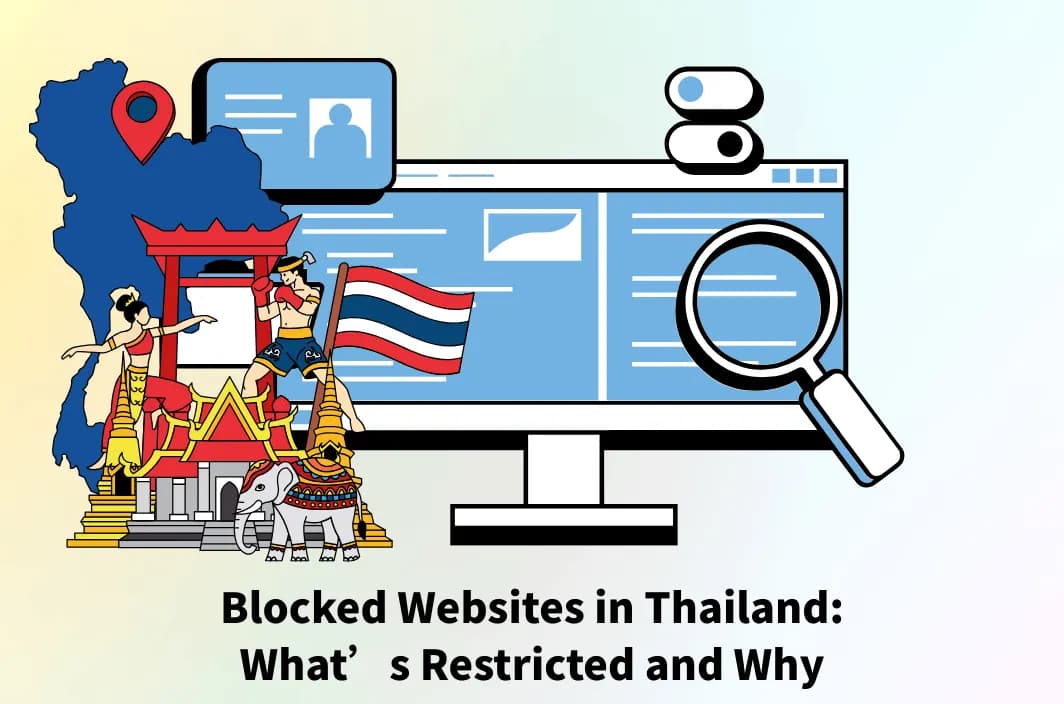
You might notice that a site works on mobile data but not on hotel Wi-Fi, or that a link loads for friends but not for you. In Thailand, that inconsistency can come from several places: local network rules, ISP filtering, or broader website blocking. This guide helps you understand which websites are commonly restricted, why blocks happen, and what you can do—legally and safely—when something you need won’t load. You’ll also get a practical checklist for diagnosing the problem and choosing privacy tools that protect you on public networks without crossing legal lines.
Overview of Internet Restrictions in Thailand
Website blocking in Thailand isn’t always a single nationwide “on/off” switch. In practice, restrictions can show up differently across networks, and enforcement priorities can shift over time. Understanding that context helps you interpret what you’re seeing—especially when a site fails on one connection but works on another.
Thailand is rated “Not Free” for internet freedom by Freedom House, which documents arrests and legal actions tied to online speech, as well as ongoing website blocking.
At the network level, measurement projects like OONI track whether websites appear blocked and what kind of interference is detected (DNS, HTTP, or TCP/IP). That matters because your “blocked website” experience might be the result of ISP-level filtering rather than the site being down globally.
What Are Blocked Website Categories in Thailand
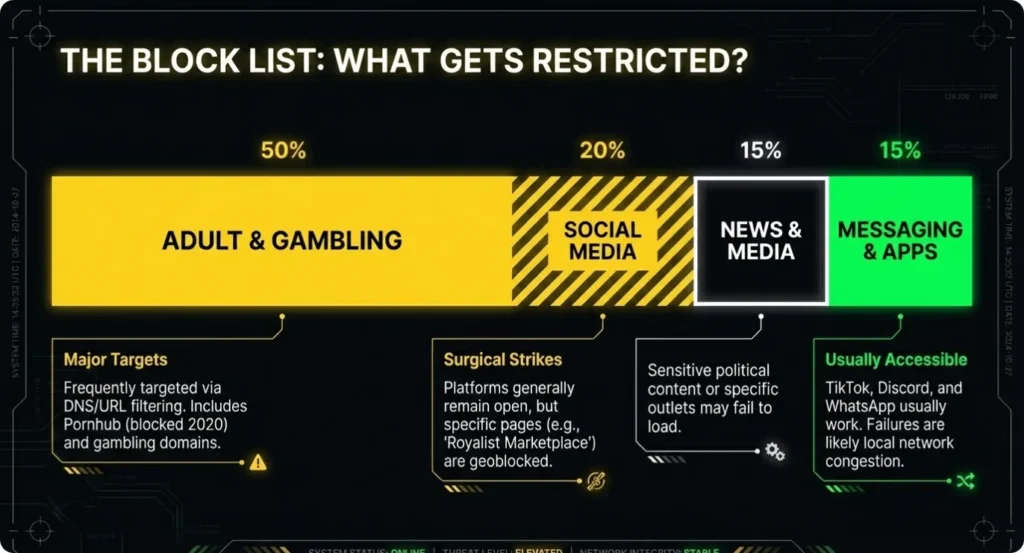
Before you look for a workaround, it helps to classify what’s being restricted. Thailand’s blocking tends to cluster around a few categories, and different categories often come with different reasons (and different levels of risk if you try to access them).
| Blocked Website Category | What you’ll typically see | Common triggers (high-level) |
| Social Media Platforms | Specific pages/groups unavailable; platform still works | Court or ministry requests for particular content |
| News & Media | Certain outlets, pages, or links fail to load | Sensitive political content; legal requests |
| Gaming & Entertainment | Some domains or streaming-related sites are inaccessible | Regional licensing, network restrictions, or targeted enforcement (case-by-case) |
| Adult & Gambling | Sites won’t resolve or show blocking behavior | Pornography restrictions; online gambling crackdowns |
| Financial & Crypto | Less common as a blanket category; may be incident-based | Fraud, scams, or illegal services (often domain-specific). |
Popular Websites and Apps Reported Blocked in Thailand (Examples & Status)
People often search for a list of blocked websites in Thailand because they want quick confirmation: is this site commonly restricted, and is it a permanent ban or something intermittent? The table below focuses on well-documented examples and uses cautious labels (reported/period-specific) because blocks can change.
| Website / App | Status | Type of Restriction (typical) | Notes |
| Pornhub | Reported blocked (notable enforcement) | ISP/URL filtering | Reported blocked in 2020; linked to Computer Crime Act enforcement in coverage. |
| Pornography sites (multiple) | Frequently targeted | DNS/URL filtering | Reports describe a broad blocking of porn sites; varies over time. |
| Online gambling domains (large volumes) | Frequently targeted | Domain/URL blocking, takedowns | Thai government reported blocking hundreds of thousands of illegal web addresses, many gambling-related. |
| “Royalist Marketplace” (Facebook group) | Restricted access within Thailand (content-specific) | Platform geoblocking | Facebook restricted access in Thailand after a legal request; the platform remained available. |
| Other blocked domains (various categories) | Confirmed in measurements | DNS/HTTP anomalies | OONI reporting has documented confirmed blocked domains across categories (counts vary by period). |
| TikTok | Usually accessible; network issues are possible | Network/ISP dependent | Most of the time it works; when it doesn’t, it’s often local network policy or congestion (check your Wi-Fi vs mobile data). |
| Discord | Usually accessible; network issues are possible | Network/ISP dependent | Similar pattern: many “blocked” complaints are actually school/hotel Wi-Fi restrictions. |
| Usually accessible; network issues are possible | Network/ISP dependent | Calls and media can fail on restrictive Wi-Fi; test on another network before assuming censorship. |
Tip: If a site is blocked, you’ll often see DNS failures (the domain won’t resolve), redirects, or unusual HTTP responses. Measurement projects categorize these signals, which is why network-specific testing can be useful.
Why Are Websites Blocked in Thailand?
If you know why a category is restricted, you can make better decisions about what to do next. Some blocks reflect ongoing policy priorities (like gambling crackdowns), while others are tied to specific cases (like restricting access to a page or group). This section keeps it practical: the goal is helping you understand patterns, not speculating about every individual block.
1) Adult content enforcement
A clear, documented example is the 2020 block affecting Pornhub and many other pornography sites, which was publicly linked to enforcement under Thailand’s Computer Crime Act in reporting.
2) Gambling and illegal web-address crackdowns
Thailand has reported blocking very large numbers of illegal web addresses, including substantial volumes of gambling sites, as part of enforcement campaigns. Between October 2025 and January 2026, Thailand’s Digital Ministry blocked a record 220,486 illegal URLs, with online gambling accounting for 183,977 of those targets. That aligns with regional measurement reporting that pornography and gambling are among the most commonly blocked categories.
3) Speech- and politics-adjacent restrictions (often content-specific)
Rather than blocking an entire platform, authorities may seek the restriction of specific pages or groups within a platform. The “Royalist Marketplace” case is frequently cited because the group was restricted within Thailand following a legal request, while the platform stayed online.
4) Network-level filtering and technical enforcement capacity
Some restrictions are implemented through ISP-level techniques (DNS interference, URL filtering, IP blocking). That’s why “it works for my friend but not for me” can be real—even inside the same country—depending on ISP and network configuration.
Is Visiting Banned Sites Illegal in Thailand?
When a site is blocked in Thailand, the key issue is usually the content and what you do with it, not just whether the page loads. Legal risk can differ between simply viewing something and distributing, uploading, or promoting it, and different laws may apply depending on the category. If you’re unsure, avoid sensitive content, keep your use lawful, and check official guidance for situations that could carry a higher risk.
Here are the practical guardrails to keep in mind:
- “Blocked” doesn’t automatically mean “you committed a crime.” Some blocks are preventive or administrative, and some are targeted at distribution networks (like gambling domains), not individual users.
- Content still matters. If something is illegal to host, distribute, or promote under local law, using a technical workaround doesn’t make it legal.
- Platform restrictions can be content-specific. If a specific page or group is restricted (rather than the whole platform), trying to bypass it may increase your risk profile depending on the case.
- VPN legality vs VPN use-case. Many people use VPNs for routine privacy and security (especially on public Wi-Fi). Even where VPNs are generally legal, using them to access illegal content can still expose you to legal issues.
If you’re using the internet in Thailand for work or travel, your safest approach is: keep your activity lawful, avoid distributing prohibited content, and prioritize security protections that reduce hacking and tracking risks on shared networks.
How to Access Blocked Websites in Thailand Safely and Legally
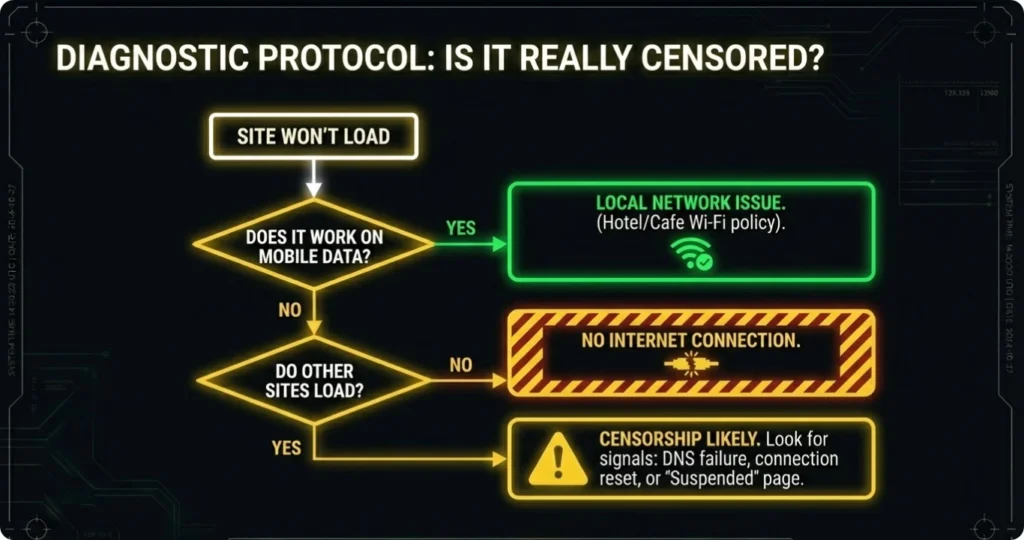
When a website won’t load, your first job is to diagnose the cause. Jumping straight to “it’s censored” can waste time—and sometimes the fix is as simple as changing networks. The steps below focus on legal, low-risk troubleshooting first, then move toward privacy tools that are widely used for security and stability.
Step 1: Rule out ordinary network problems
Try these quick checks before anything else:
- Test the site on mobile data vs Wi-Fi (hotel, cafe, co-working space).
- Try another DNS-capable device (laptop vs phone).
- See if only one service fails (for example, WhatsApp calls drop but browsing works) or if everything is affected.
If it works on mobile data but not on Wi-Fi, you’re often dealing with local network policy, filtering, or weak routing—not a nationwide block.
Step 2: Use official channels when available
If a service has an official app, official mirror, or alternate domain, that’s usually the lowest-risk path. This matters for productivity tools and messaging apps like Discord or TikTok, where failures are frequently caused by restrictive Wi-Fi policies.
Step 3: Consider privacy tools for security and stable routing
If you need consistent access—especially on public Wi-Fi—privacy tools can help protect your connection and reduce exposure to tracking or malicious interception. This is where a VPN is commonly used for legitimate purposes like:
- securing logins on shared networks,
- reducing man-in-the-middle risk,
- keeping your traffic encrypted end-to-end.
If you go this route, keep it responsible: the goal is secure access and privacy, not evading laws around prohibited content.
Best VPN for Thailand: What to Look For When Sites Are Blocked
A lot of guides jump straight to “best VPN Thailand” without explaining why your choice matters. In reality, if you’re trying to reach a blocked site or stabilize access on a restrictive network, the details—protocol, leak protection, and server options—change your results. You’ll get the best experience by choosing a VPN built for reliable routing and privacy on everyday networks, not just flashy marketing claims
Here’s a practical checklist you can use:
- Fast, modern protocol for real-world networks
Look for WireGuard (or an equivalent modern protocol) because it typically performs better on mobile and congested Wi-Fi. This is especially helpful when services like WhatsApp media uploads or Discord voice chat struggle on hotel networks. - Kill Switch + leak protection (so your traffic doesn’t “fall back” unexpectedly)
If the VPN drops for a moment and your device reconnects unprotected, you can leak IP/DNS information. A Kill Switch reduces that risk—useful when you’re relying on stable privacy in cafes or airports. - Server choice that matches your goal
For many users, selecting a nearby region improves speed. But if a service behaves differently by region (or your route is unstable), switching servers can help. It’s common to try a Singapore Server or Japan Server for speed first, then test a US Server or UK Server if you need a different route. - Clear privacy stance (no-logs positioning, transparent policies)
You’re often using a VPN because you want less tracking on shared networks. The provider’s privacy posture matters as much as raw speed.
Where BearVPN fits (and why it’s relevant to this topic)
If your goal in Thailand is safe access + privacy on public Wi-Fi—not risky behavior—BearVPN is a practical option to consider. Its positioning focuses on core security fundamentals (strong encryption, modern VPN protocols, and protections like a Kill Switch), which directly address the two pain points people have when they run into blocked websites in Thailand: unstable routing and privacy exposure on shared networks.
In other words, you’re not choosing it just to “open a blocked page.” You’re choosing it because:
- it can keep everyday apps like WhatsApp and Discord more consistent on restrictive Wi-Fi,
- it gives you flexible routing options (for example, testing a US Server if a site behaves differently by region),
- and it reduces the chance you’ll accidentally browse unprotected if the connection drops.
Used responsibly—within local law—this is the most realistic way a VPN helps in Thailand: secure, stable access to normal services you rely on.
Conclusion
Blocked websites in Thailand are best understood as a mix of category-based enforcement (especially gambling and adult content), content-specific restrictions, and network-level filtering that can vary by ISP or Wi-Fi provider. When something won’t load, you’ll save time by diagnosing the cause first—switch networks, verify whether it’s a local restriction, and use official channels where possible. If you need reliable access for work, travel, or everyday communication, a security-focused VPN can help by improving routing stability and protecting you on public networks. Just keep your use responsible and lawful.
FAQs
1. What websites are blocked in Thailand most often?
Adult-content sites and many online gambling domains are commonly targeted, with periodic crackdowns reporting large volumes of blocked illegal web addresses.
2. Is a VPN legal in Thailand?
Many people use VPNs for standard privacy and security, especially on public Wi-Fi. But legality depends on use: a VPN doesn’t make illegal content legal, and sensitive cases can carry higher risk.
3. How can you check if a website is actually blocked?
Compare multiple networks (mobile vs Wi-Fi) and look for patterns like DNS failure or unusual redirects. Measurement projects like OONI also explain how blocking signals are detected.
References
- Freedom House. Freedom on the Net 2025 — Thailand.
- OONI (Open Observatory of Network Interference). Thailand — OONI Explorer (measurements & blocking signals).
- Bangkok Post. 220,000 illegal web addresses blocked since October (incl. gambling websites).
- Human Rights Watch. Thailand: Cyber Crime Act Tightens Internet Control.