Key Takeaways
- Only a few countries fully ban TikTok nationwide, including India, Afghanistan, Jordan, Somalia, and Senegal.
- Many “TikTok bans” are partial—such as ISP blocking, app store removal, or limits on government devices rather than public use.
- In the US, EU, UK, and Canada, TikTok is restricted for officials, not the general public.
- TikTok access is fluid: some bans become permanent, while others are reversed, highlighting a growing split in how countries control the internet.
In the rapidly evolving digital landscape of 2026, TikTok remains the ultimate paradox of the internet: it is the world’s most downloaded short-form video app and, simultaneously, the most targeted platform for government restrictions. From the bustling streets of Mumbai to the administrative offices of Washington D.C., the question of which countries banned TikTok has shifted from a tech-news curiosity to a matter of international diplomacy and national security.
As of early 2026, the global map of TikTok accessibility is a patchwork of total prohibitions, partial restrictions, and uneasy truces. Whether you are a digital creator, a global traveler, or a business owner relying on social commerce, staying informed about where TikTok is banned is crucial for navigating the modern web.
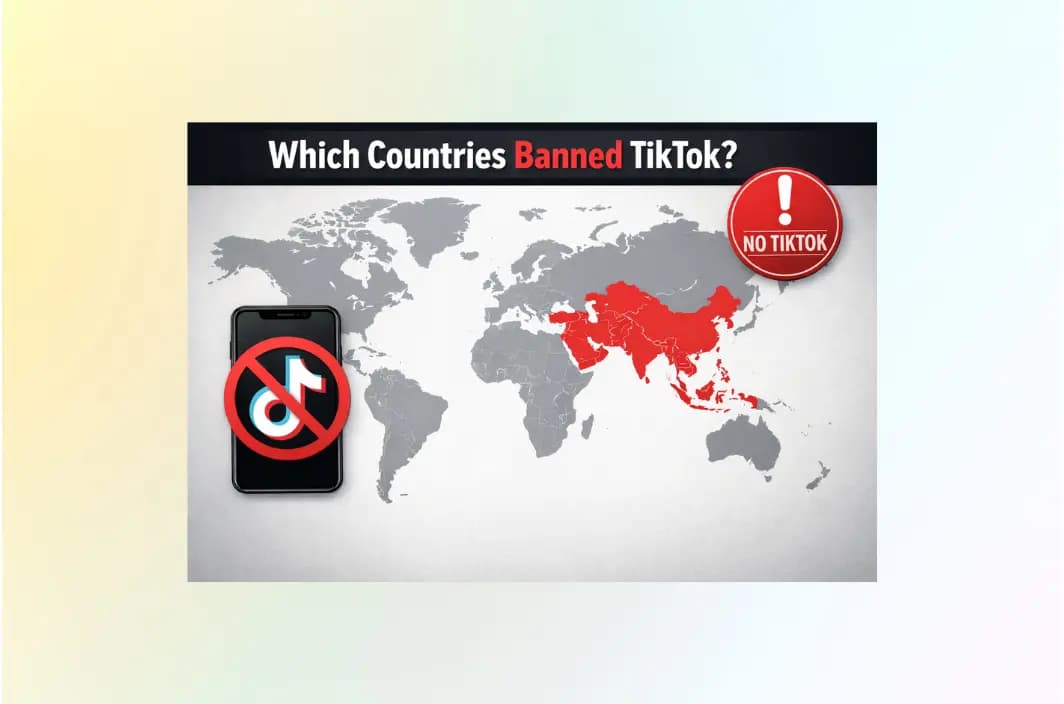
Which Countries Have Banned TikTok in 2026? (Full List by Region)
The following table provides a high-level overview of the countries and regions that have implemented significant measures against the platform as of January 2026.
| Country/Region | Restriction Type | Timeline | 2026 Current Status |
| India | Complete Nationwide Ban | Since June 2020 | Yes, permanently. |
| Afghanistan | Complete Nationwide Ban | Since April 2022 | Full block; cited as “misleading the youth.” |
| Jordan | Full Nationwide Block | Since Dec 2022 | Yes, remains suspended. |
| United States | Partial / Federal Device Ban | 2023 – 2026 | Restricted on government phones; national ban is in legal limbo. |
| Russia | Partial / Self-Suspension | Since March 2022 | Restricted (no new uploads). |
| Nepal | Previously Banned (Now Lifted) | Nov 2023 – Aug 2024 | No, access was restored. |
| Senegal | Full Nationwide Block | Since Aug 2023 | Blocked due to political unrest; still in effect. |
| Somalia | Complete Nationwide Ban | Since Aug 2023 | Banned to combat “indecent” content and misinformation. |
| EU / UK / Canada | Government Device Ban | Since Early 2023 | Banned for officials; legal for the general public. |
Disclaimer: Status may change as governments update policies; this article reflects publicly available information as of January 2026.
TikTok Ban vs Restriction vs Device-Level Ban: What’s the Difference?
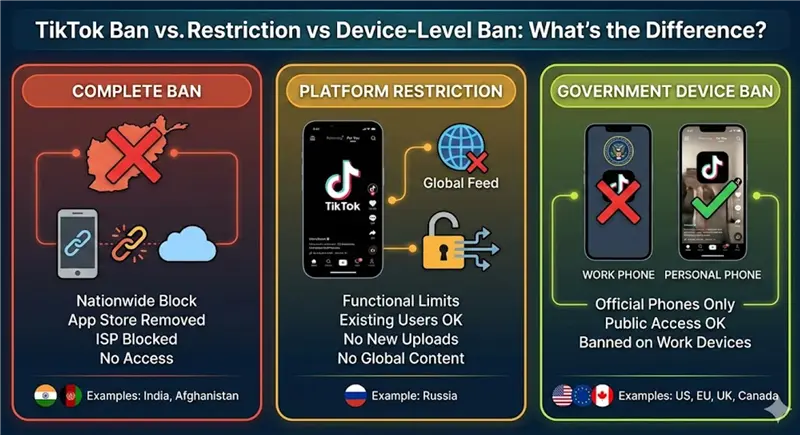
When headlines say “TikTok is banned,” they don’t always mean the same thing. In reality, governments apply three very different levels of restriction, each with a distinct legal and practical impact on users:
Complete Ban
A complete ban means TikTok is fully blocked at the national level. The app is removed from app stores, network access is restricted by ISPs, and the platform is effectively inaccessible without advanced circumvention tools. India and Afghanistan fall into this category.
App Store Removal or Platform Restriction
In this scenario, TikTok may disappear from local app stores or face functional limits, but existing users can still access some content. Russia is a prime example, where TikTok remains viewable, but new uploads and global content are restricted due to compliance and legal pressures.
Government Device Ban
This is the most limited form of restriction. TikTok is prohibited only on government-issued phones and computers, while the general public can continue using the app normally. The United States, EU institutions, the UK, and Canada all enforce this model as a cybersecurity precaution rather than a public ban.
Countries Where TikTok is Illegal or Restricted (Detailed Analysis)
India: The First Major Domino to Fall
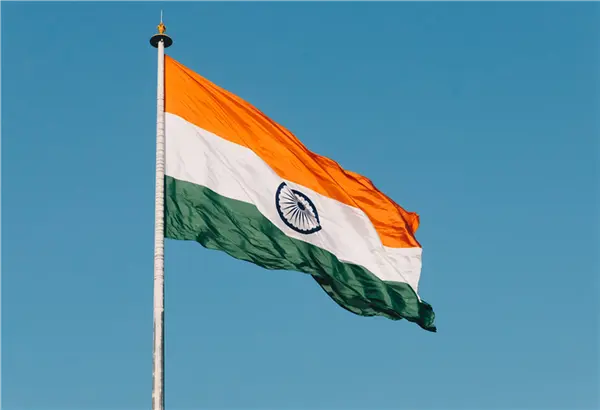
When discussing which countries have banned TikTok, India is always the starting point. In June 2020, following a deadly border skirmish with Chinese forces in the Galwan Valley, the Indian government executed what analysts called a “digital counterstrike.” Is TikTok banned in India? The answer remains a definitive yes.
The Ministry of Electronics and Information Technology (MeitY) blocked TikTok along with 58 other Chinese-origin apps, citing concerns that they were “prejudicial to the sovereignty and integrity of India.” By 2021, this temporary measure was made permanent. In 2026, despite occasional rumors of a “TikTok Lite” return, the platform remains completely inaccessible to over 200 million former users without the use of advanced bypass tools.
Jordan: A “Temporary” Ban That Became Permanent
Many travelers are surprised to find the app non-functional upon arrival. The ban was initiated in December 2022 following a wave of protests over rising fuel prices. The Jordanian authorities claimed that the platform was being misused to “incite violence and disorder.”
While originally described as a “temporary suspension,” the ban has persisted into 2026. The government continues to demand that TikTok establish a local office and adhere to strict content moderation guidelines before it will consider lifting the block.
Russia: A Different Kind of Restriction
Is TikTok banned in Russia? The situation in Russia is unique. Technically, the government has not issued a total ban as it did for Facebook or Instagram. Instead, TikTok itself suspended new video uploads and live-streaming for Russian users in March 2022 to comply with the country’s “fake news” laws.
In 2026, the Russian version of TikTok is a “ghost town” of content. Users can scroll through old videos, but the global “For You” feed is inaccessible. Furthermore, researchers have noted that the Russian feed is now heavily dominated by state-aligned content, creating a digital bubble.
Nepal: A Case Study in Reversal
For those asking is TikTok banned in Nepal, the news is positive for 2026. After a nine-month ban that began in late 2023—cited as necessary to preserve “social harmony”—the Nepalese government lifted the restriction in August 2024. The reversal came after TikTok agreed to collaborate with local law enforcement to address cybercrimes and designate a “focal point” for content moderation within the country.
Why Did Countries Ban TikTok? (Deep Dive into the Reasons)
The reasons for banning TikTok are rarely about just one factor. Usually, it is a complex intersection of geopolitics, data privacy, and social engineering.
- National Security and Data Sovereignty
The most cited reason globally is the fear that TikTok’s parent company, ByteDance, is subject to Chinese national security laws. Governments in the U.S., Canada, and Europe argue that:
- Data Harvesting: The app collects vast amounts of metadata, including location, biometrics, and browsing history.
- Foreign Influence: The algorithm could potentially be manipulated to amplify certain political narratives or suppress others during election cycles.
- Public Order and Political Stability
In regions like the Middle East and parts of Africa (Senegal, Somalia), TikTok is viewed as a tool for rapid mobilization. Because the platform can make content go viral in minutes, governments facing civil unrest often see it as a threat to public order.
- Cultural Values and Morality
In countries with conservative religious or cultural foundations, such as Afghanistan and Kyrgyzstan, the ban is often framed as a “protection of the youth.” Authorities argue that the platform’s content—often featuring music, dance, and “secular” lifestyles—violates local moral codes and promotes “social degradation.”
- Psychological Impact and “Brain Rot”
A newer trend in 2025-2026 involves bans based on mental health. Several European nations have launched investigations into TikTok’s “addictive” design. Australia, for example, has moved toward a “Social Media Minimum Age” law in 2026, which effectively bans the platform for children under 16 to combat the rise of “digital addiction.”
TikTok Bans and Their Impacts on Countries
The impacts of TikTok bans are far-reaching and often result in unintended consequences.
Economic Fallout
In India, the ban led to the overnight loss of income for millions of “micro-influencers” who lived in rural areas and used TikTok as their primary revenue stream. While Instagram Reels and YouTube Shorts have filled the void, the barrier to entry on those platforms is often perceived as higher.
The Rise of Domestic Alternatives
Whenever a global giant is banned, domestic “clones” emerge. India saw the rise of apps like Moj and Chingari. In Russia, VK’s “Clips” has seen a massive surge in users. These domestic platforms are often easier for the government to regulate but offer a more localized, less “global” experience.
Digital Isolation
For the younger generation, TikTok is more than an app; it is a search engine and a news source. Banning it can lead to a sense of digital isolation, where users in restricted countries are disconnected from global memes, trends, and cultural conversations.
How to Access TikTok Safely
If you are traveling through a region where access is restricted, or if you reside in a country with limited access, there are several solutions for TikTok access that do not involve violating local laws.
1. Using a High-Quality VPN
A Virtual Private Network (VPN) is the gold standard for bypassing geographic blocks. By encrypting your data and masking your IP address, a VPN makes it appear as though you are browsing from a different country.
Accessing TikTok effortlessly with BearVPN. For those looking to browse TikTok in restricted regions, BearVPN offers one of the most straightforward solutions available. With a network of over 2,000 dedicated global servers, it allows users to browse freely from any location with just a single click, providing an experience as if they were located overseas.
Why choose BearVPN?
While standard tools often experience lag or connectivity issues in high-restriction areas like Jordan or Senegal, BearVPN’s extensive server library ensures a connection to the fastest possible route. This guarantees that the “For You” feed remains lightning-fast, providing a seamless, buffer-free viewing experience even for high-definition content.
2. International SIM Cards and Roaming
If you are a traveler, using a SIM card from a country where TikTok is legal (e.g., the UK or the USA) with data roaming enabled can often bypass local firewalls. This is because your traffic is routed through your home country’s servers.
3. Browser-Based Access
Sometimes, the ban only applies to the app stores. You may be able to access TikTok via a mobile browser (like Safari or Chrome) by visiting tiktok.com. However, the web experience is often less feature-rich than the app.
Disclaimer:
The use of a VPN may be subject to local laws and regulations. Before proceeding, we strongly advise you to verify the legal status of VPN software and the circumvention of regional restrictions within your specific jurisdiction. Users assume all responsibility for ensuring their actions align with local legal frameworks.
Conclusion
The question of which countries banned TikTok is not a static one; it is a moving target. As we have seen in 2026, a country can be “banned” one year (like Nepal) and “open” the next, or a temporary restriction can turn into a multi-year blackout (like Jordan).
For the average user, these bans represent a growing trend of “splinternet”—where the digital world is divided by national borders. To maintain your digital freedom and stay connected to the global creator economy, tools like BearVPN have become essential components of the modern internet toolkit.
Frequently Asked Questions about TikTok Restrictions
- Is TikTok banned in Russia?
As of 2026, TikTok remains in a state of “self-imposed” restriction in Russia. While the app can be downloaded and existing content can be viewed, Russian users are prohibited from posting new videos or viewing content from outside the country. This restriction was originally implemented by TikTok in 2022 following the introduction of “fake news” laws.
- Is TikTok banned in Nepal?
No. While the government of Nepal issued a ban in late 2023, citing concerns over social harmony, that ban was officially lifted in August 2024. In 2026, the app will be fully accessible and operational for all users within Nepal.
- Is TikTok banned in India?
Yes. India has maintained a strict nationwide ban since June 2020 due to national security and privacy concerns. The app is unavailable on the Apple App Store and Google Play Store, and Indian ISPs (Internet Service Providers) continue to block access to TikTok’s servers.
- Is TikTok banned in Jordan?
Yes. The “temporary” ban issued in December 2022 remains in effect throughout 2026. Despite various public requests for its reinstatement, the Jordanian government has not yet restored access to the platform, citing a failure to meet regulatory and safety requirements.
- Is TikTok banned in the United States?
As of 2026, TikTok’s status in the U.S. is governed by the Protecting Americans from Foreign Adversary Controlled Applications Act. Following the expiration of the legal deadlines in 2025, the app is either operating under new ownership (divested from ByteDance) or facing significant federal restrictions. Access currently depends on the outcome of the high-profile legal challenges that concluded in late 2025.
- Is TikTok banned in Afghanistan?
Yes. The ban enacted by the Taliban leadership in 2022 remains strictly enforced in 2026. The government continues to block the platform, claiming that the app’s content is inconsistent with national and religious laws.
- Is TikTok banned on government devices in the UK, Canada, and the EU?
Yes. While TikTok is available for the general public in these regions, it remains banned on official government-issued devices. These restrictions, implemented in 2023, were made permanent to prevent potential data security risks involving civil servants and government officials.
References & Sources:
- Digital 2026 Global Overview Report – An in-depth analysis of global social media censorship patterns and internet adoption.
- Associated Press (AP): TikTok Ban Timeline and Global Restrictions – Comprehensive coverage of international bans, including the long-standing restrictions in Jordan and the US.
- The Times of India: Why the 2020 App Ban became a Permanent Pillar of Indian Policy – Official government clarification on the permanent status of the TikTok ban in India as of late 2025.
- TechCrunch: TikTok’s Compliance Agreements and Technical Enforcement in South Asia – Analysis of the platform’s struggle with regional compliance and the technical side of nationwide blocks.