Key Takeaways
- Website blocking in Malaysia is real and inconsistent, often varying by ISP and domain format.
- Gambling and adult content are the most consistently blocked, with occasional restrictions affecting news or political sites.
- Most blocks rely on DNS-level interference, which can persist even when switching DNS providers.
- Some restrictions are temporary and can be reversed without formal policy changes.
- A reputable VPN can help bypass ISP-level blocking and protect privacy, but it does not override local laws or platform rules.
In Malaysia, some websites and online services become unavailable because access is restricted at the ISP level, usually following regulatory action or enforcement priorities. These blocks don’t always look the same: one domain might fail on home broadband, but load on mobile data, or a restriction might appear briefly and then disappear after a platform changes its safeguards.
If you’re trying to figure out whether a site is actually blocked, why it happened, and what your options are for regaining access without creating new privacy risks, this guide walks you through the categories, real examples, and practical next steps.
Overview of Internet Restrictions in Malaysia
Malaysia does restrict access to certain online content, and these restrictions are typically carried out through internet service providers. What matters in practice is not only whether a site is restricted, but also how consistently it’s restricted across networks and whether it’s a targeted action (specific domains) or broader interference (such as DNS-level measures).
One reason this topic feels confusing is that blocked websites in Malaysia aren’t a single fixed list. Independent monitoring has repeatedly documented blocks that appear on certain providers but not others, and sometimes on a specific domain variant rather than the whole site. For example, monitoring around MalaysiaNow noted differences across major ISPs and even differences between www.malaysianow.com and malaysianow.com.
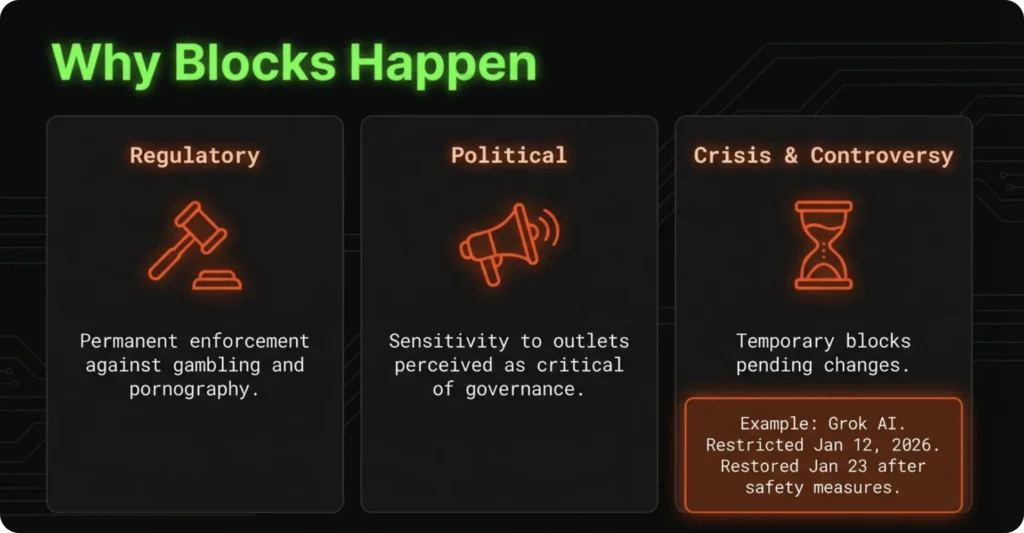
The second reason is that restrictions can be event-driven. A service might be restricted during a controversy and later restored after changes are made. Reuters reported that Malaysia temporarily restricted access to Grok in January 2026 and later restored access after additional safety measures were implemented.
Common Blocked Website Categories in Malaysia
Before you look for a specific site, it helps to understand the categories that most often draw enforcement. This makes it easier to interpret what you’re seeing—especially when a block is partial, temporary, or appears only on certain networks. The categories below reflect recurring patterns documented in Malaysia-focused monitoring and reporting.
| Category | What usually gets restricted | What it looks like when blocked |
| Social & dating | Certain LGBTQ-related services or sensitive community sites | Domain fails to resolve, redirects, or loads a block page |
| News & political content | Outlets seen as critical or politically sensitive | Often ISP-specific; sometimes temporary |
| Adult & gambling | Pornography, online casinos, betting portals | Consistently high-block category over time |
| Copyright & torrenting | Torrent indexes, piracy-related domains | Can be blocked via DNS or other methods (historically documented) |
| Harmful/abusive content | Services tied to indecent or manipulated content controversies | May be temporarily restricted pending platform changes |
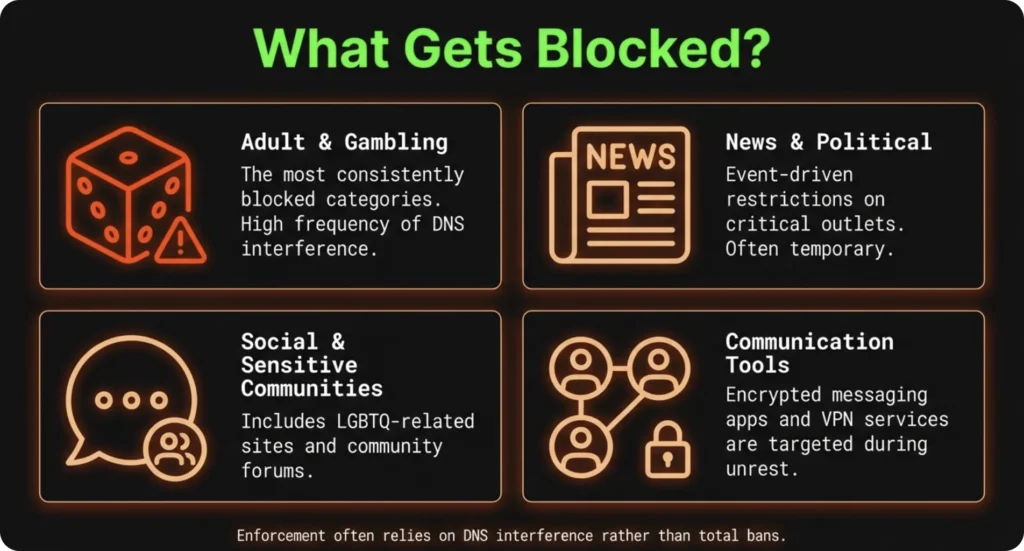
The scale of these restrictions is significant. According to the most recent MCMC transparency data, the commission blocked a total of 24,277 websites between 2018 and August 1, 2024. Of these, approximately 39% were related to illegal gambling and 31% were categorized as ‘obscene content,’ proving that while political blocks get the headlines, the majority of interference targets safety and category enforcement.
This table is meant to help you diagnose intent, not to encourage you to access illegal content. The next section focuses on recognizable examples people commonly encounter, along with notes about how the restrictions were reported.
Popular Websites Blocked You Might Encounter in Malaysia
In most cases, the issue comes down to whether the site is being actively restricted or whether different networks are handling traffic in different ways. The examples below are useful because they illustrate patterns—ISP variance, temporary restrictions, and category-based enforcement—rather than implying there’s one permanent nationwide list.
| Website / App | Status | Type of restriction | Notes |
| MalaysiaNow | Reported blocked (ISP-varying) | DNS/ISP-level interference | Monitoring noted differences by ISP and by domain variant (www vs non-www). |
| UtusanTV/TV Pertiwi/Asia Sentinel | Reported blocked during coverage periods | ISP-level restriction | Freedom House notes MCMC blocked some news outlets/blogs perceived as critical. |
| Grindr (website) | Reported blocked | Category-based blocking | iMAP Malaysia 2024 report notes that LGBTQ-related websites continued to be blocked. |
| Grok (xAI via X) | Temporarily restricted, later restored | Temporary access restriction | Reuters reported restriction on Jan 12, 2026; later access was restored after adding safety measures. |
| Gambling & pornography domains (category) | Frequently restricted | Category-based blocking | iMAP Malaysia 2024 reports gambling/pornography as the highest-rate blocking category. |
A practical takeaway: if you’re checking a site’s availability, test it on more than one network (home Wi-Fi vs mobile data) and pay attention to the exact domain you typed. Variations that look trivial to you can behave differently under DNS-based blocking.
Why Are Websites Blocked in Malaysia?
When a page doesn’t load, it’s tempting to assume “the government blocked it” and stop there. But if you want a useful explanation—and a better chance at diagnosing what’s happening—you’ll get farther by separating policy reasons from technical methods. The same DNS-level technique can be used for very different types of enforcement.
1) Category enforcement (adult content, gambling, and similar)
Monitoring reports consistently identify adult content and gambling as high-frequency categories for blocking in Malaysia.
If you’re running into blocks while researching sports betting portals, casino domains, or explicit content sites, that category context matters: you’re more likely to see broad and persistent restriction patterns.
2) Political sensitivity and news/media restrictions
Malaysia-focused reporting and monitoring have documented cases where news outlets or political criticism sites were restricted, sometimes during specific periods. Freedom House’s Malaysia Freedom on the Net report describes blocks affecting outlets and blogs seen as critical of the government.
From a user perspective, this category often shows “uneven” blocking—available on one provider, unavailable on another, or disappearing after a short window.
3) Targeted action tied to harmful content controversies
Not all restrictions are permanent. The Grok case is a good example of an event-driven restriction: Reuters reported Malaysia restricted access in January 2026 amid backlash over sexualised AI images, and later restored access after additional safety measures were implemented.
If you’re troubleshooting a newly restricted service, look for signs that it’s tied to a current controversy and may change quickly.
4) Technical network controls that don’t always behave transparently
Even if the reason for the restriction is straightforward, the method can be messy. iMAP reported cases where ISPs implemented a transparent DNS proxy affecting Cloudflare and Google Public DNS, making it appear as if you were using public DNS while traffic was still intercepted.
That matters because it changes what troubleshooting steps will work—and it explains why two people can get different results even when they use the same DNS.
Is Visiting Banned Sites Illegal in Malaysia?
This is the question behind a lot of anxiety, and you deserve a clear way to think about it. The safest framing is: legality and risk depend on the content and your actions, not just the act of loading a page. If a site involves illegal activity (for example, certain gambling operations, prohibited content, or copyright infringement), accessing or distributing that material can increase your exposure.
There’s also a difference between a site being restricted and your activity being lawful. A restriction might exist because authorities consider the content harmful or because of enforcement priorities, but that doesn’t automatically tell you what will happen to an individual user. For policy context on how blocking is applied and which types of sites have been affected, Freedom House’s Malaysia reporting is a useful starting point.
Is a VPN legal in Malaysia?
Many users are unsure about the legal status of VPN use in Malaysia, especially amid periodic discussions about tighter online controls. The general point to keep in mind is that a VPN is a technology—using it doesn’t grant permission to break the law, but it can be used for legitimate privacy and security reasons (especially on public Wi-Fi). Also, Malaysia’s approach has focused on restricting specific content/services and implementing network controls, including DNS-level measures, rather than a blanket ban on VPN technology.
If your goal is normal privacy (protecting logins on cafés/hotels, reducing tracking, or avoiding ISP interference for lawful browsing), you’re in a very different risk category than someone trying to distribute illegal material. Keep your use aligned with local law and the terms of the services you access.
How to Access Blocked Websites in Malaysia Safely
If you’re trying to regain access, you’ll get the best outcome by treating this as a stability + privacy problem, not a “hack.” In Malaysia, blocks can be ISP-specific, DNS-mediated, or temporary, so the right approach depends on what’s actually happening on your connection. Your priority should be keeping your traffic private (especially on public Wi-Fi) and minimizing accidental exposure from DNS or connection drops.
Use a reputable VPN when ISP-level interference or public Wi-Fi is the issue
A well-designed VPN can help in two common situations:
- when your ISP is interfering with DNS or access routes, and
- when you’re on public networks where you don’t control who’s watching or logging traffic.
This is where a service like BearVPN fits naturally: you’re not using it as a gimmick—you’re using it as a safety layer. Look for features that matter when blocks are inconsistent or when networks are “noisy,” such as a dependable modern protocol (for performance), a Kill Switch (so traffic doesn’t spill outside the tunnel if the connection drops), and predictable server options when you need lower latency.
Just as importantly, a VPN helps reduce exposure when you switch between home broadband and mobile data. Since monitoring has documented provider-level differences in Malaysia (including cases where one ISP blocks a domain while another doesn’t), keeping your connection path consistent can reduce the “it works here but not there” confusion.
Diagnose DNS-based blocking (without turning it into a risky guessing game)
Because DNS interference has been documented in Malaysia—including implementations that can affect “public DNS” behavior—you shouldn’t assume that switching DNS alone will always solve the issue.
A safer mindset is: confirm whether the failure is DNS-related (name resolution behaving oddly, redirects, block pages) versus a more direct IP/HTTP restriction. If you’re not sure, you’ll often see clearer results by testing the same domain across two networks (Wi-Fi and mobile data) before changing multiple settings at once.
Handle “temporary restriction” scenarios differently
When a restriction is tied to a current controversy or compliance dispute, you may find that access changes quickly. The Grok example shows how a service can be restricted and later restored after safeguards are added.
In these cases, the best “fix” is sometimes simply time plus official platform changes—so it’s worth checking credible updates rather than repeatedly cycling settings and creating new security mistakes.
Conclusion
In Malaysia, blocked websites aren’t just a theoretical issue—they can be category-driven, ISP-specific, or temporary depending on what’s happening politically, legally, or technically. If you’re trying to regain access, you’ll get better results by identifying the pattern first: does it fail only on one ISP, does the domain variant matter, or is it tied to a current controversy that may change quickly? For stable privacy—especially on public Wi-Fi—a reputable VPN can reduce exposure and smooth out ISP-level interference, as long as your use stays within local law and the terms of the services you access.
FAQs
1. Why does a site work on mobile data but not on home Wi-Fi?
This often points to ISP-specific restrictions or DNS-level interference from your home provider. Monitoring around MalaysiaNow documented cases where one ISP blocked a domain while others didn’t, and where www and non-www versions behaved differently.
2. How can you tell if a website is actually blocked?
Look for consistency across networks and devices. If the same domain fails on multiple unrelated connections, a restriction is more likely. Tools and measurement projects like OONI are designed to test web connectivity across DNS/HTTP/TCP layers, which can help separate “blocked” from “broken.”
3. What’s the difference between DNS blocking and other types of blocks?
DNS blocking typically interferes with how a domain name resolves, sometimes redirecting you or failing to return the correct address. Other restrictions can happen at the IP, HTTP, or application level. iMAP has documented DNS-related interference in Malaysia, including transparent DNS proxy behavior affecting public DNS services.
4. Why is your VPN connected, but the site still won’t load?
Common reasons include DNS leaks (your device still queries the ISP DNS), cached DNS results, or the site applying its own geo or security rules. Start by testing a different server location, then check whether only one domain fails or many do. If only one site fails, it may be a site-side rule rather than a Malaysia-wide block.
5. Can you use Malaysian banking apps while connected to a VPN?
Usually, yes, but you may trigger extra verification steps. Banking and payment services can flag logins that suddenly appear from a different region or unusual IP range. If you rely on a bank app daily, use a VPN server location that’s stable and avoid hopping locations repeatedly in short periods.
6. Do I need a license to use social media in Malaysia under the 2026 laws?
No. The Online Safety Act 2025 licensing requirement applies to the service providers (the platforms themselves), not to individual users. As a user, you do not need a license to browse, though platforms are now under stricter obligations to verify user ages and remove content that violates Malaysian safety standards.
References
- iMAP Malaysia 2024 Internet Censorship Report (Sinar Project)
- Freedom House — Malaysia: Freedom on the Net 2024
- iMAP case note — Blocking of MalaysiaNow (ISP variance details)
- iMAP update — Transparent DNS proxy affecting public DNS
- Reuters — Malaysia restricts access to Grok (Jan 12, 2026)
- Reuters — Malaysia restores access to Grok (Jan 23, 2026)

![How to Bypass OmeTV Ban [Safe & Workable]](/_next/image/?url=https%3A%2F%2Fcms.bearvpn.com%2Fwp-content%2Fuploads%2F2026%2F02%2Fhow-to-bypass-ometv-ban.webp&w=640&q=75)