Key Takeaways
- Website blocking in Egypt is real, but it isn’t always a clean “blocked vs unblocked” switch—many services are throttled, intermittently disrupted, or filtered differently by ISP.
- Since 2017, rights groups and media monitors have documented large-scale blocking, especially affecting news/media, human rights sites, and circumvention tools.
- If a site won’t load, treat it like a diagnosis problem first: DNS vs network filtering vs app-level restrictions—you’ll fix it faster and avoid risky trial-and-error.
- If you use a VPN, focus on privacy, stability, and leak protection (especially on public Wi-Fi). And always stay within local laws and terms of service.
When a website suddenly stops loading in Egypt, the reason isn’t always obvious. Sometimes it’s a straightforward block at the ISP level; other times it’s throttling, protocol interference, or an app feature (like voice calling) that fails while the rest of the service works.
This guide breaks down what blocked websites in Egypt typically means in practice, which categories are most affected, and why restrictions happen. You’ll also find a short, source-backed list of commonly affected services, practical steps to diagnose what’s happening on your connection, and safer ways to regain access without turning your browsing into a guessing game.
Overview of Internet Restrictions in Egypt
Internet restrictions in Egypt tend to show up in a few repeat patterns: whole domains that won’t resolve, pages that time out only on certain networks, and services that work “partly” (messages load, calls fail). Understanding these patterns matters because the quickest fix depends on whether you’re dealing with DNS interference, traffic filtering, or app-specific disruption.
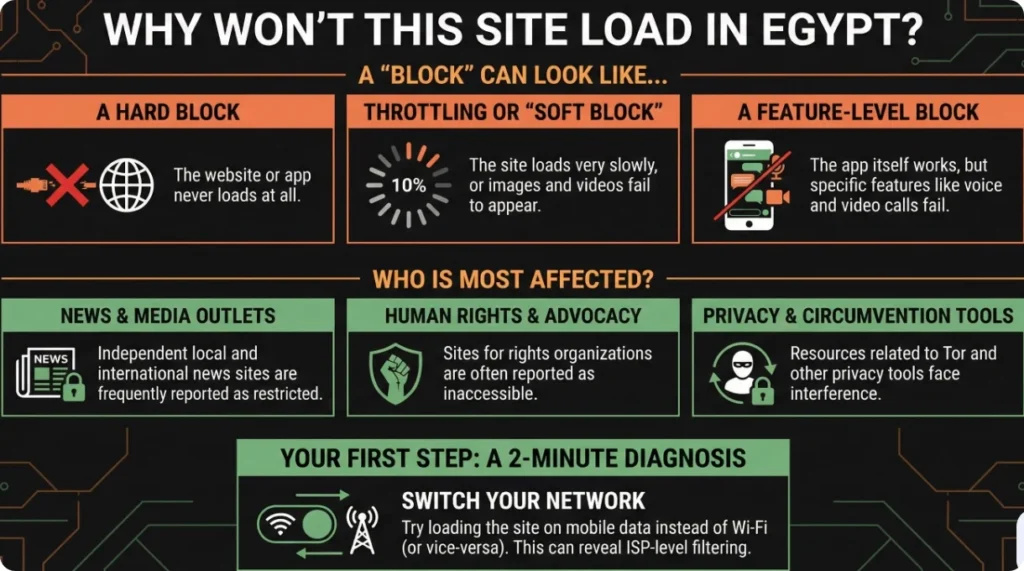
What “blocked” can look like on your screen
- Hard block: the site never loads (often consistent across browsers and devices on the same network).
- Soft block/throttling: it loads slowly, stalls on images/video, or fails only at peak times.
- Feature-level restriction: the app works, but a feature doesn’t—common with VoIP calling.
- ISP variability: the same site may work on one carrier and fail on another.
Who usually implements the restriction
Reports commonly describe restrictions being enforced via internet service providers and sometimes accompanied by broader legal and regulatory actions targeting online content.
Check the Blocked Website Categories in Egypt
Instead of memorizing a huge list of domains, it’s more useful to think in categories. When you can label the type of site (news, human rights, circumvention tools, calling apps), you can predict the failure mode—and choose a safer, more reliable way to get access.
Common categories affected
News & Media
- Independent local outlets and international news sites have been repeatedly reported as targets since 2017.
Human Rights & Advocacy
- Rights organizations and advocacy sites have also been reported as inaccessible at times.
Circumvention & Privacy Tools
- Measurement groups have documented interference affecting Tor-related resources and other circumvention tooling.
Social, Messaging, and VoIP
- In many places, the “block” isn’t the whole app—it’s calling, voice chat, or connectivity for specific protocols that fails inconsistently.
What’re The Popular Websites Blocked in Egypt
Availability can change by year, ISP, and even the specific subdomain you’re trying to reach. The entries below are best read as “reported blocked/interfered with” examples that show up repeatedly in credible reporting—not a definitive real-time status check. If a site matters to you, test it on more than one network.
| Website/App | Status (reported) | Type of Restriction | Notes |
| Al Jazeera | Blocked (since 2017 wave) | ISP blocking | Reported among initial targets when authorities ordered blocks on news sites. |
| Mada Masr | Blocked / temporarily blocked | ISP + regulatory action | Documented as blocked since 2017; Freedom House notes later regulatory blocking announcements as well. |
| Huffington Post Arabic (legacy) | Blocked (reported) | ISP blocking | Cited in monitoring reports listing blocked news outlets. |
| Medium | Blocked (reported historically) | ISP blocking | Reported blocked during the 2017 crackdown period; accessibility may vary. |
| Human Rights Watch (HRW) | Blocked (reported) | ISP blocking | Cited among human rights sites reported inaccessible. |
| Tor Project resources / Tor bridges | Cited among human rights sites reported as inaccessible. | Network interference | Access Now and OONI describe blocking and interference affecting Tor-related domains and bridges. |
| General “circumvention tools” | Blocked (reported at scale) | Mixed | CPJ and Access Now cite hundreds of blocked websites/links over time, including tools used to bypass blocks. |
Why Are Websites Blocked in Egypt?
Different restrictions can have different drivers, and they’re often described using broad terms like “national security,” “false news,” or protecting the public interest. What matters for you is the practical outcome: certain categories face a higher risk of being restricted, and collateral blocking can sometimes affect unrelated services on shared infrastructure.
1) News and political information controls
The 2017 wave of blocks was publicly framed around accusations such as supporting terrorism or spreading false news, with monitoring groups describing a wider campaign affecting independent media.
2) Legal and regulatory frameworks
Country monitoring reports describe multiple laws and authorities that can enable censorship and blocking. The details evolve, but the consistent theme is broad discretion and weak transparency around what gets blocked and why.
3) Technical enforcement and “side effects”
Network measurement research in Egypt has documented techniques such as DPI, throttling, and interference that can create inconsistent user experiences—one day a site loads, the next day it hangs.
4) Circumvention suppression
Some reporting specifically notes blocking of tools or resources used to bypass restrictions (for example, Tor-related domains/bridges), which can make privacy fixes feel unreliable unless you choose a more resilient setup.
Is Visiting Blocked Sites Illegal in Egypt?
You’ll see people treat this as a simple yes/no question, but in reality you should separate the tool from the activity. An Egypt VPN is a privacy and security tool; the legal risk typically depends on what you access and what you do with it—especially if content is restricted under local law. Monitoring groups also document arrests and prosecutions tied to online speech, which is why a cautious approach matters.
Practical, non-dramatic guidance:
- Assume enforcement can be selective. If a category is routinely targeted (news, advocacy), act accordingly.
- Don’t confuse “it loads” with “it’s permitted.” Technical access is not a legal permission slip.
- If you’re using a VPN mainly for privacy, keep your behavior normal: avoid risky downloads, piracy sites, or anything that violates platform rules or local law.
(This article is informational, not legal advice. If your use case is business-critical, consult qualified counsel in Egypt.)
How to Access Blocked Websites in Egypt More Reliably
When your goal is simply to read news, do research, or restore normal app functionality, reliability beats cleverness. The safest path is to reduce how much your traffic reveals about what you’re doing (especially on public Wi-Fi), and to use tools that are built for unstable or filtered networks. That’s where a well-designed VPN setup can help—especially when blocks are inconsistent and ISP-dependent.
Start with a quick diagnosis (2 minutes)
Before you change anything, try these quick checks:
- Switch networks (mobile data vs home Wi-Fi). If it works on one but not the other, you’re likely seeing ISP-level filtering.
- Try a different browser and turn off extensions. Some failures are local.
- Test a known-safe site (e.g., a major global domain). If everything is slow, it may be congestion, not blocking.
Options that people commonly use (high-level)
- VPN: Encrypts your traffic and can help bypass certain ISP blocks while improving privacy.
- Secure DNS: Can help when the issue is DNS tampering, but won’t fix deep packet filtering.
- Alternative networks: For some users, simply changing networks resolves the problem.
Choosing a VPN that fits Egypt’s reality (what actually matters)
If you’re dealing with blocked websites in Egypt or unreliable VoIP features, you want a VPN that focuses on:
- Connection stability (fast reconnect, consistent performance)
- Modern protocols (for speed and reliability)
- Kill switch + leak protection (so your real IP/DNS doesn’t “peek out” during drops)
- A server spread that makes sense (nearby regions for speed; a few distant options for flexibility)
This is where BearVPN fits naturally for many people: it’s designed as a straightforward VPN app that prioritizes stable connections, privacy protections like a kill switch, and a clean, no-fuss experience when you just want sites and apps to work normally again—especially on hotel, café, or airport Wi-Fi. You’re not looking for a hacking toolkit; you’re looking for predictable access and safer browsing.
How to restore access in Egypt with BearVPN:
Step 1: Download and install BearVPN on your device.
Pro Tip: If the main website is throttled by your ISP, try downloading the app via a mobile hotspot first, as mobile data routing in Egypt often differs from home Wi-Fi.
Step 2: Launch the app and create your account using a secure email.
Security Check: Before connecting, go to Settings and enable the Kill Switch. This ensures that if your connection drops due to ISP interference, your real Egyptian IP address is never exposed.
Step 3: Open the server list and select a location geographically close to Egypt to minimize latency (ping).
Recommended Regions: For users in Cairo or Alexandria, connecting to servers in Cyprus, Italy, or Turkey typically provides the fastest speeds for streaming and lag-free VoIP calls.
Automatic Mode: You can also use BearVPN’s Auto Mode, which intelligently identifies and connects you to the fastest available server for your specific network conditions.
Also Read: Why Your VPN Is Not Working in Egypt (And What Still Does)
Why WhatsApp Calls Still Don’t Work (Even When Other Apps Do)
This is one of the most common “it’s not fully blocked, but it’s not usable” scenarios. Calling features can fail because the restriction targets specific protocols or ports, or because traffic is throttled in a way that breaks real-time audio/video while leaving text and media mostly intact. In other words, your symptoms can be the clue: calls fail first.
What you can try without getting technical
- Change networks: VoIP may fail on one ISP and work on another.
- Reconnect your VPN and switch server regions: some routes are simply more stable.
- Disable battery/data saver modes: they can break background connectivity for calls.
- Update the app: calling stacks change frequently; old versions fail more often on marginal networks.
If calls matter for work, treat it like a reliability problem—keep a backup channel (regular phone call, or a second messaging app) so you’re not troubleshooting during an important conversation.
Conclusion
If you’re dealing with blocked websites in Egypt, the biggest win is switching from guesswork to a simple framework: identify whether you’re seeing a hard block, throttling, or feature-level disruption—and test across networks before you change settings. Restrictions are most often reported around news/media, advocacy sites, and circumvention tooling, and the exact experience can vary by ISP and over time. When you want reliable access with better privacy—especially on public Wi-Fi—a stable VPN app like BearVPN can be a practical option, as long as you use it responsibly and within local law.
FAQs
1. Is there a public list of blocked websites in Egypt?
Yes—civil society groups have published and updated lists over time, and media monitors have documented waves of blocking since 2017. For a starting point, see AFTE’s blocked websites list.
2. Are news websites blocked in Egypt?
Multiple credible reports describe blocking of local and international news outlets, including the 2017 order for ISPs to block access to 21 news websites and later expansions tracked by rights groups.
3. Is a VPN legal in Egypt?
The practical reality is nuanced. People use VPNs for privacy and security, but legal risk depends on what you access and what you do online. If your use is business-critical, get professional legal guidance locally.
4. Is Tor blocked in Egypt?
Measurement and rights groups have documented interference affecting Tor-related resources and bridges, which can make Tor unreliable depending on the network you’re on.
5. Why does a site work on mobile data but not home Wi-Fi?
That pattern strongly suggests ISP-level filtering or routing differences. Testing across networks is often the fastest way to distinguish “local device issue” from “network restriction.”
References
Freedom House — Freedom on the Net 2024: Egypt country report
AFTE — Blocked Websites List (Egypt): periodic list and classification
Egypt blocks access to 21 news websites
Egypt: Media censorship, Tor interference, HTTPS throttling and ad injections