In the high-stakes world of Counter-Strike 2 (CS2), a single millisecond of latency can be the difference between a clinical headshot and a frustrating trip back to the spectator screen. As we move through 2026, the global networking landscape has become more complex, with ISP throttling and routing inefficiencies frequently hampering competitive play. Utilizing a gaming-optimized VPN is no longer just for privacy; it is a strategic tool to stabilize your connection and protect your rank.
Key Takeaways: How to Optimize CS2 Performance in 2026
- Select a Gaming-First VPN: Choose a provider like BearVPN that offers low-latency protocols and dedicated gaming routes.
- Match Server to Geography: Always connect to the VPN server closest to the actual CS2 game server to minimize “travel distance” for data.
- Avoid Steam Store Spoofing: Use your VPN for gaming only; changing regions to buy cheaper skins can lead to a Steam account ban.
- Enable Technical Optimizations: Use Split Tunneling to ensure only CS2 traffic is encrypted, preserving maximum bandwidth for the game.
- Hardwire Your Setup: A VPN cannot fix the inherent jitter of unstable Wi-Fi; always use an Ethernet cable for competitive play.
Top VPNs for CS2 [Quick Comparison]
Choosing the right VPN for CS2 requires a focus on three pillars: Protocol Speed, Server Proximity, and Routing Stability. Based on our 2026 performance benchmarks, here are the top contenders:
| VPN Service | Core Competitive Advantage | Key Feature for Gamers |
| BearVPN | High-Assurance Security & Speed | “Direct Mode” for ultra-fast IP routing |
| NordVPN | Best Overall Performance | NordLynx protocol for minimal speed loss |
| Surfshark | Best Budget/Value | Unlimited simultaneous device connections |
| ExpressVPN | Region Exclusive Expert | Lightway Turbo protocol for Windows users |
| Proton VPN | Best for Privacy | Based in Switzerland with RAM-only servers |
| CyberGhost | Optimized Server Fleet | Dedicated servers specifically for gaming |
| PureVPN | Verified Game Compatibility | Native support for CS2 and LoL |
| PrivadoVPN | Best Free Tier | 10 GB data cap with high speeds |
Below is an expanded and more informative version of your section. It adds more technical context (protocols, latency, routing, gaming scenarios) while keeping the tone aligned with an SEO comparison article for CS2 players.
Top 8 VPNs for CS2 in 2026
Choosing the right VPN for Counter‑Strike 2 (CS2) requires more than just looking at general speed claims. Competitive shooters are extremely sensitive to latency, packet loss, and routing efficiency, meaning a VPN must be optimized for real-time traffic rather than just streaming or browsing.
For CS2 players, three technical factors matter most:
- Protocol Speed – Modern protocols like WireGuard or Lightway reduce encryption overhead and minimize latency spikes.
- Server Proximity – The closer your VPN server is to Valve’s game servers, the lower your ping.
- Routing Stability – Intelligent routing can bypass congested ISP paths, reducing jitter and packet loss.
Based on 2026 performance benchmarks and gaming network tests, the following VPNs consistently perform best for competitive gameplay.
1. BearVPN (Best Overall for Competitive Play)
BearVPN has quickly become a strong contender among gaming-focused VPNs thanks to its network routing optimization for high-bandwidth activities like competitive gaming, streaming, and VoIP communication.
Instead of relying solely on traditional VPN tunneling, BearVPN integrates adaptive routing logic that analyzes congestion in real time and chooses the fastest available path between the user and the target server.
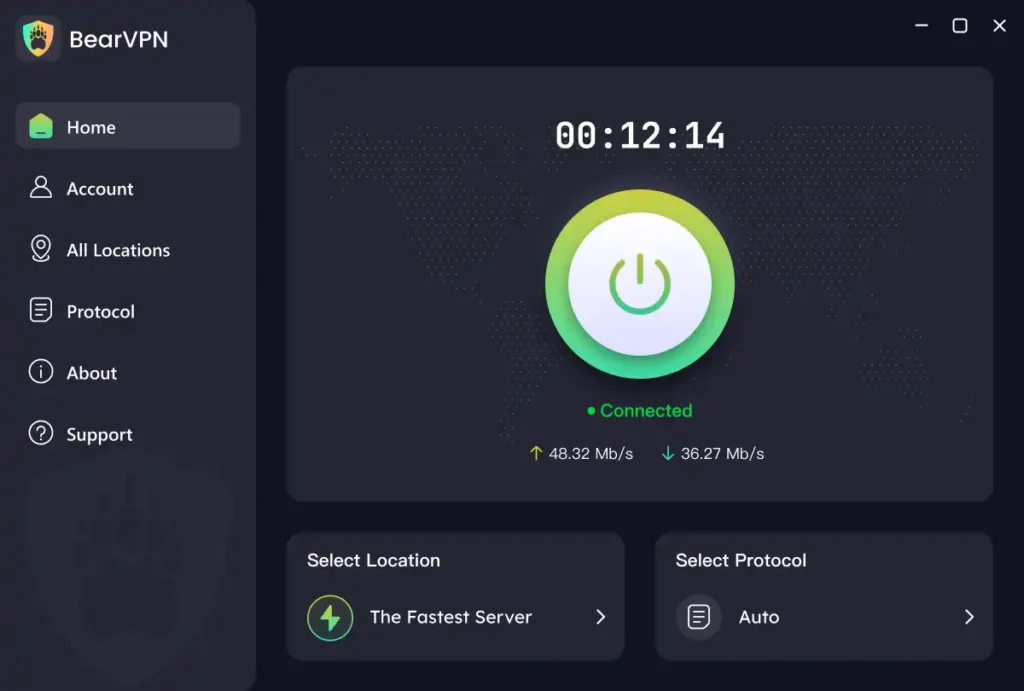
Key Features
- Direct Mode routing is designed to shorten the data path between the player and the game server.
- BearLink+ clustering technology, which connects multiple routing nodes together to create redundant low-latency pathways.
- 2000+ server lines across 50+ regions, giving players multiple geographic options when connecting to Valve servers.
Why It Works Well for CS2
Competitive shooters like CS2 depend on stable tick-rate synchronization. If your ISP routes traffic inefficiently, you may experience higher ping even when servers are nearby. BearVPN’s routing optimization can sometimes reduce ping variance by bypassing congested ISP routes, especially in regions with heavy network restrictions.
Pros
- Strong performance in regions with strict internet filtering
- One-click connection for quick setup
- Very competitive pricing (starting around $1.67/month)
Cons
- Newer brand compared with legacy VPN providers
- Smaller marketing presence than top-tier competitors
2. NordVPN (Best for Raw Speed)
NordVPN remains one of the most established VPN providers, backed by a massive global infrastructure and continuous investment in performance technologies.
Its biggest advantage for gamers is NordLynx, a WireGuard-based protocol designed to minimize encryption overhead and deliver near-native speeds.
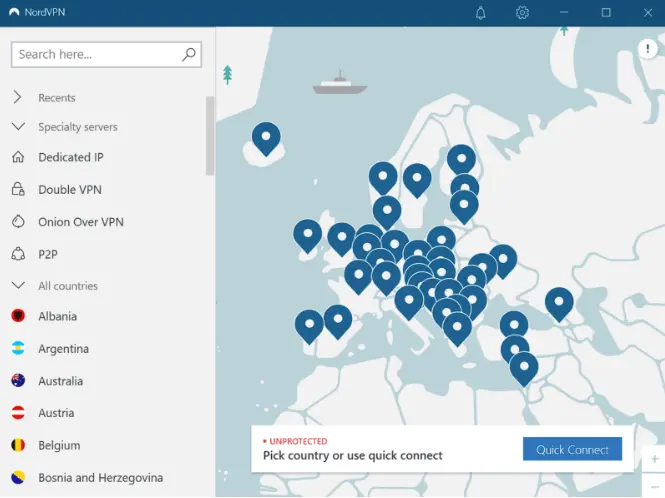
CS2 Performance:
- Very low latency under ideal network conditions
- Near-native performance when ISP routing is already efficient
- Stable baseline ping for players close to game servers
NordLynx significantly reduces the latency penalty typically introduced by VPN encryption. This allows players to maintain competitive ping levels while still protecting their IP address from DDoS attacks.
Where It Falls Short: NordVPN primarily optimizes encryption efficiency, not network routing. If your ISP takes inefficient or congested routes to Valve servers, NordVPN will not actively reroute your traffic. This can result in:
- Higher ping than expected despite fast protocols
- Increased jitter during peak hours
- Inconsistent performance across different server nodes
Key Features
- NordLynx protocol for ultra-low overhead
- 6,000+ servers worldwide
- Built-in DNS leak protection and DDoS protection
Pros
- One of the fastest VPNs in independent speed tests
- Excellent performance on well-routed networks
- Large server network for flexible server selection
Cons
- No advanced routing optimization for gaming traffic
- Performance depends heavily on ISP path quality
- Higher price compared to budget alternatives
3. Surfshark (Best for Multi-Device Users)
Surfshark has gained popularity by combining high performance with excellent value, especially for households with multiple gamers or shared gaming setups.
Unlike most providers, Surfshark allows unlimited simultaneous connections, meaning every device in a household can run the VPN at the same time.
Surfshark is a value-focused VPN that stands out with unlimited simultaneous connections.
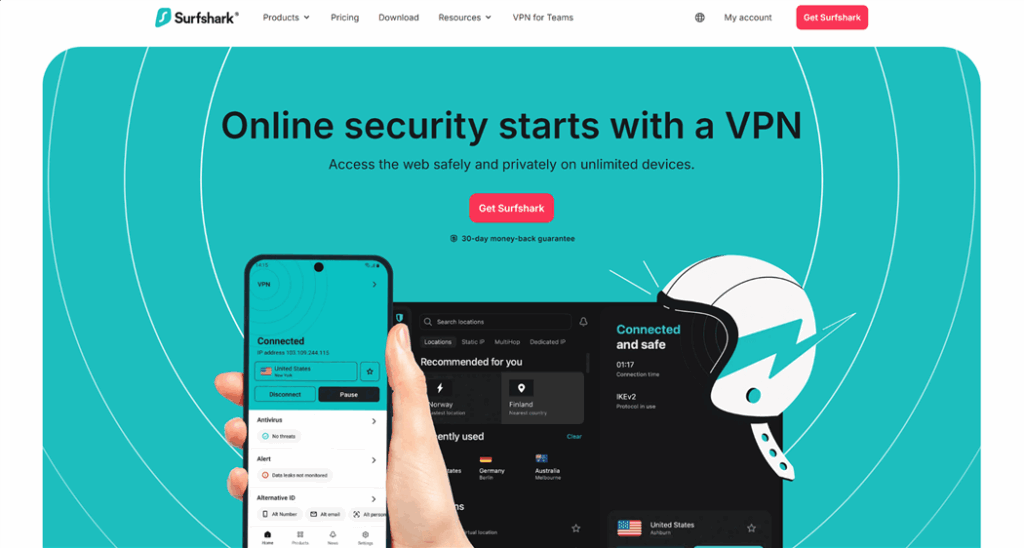
CS2 Performance:
- Solid performance using WireGuard
- Works well across multiple devices and setups
Perfect for players who run a VPN across multiple devices—such as a PC, laptop, or router—without needing separate subscriptions.
However, Surfshark is not specifically optimized for gaming traffic. Its routing capabilities are relatively limited, which means it may not consistently deliver the most efficient path to CS2 servers. As a result, players can experience occasional jitter on certain nodes, and overall performance tends to vary more compared to premium, gaming-focused VPNs.
Key Features
- Unlimited device connections per account
- WireGuard protocol support for improved gaming performance
- Built-in ad blocking and malware protection
Pros
- Excellent value for families or gaming groups
- Intuitive apps across platforms
- Solid performance for casual and competitive gaming
Cons
- Some servers may show slightly higher jitter
- Gaming performance depends heavily on server selection
4. ExpressVPN (The Reliability Standard)
ExpressVPN has long been considered one of the most polished VPN services available, known for consistent uptime, stable connections, and strong global coverage.
Its proprietary Lightway protocol was designed to outperform traditional OpenVPN connections while remaining extremely lightweight.
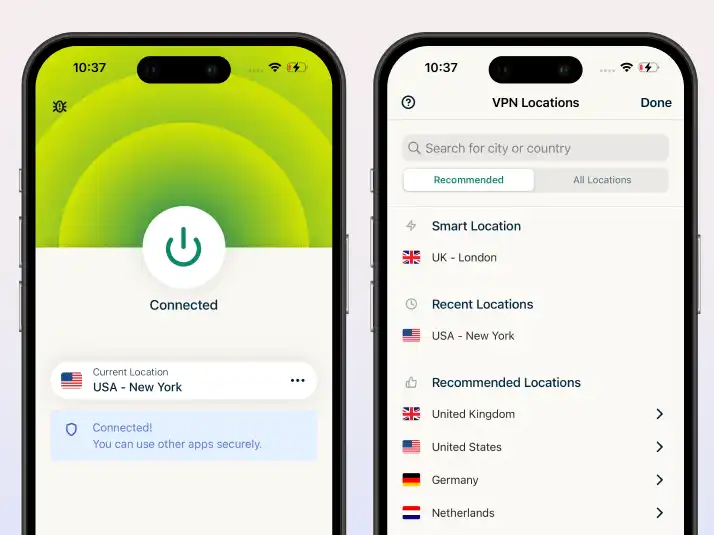
CS2 Performance:
- Very stable during long matches
- Minimal disconnects
- Consistent latency
Reliability is crucial in competitive matches, and ExpressVPN consistently delivers stable connections with minimal packet loss—making it a dependable choice for longer gaming sessions.
However, this focus on stability comes at the cost of peak performance. Compared to gaming-optimized VPNs, ExpressVPN typically has slightly higher latency and lacks specialized routing optimization, which can limit its ability to achieve the lowest possible ping in competitive scenarios.
Key Features
- Lightway protocol is designed for fast connection establishment
- Servers in 90+ countries
- Highly optimized desktop and mobile applications
Pros
- Excellent global infrastructure
- Very stable connections
- Easy setup for beginners
Cons
- Premium pricing
- Limited simultaneous connections compared to Surfshark
5. Proton VPN (Best for Privacy-Focused Gamers)
Proton VPN is developed by the team behind Proton Mail and is built with a strong emphasis on privacy, transparency, and open-source security. Its infrastructure is designed to prioritize data protection over raw performance.
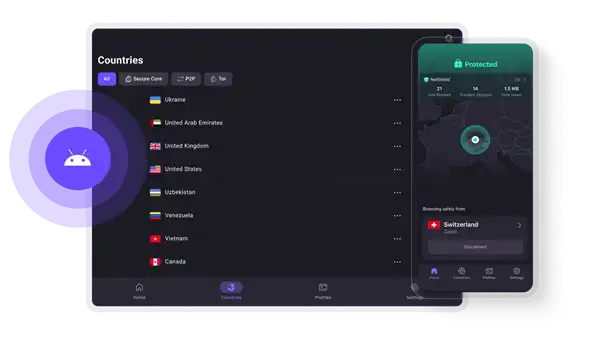
CS2 Performance:
- Strong IP protection and security
- Stable connections under normal conditions
- Not specifically optimized for low-latency gaming
Proton VPN provides excellent protection against DDoS attacks, which can be particularly valuable in high-rank competitive matches. Its stable infrastructure also ensures consistent connectivity during gameplay.
However, Proton VPN is not designed for speed-critical scenarios. Features like Secure Core (multi-hop routing) can increase latency, and even standard connections are not optimized for minimizing ping—making it less suitable for fast-paced competitive gameplay.
Key Features
- Secure Core architecture routing traffic through privacy-friendly countries
- Fully open-source applications
- Independently audited security
Pros
- Industry-leading privacy protection
- Transparent, open-source infrastructure
- Reliable and secure connections
Cons
- Higher latency compared to gaming-focused VPNs
- Smaller server network than the top competitors
- Performance varies depending on the routing configuration
An excellent choice for privacy and security—but not ideal for players seeking the lowest possible ping in CS2.
6. CyberGhost (Best for Dedicated Gaming Servers)
CyberGhost takes a user-friendly approach by organizing its servers based on specific use cases, including gaming and streaming. Instead of manually testing hundreds of nodes, players can quickly select servers labeled for low-latency performance.
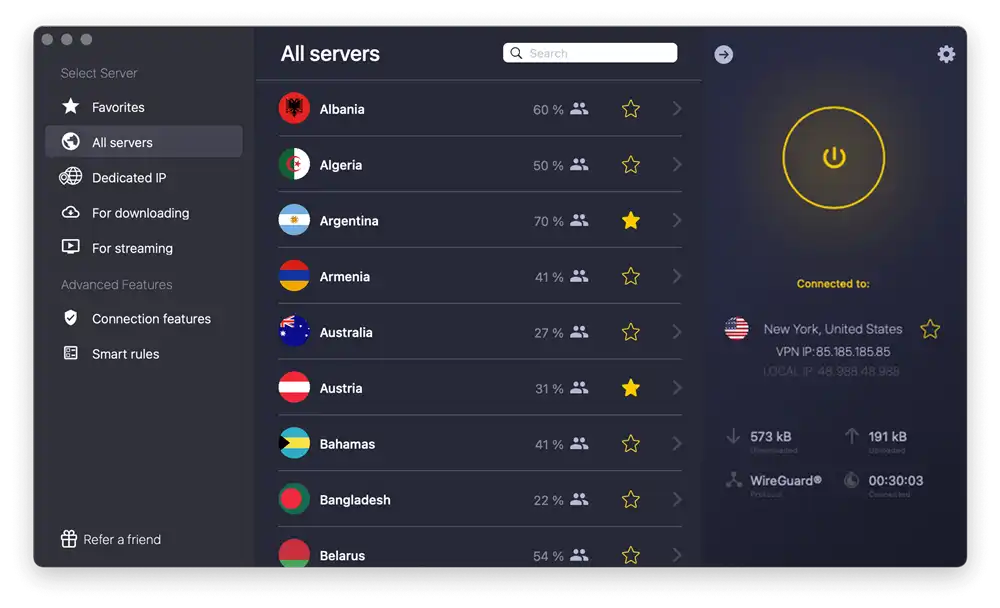
CS2 Performance:
- Easy to identify low-latency servers
- Smooth setup for beginners
- Decent stability for casual matches
Its categorized server system significantly reduces the trial-and-error process, allowing players to quickly connect to servers that are optimized for gaming. This is especially helpful for users who are less familiar with manual server selection.
However, server labels do not guarantee optimal routing. Performance can vary depending on region and network conditions, and CyberGhost lacks advanced routing optimization—making it less consistent for competitive CS2 gameplay.
Key Features
- Dedicated gaming server categories
- 9,000+ servers worldwide
- Beginner-friendly interface
Pros
- Very easy to use
- Large global server network
- Generous 45-day money-back guarantee
Cons
- Inconsistent performance across regions
- No advanced routing controls for power users
7. PureVPN (Best for Wide Compatibility)
PureVPN stands out for its broad compatibility, offering support across a wide range of devices, including PCs, consoles, and routers. Its router-level installation is particularly useful for gamers who want to protect their entire network with a single setup.

CS2 Performance:
- Suitable for whole-home network protection
- Works seamlessly across multiple devices
- Stable baseline performance for casual play
PureVPN’s router configuration allows all connected devices to run through the VPN without individual setup. This is especially useful for households with multiple gamers or mixed platforms, ensuring consistent protection and convenience. However, PureVPN is not specifically optimized for competitive gaming. Its latency performance can be inconsistent depending on the server and region, and it lacks advanced routing optimization—making it less reliable for maintaining low, stable ping in CS2.
Key Features
- Support for routers, consoles, and PCs
- Large global server network
- Independently audited no-logs policy
Pros
- Easy router-level setup
- Wide device compatibility
- Competitive pricing
Cons
- Inconsistent latency performance
- Not optimized for low-ping gaming
- Interface less polished than top competitors
8. PrivadoVPN (Best Free Tier)
PrivadoVPN offers one of the most generous free VPN plans currently available.
Unlike many free VPNs that throttle speeds or inject ads, PrivadoVPN provides relatively fast connections with no advertising.

CS2 Performance:
- Decent for casual matches
- Stable under light usage
PrivadoVPN is a viable option for casual players who only play occasionally, offering decent speeds and a simple setup without requiring a paid commitment.
However, its limitations become noticeable in more demanding scenarios. The 10GB monthly data cap restricts extended playtime, while limited server access reduces flexibility when choosing low-latency nodes. During peak hours, network congestion can further impact performance, making it less suitable for consistent competitive play.
Key Features
- Free tier with 10 GB monthly data
- WireGuard support
- Servers in multiple regions
Pros
- One of the fastest free VPNs
- No ads in the free version
- Simple setup
Cons
- 10 GB monthly data cap
- Limited server access compared with paid plans
Is it Allowed to Play CS2 with a VPN?
A common myth in the Counter-Strike community is that using a VPN will lead to an immediate ban. This is false. Valve generally does not ban accounts for using a VPN to improve connection quality, reduce lag, or protect privacy.
The Valve Anti-Cheat (VAC) system is designed to detect “cheats”—software that modifies game files or memory to give an unfair advantage (like wallhacks or aimbots). A VPN like BearVPN only handles your network routing. It does not touch your game files, meaning it is 100% safe from VAC detection.
Critical Risk Areas to Avoid:
- Regional Pricing Exploits: Do NOT use a VPN to spoof your location to buy skins or games at lower prices in other regions (e.g., trying to access lower-priced markets in different currency zones). This is a direct violation of the Steam Subscriber Agreement and is the most common reason for account termination related to VPNs.
- Purchasing Safety: We highly recommend turning off your VPN when making any financial transactions on Steam to avoid being flagged by automated fraud-prevention systems.
- Account Sharing: Avoid logging into your Steam account through VPN servers in multiple countries within a short timeframe, as this may trigger “suspicious activity” locks.
Which Server is Best for CS2?
The “best” server is always the one geographically closest to your physical location. However, if your local ISP has poor peering (meaning they take a “scenic route” to reach the game server), connecting to a VPN server in a major tech hub can actually lower your ping.
Major Global Hubs for 2026:
- North America: New York (East), Chicago (Central), and Los Angeles (West).
- Europe: Frankfurt (widely considered the most central and stable hub), London, and Amsterdam.
- Asia: Singapore (the primary hub for Southeast Asia), Tokyo (East Asia), and Hong Kong.
Ping Performance Guidelines:
Use the console command net_graph 1 in CS2 to monitor your performance in real-time. Look for these thresholds:
- 0–50ms:Excellent. The gold standard for competitive play. You will not notice any delay.
- 50–100ms:Good. Acceptable for most non-professional matches, though you may occasionally feel a “peekers advantage” from opponents.
- 100ms+:Poor. Noticeable delay; accuracy and reaction times will be negatively impacted. If you are in this range, try switching your BearVPN node to a different city.
How to Optimize Your Connection (Technical Guide)
Simply turning on a VPN isn’t enough; you need to configure it for the specific demands of a first-person shooter.
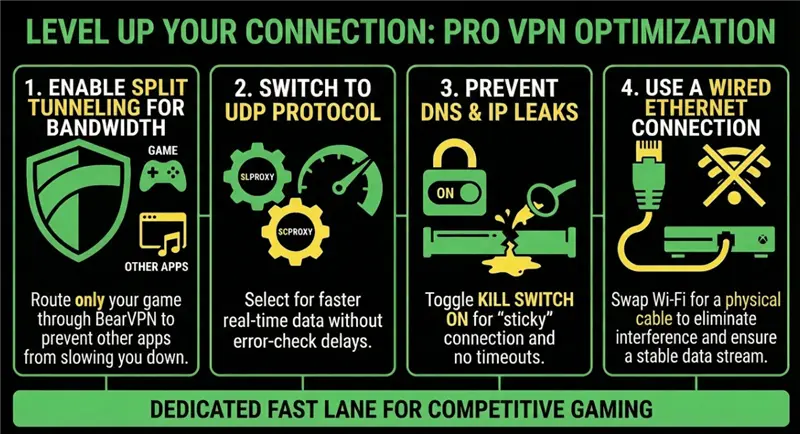
Step 1: Use Split Tunneling
Available in the BearVPN settings, Split Tunneling allows you to choose which apps use the VPN tunnel.
- Open BearVPN Settings.
- Enable Split Tunneling.
- Select the cs2.exe file.
This ensures that your background Discord call or Chrome tabs don’t waste your encrypted bandwidth, leaving the “fast lane” entirely for your game.
Step 2: Switch to UDP (The Gaming Protocol)
Most VPNs default to “Automatic” or “TCP.” For gaming, UDP (User Datagram Protocol) is king. Unlike TCP, which checks every packet for errors (causing delays), UDP focuses on speed and real-time delivery. In BearVPN, select the SLProxy or SCProxy protocols for the best balance of stealth and velocity.
Step 3: Prevent DNS and IP Leaks
A sudden IP leak during a match can cause a “connection timed out” error. Ensure Kill Switch and DNS Leak Protection are toggled ON in your BearVPN dashboard. This keeps your connection “sticky” even if your local internet flickers.
Step 4: The Hardware Factor
Regardless of how good your VPN is, Wired is King. Ethernet cables provide a stable stream of data, whereas Wi-Fi is susceptible to interference from walls and other devices. Always pair your BearVPN connection with a physical cable for the most stable experience.
Conclusion: Take Control of Your Connection
Don’t let poor ISP routing or high-traffic jitter cost you the round. In the competitive landscape of 2026, stability is just as important as aim. By choosing a gaming-optimized server and utilizing BearVPN’s advanced protocols, you can achieve the “pro-level” stability needed to climb the ranks.
Frequently Asked Questions About Using VPNs for CS2
- Can a VPN actually lower my ping in CS2?
Yes. If your ISP uses inefficient routing or throttles gaming traffic during peak hours, a VPN like BearVPN can provide a more direct path through its dedicated 10Gbps server network. This reduces the distance your data travels, often lowering ping and stabilizing your connection.
- Will I get a VAC ban for using BearVPN?
No. Valve Anti-Cheat (VAC) only detects file tampering or software that modifies game memory. A VPN simply changes your network path and does not interact with CS2’s game files. Using BearVPN is completely safe under Valve’s current policies.
- Is it legal to use a VPN for gaming in the US and other regions?
Absolutely. VPN use is legal in the US, Europe, and most Western countries. Many competitive players use VPNs to protect against DDoS attacks, improve connection stability, or maintain privacy during online matches.
- Does BearVPN work on the Steam Deck or other devices?
Yes. BearVPN supports multiple platforms including Windows, macOS, Linux (used by the Steam Deck), Android, and iOS. A single account can protect up to 10 devices simultaneously.
- What should I do if I get a “Failed to reach any official servers” error in CS2?
This error often occurs when your local IP is temporarily blocked or misrouted by the game coordinator. Connecting through a BearVPN server refreshes your connection and usually resolves the issue immediately.
- Can I use a VPN to access CS2 in restricted regions?
Yes, a VPN can help bypass regional blocks or poor ISP peering. However, you should avoid using a VPN to bypass pricing restrictions, as this may violate Steam’s terms of service.
- Which VPN protocols are best for CS2?
Protocols like WireGuard, NordLynx, or BearVPN’s Direct Mode are ideal because they minimize encryption overhead, reduce latency, and maintain a stable connection during fast-paced matches.
- Will a VPN reduce my packet loss in CS2?
In many cases, yes. By bypassing congested ISP routes, a VPN can reduce packet loss and jitter, improving the consistency of your gameplay, especially in regions with poor peering or high traffic.