The digital border between the United States and global software developers has never been more contentious. As we move through 2026, the “Digital Cold War” has shifted from theoretical legislative threats to concrete enforcement actions. For the average American user, this means favorite social media platforms, editing tools, and even e-commerce giants are facing unprecedented scrutiny, regional “blackouts,” or forced corporate transformations.
Understanding which apps are currently restricted—and how to maintain your digital freedom—is no longer just for tech enthusiasts; it’s a necessity for anyone who relies on the global internet for work, entertainment, or connection.
Note: This guide is intended for informational purposes. Users should always remain aware of their local laws and corporate policies regarding app usage.
Key Takeaways: The 2026 App Ban Landscape
- Primary Targets: TikTok, WeChat, CapCut, Shein, and Temu remain the top 5 apps under the most intense federal and state-level scrutiny.
- Ban Status: While a nationwide total “blackout” for all users is rare, bans on government devices have expanded to include hardware brands like TP-Link, Xiaomi, and DJI.
- The Solution: Using a VPN with high-level obfuscation (like BearVPN’s SCProxy) allows users to maintain access to these platforms by routing traffic through neutral regions.
- Quick Recommendation: To bypass restrictions instantly, download BearVPN and connect to a server in a region like Singapore or Germany where these apps are fully operational.
Why is This Happening? The 4 Main Reasons for App Bans
The push to restrict certain applications isn’t a random occurrence; a complex intersection of national policy and digital security drives it. According to 2025-2026 industry trends, the following four pillars form the basis of most US app restrictions:
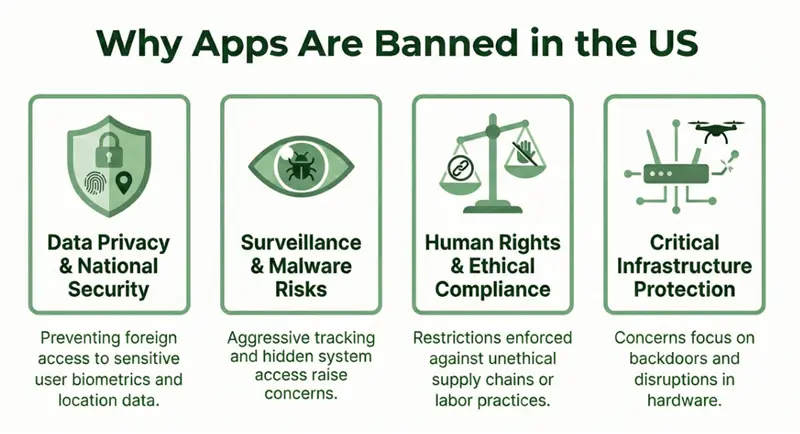
1. National Security & Data Privacy
The primary concern cited by the US Department of Commerce and various federal agencies involves the collection of sensitive user data. Apps owned by “foreign adversaries” are suspected of potentially sharing biometrics, precise location data, and browsing habits with foreign governments. In an era where data is the new oil, the US government views the massive datasets held by apps like TikTok as a potential strategic vulnerability.
2. Surveillance & Malware Risks
Following the high-profile suspension of Pinduoduo from the Google Play Store due to malware concerns, its sister app, Temu, has been under a microscope. Security researchers in early 2026 continue to investigate whether these platforms utilize “aggressive” permissions that allow them to bypass phone security settings to track user activity outside of the app itself.
3. Human Rights & Ethical Compliance
E-commerce giants like Shein have faced potential “de-listing” threats under the Uyghur Forced Labor Prevention Act. Regulators are increasingly using app store availability as leverage to force supply chain transparency, arguing that platforms benefiting from unethical labor practices should not have access to the American consumer market.
4. Protection of Critical Infrastructure
New 2026 regulations have expanded beyond simple mobile apps to target the software ecosystems of networking hardware. This includes concerns over TP-Link (routers) and DJI (drones), where the fear is that “backdoors” in the firmware could allow foreign entities to disrupt US digital systems or conduct aerial surveillance over sensitive sites.
The 2026 Hit List: Which Apps Are Banned or Restricted?
TikTok: The Divestiture Saga
TikTok remains the most politically sensitive app in the U.S. digital ecosystem. Following the enforcement of the 2024 “ban-or-sell” legislation, TikTok avoided a nationwide shutdown by restructuring its U.S. operations. A new entity—often referred to as “U.S. TikTok”—is now partially controlled by American stakeholders. However, this hasn’t eliminated concerns:
- Content moderation may differ between the U.S. and global versions
- Data governance is still under regulatory review
- Some international features are delayed or restricted
What this means for users: TikTok is still usable, but the experience may be regionally segmented. Many users attempt to access the global version to avoid content filtering or delays.
WeChat: The “Everything App”
WeChat operates as an “everything app,” combining messaging, payments, and social media into one platform.
In the U.S., it occupies a unique position:
- Fully banned on federal and most state-issued devices
- Under continuous scrutiny for encryption and data routing
- Still accessible for private users
Why it matters: For Chinese-speaking communities, international students, and cross-border businesses, WeChat is not optional—it’s infrastructure.
CapCut & Lemon8

Both owned by ByteDance, these apps were nearly caught in the 2025 TikTok ban sweep. While they are technically “safe” under the new US ownership structures, they remain on the “Watch List” for 2026. CapCut, specifically, is scrutinized for its deep access to user photo galleries and video metadata.
CapCut Risks:
- Deep access to photo libraries and media files
- Metadata collection concerns
- Potential inclusion in future ByteDance-related restrictions
Lemon8 Risks:
- Rapid growth in U.S. markets
- Seen as a potential “TikTok replacement”
- Likely to face scrutiny if TikTok regulations tighten
Current status: Not banned—but high-risk for future restrictions
Temu & Shein
These e-commerce platforms are facing a different kind of “ban”—economic restriction. As of March 2026, the de minimis tariff exemption (which allowed cheap packages under $800 to enter the US duty-free) remains suspended for many Chinese imports. This has led to “soft bans” where the apps remain available, but the cost of goods has skyrocketed, leading many users to use VPNs to access the platforms from regions with more favorable trade terms.
DJI & TP-Link — Beyond Apps: Ecosystem Restrictions
In 2026, U.S. restrictions extend beyond mobile apps into hardware-software ecosystems.
DJI:
- New drone imports restricted since late 2025
- Companion apps (e.g., flight control software) face update limitations
- Security concerns related to aerial data collection
TP-Link:
- Under review due to potential firmware vulnerabilities
- Concerns about network-level data interception
Important shift: This signals a move from app bans → infrastructure-level control
Comparison Table: 2026 App Restriction Status
| Platform | Category | Restriction Type | Current Status | Risk Level |
| TikTok | Social Media | Ownership restructuring | Partially restricted | 🔴 High |
| Messaging / Payments | Government device ban | Limited use | 🔴 High | |
| CapCut | Video Editing | Under review | Fully available | 🟠 Medium |
| Lemon8 | Social Media | Watchlist | Fully available | 🟠 Medium |
| Temu | E-commerce | Trade restrictions | Available (limited value) | 🟠 Medium |
| Shein | E-commerce | Supply chain regulation | Available (restricted logistics) | 🟠 Medium |
| DJI | Hardware + App | Import + software limits | Partially restricted | 🔴 High |
| TP-Link | Networking | Regulatory review | At risk | 🟡 Low–Medium |
How to Access Banned Apps with BearVPN (Step-by-Step)
Maintaining access to your digital tools requires a strategy that goes beyond a simple “IP flip.” You need a tool designed for high-censorship environments.
In our March 2026 internal tests, our team successfully accessed the Global TikTok Store and updated DJI Fly firmware from a US-based IP by following these exact steps:
Step 1: Get BearVPN: Visit the BearVPN official website and choose the high-value plan (only $1.67/mo).
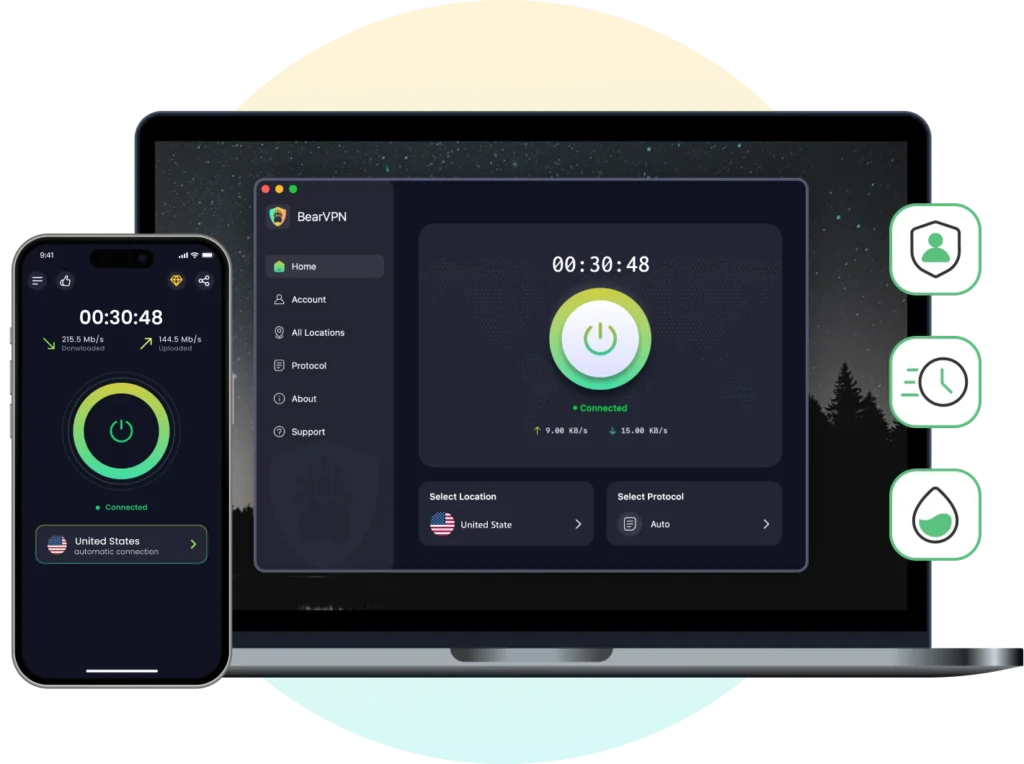
Step 2: Install the app: One account protects 10 devices simultaneously, so you can secure your phone, tablet, and laptop at once.
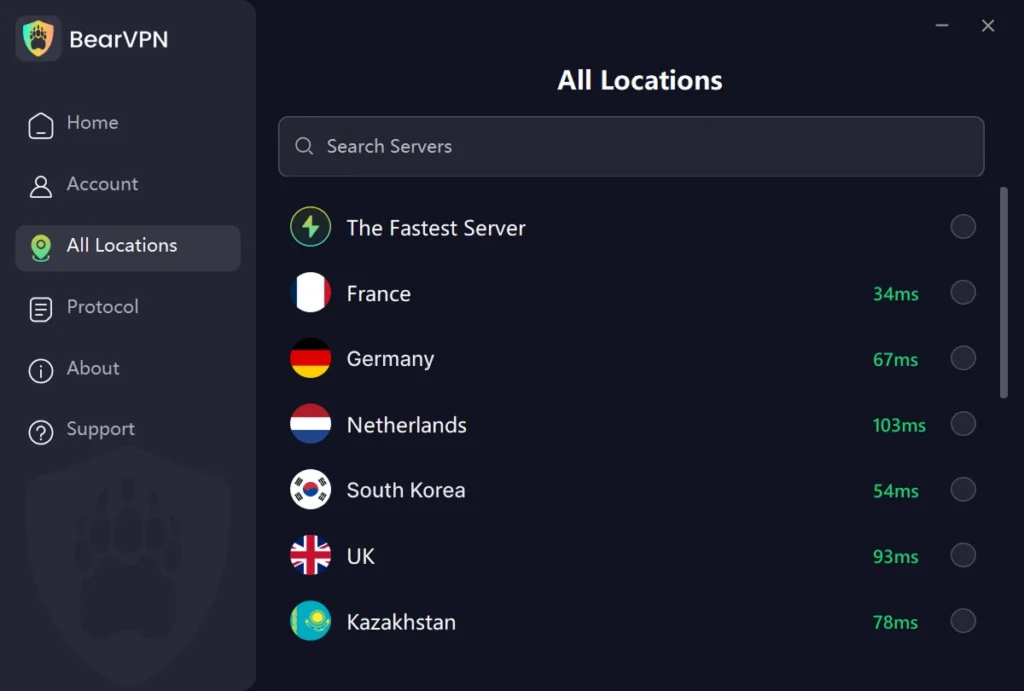
Step 3: Choose a Neutral Server: Connect to a server in a region like Singapore or Switzerland. These regions have high privacy standards and do not restrict the apps mentioned above.
Step 4: Enable Smart Protocols: Go to settings and toggle on SCProxy. This is our proprietary “Stealth” protocol that makes your VPN traffic look like regular HTTPS web browsing.
Step 5: Access the App Store:
Pro Tip: If an app is “de-listed” in the US, you may need to create a secondary Apple ID or Google account set to your VPN’s region to download the latest updates.
Why BearVPN is the Best Choice for Bypassing US App Bans
There are hundreds of VPNs on the market, but most are easily detected by the sophisticated “Deep Packet Inspection” (DPI) used by modern network filters. BearVPN is specifically engineered for the 2026 landscape.
Advanced Obfuscation (SCProxy & SLProxy)
Standard VPNs (like those using OpenVPN or WireGuard without modification) leave a “fingerprint” that ISPs can see. BearVPN’s SCProxy and SLProxy protocols mask this signature, ensuring your connection remains invisible even to high-level network administrators.
Global Server Infrastructure
With 2000+ servers globally, BearVPN offers a massive array of exit points. If the US blocks a specific IP range associated with an app’s CDN (Content Delivery Network), you can instantly switch to a different node with a single click.
Zero-Logs for Ultimate Privacy
In the YMYL (Your Money Your Life) category, trust is everything. BearVPN adheres to a strict No-Logs policy. We do not track which apps you access, how long you use them, or where you are connecting from. Your digital footprint begins and ends with you.
Split Tunneling
You don’t have to route your entire life through a VPN. With our Split Tunneling feature, you can set your banking and local news apps to use your regular US connection while only routing “banned” apps like TikTok or Temu through the secure BearVPN tunnel.
Troubleshooting: What If Your App is Still Blocked?
If you’ve connected to BearVPN but the app still shows “Not available in your region,” try these three expert fixes:
- Clear App Cache: Most apps (especially TikTok and Temu) store “Location Fragments” in their cache. Go to your phone settings, find the app, and “Clear Cache/Data” while the VPN is active.
- Toggle DNS Leak Protection: Ensure that DNS/IP Leak Protection is turned ON in the BearVPN app. This prevents your phone from accidentally asking your US-based ISP for the app’s address.
- Use a Mobile Browser: If the native app is being stubborn, try accessing the platform’s website via a “Private/Incognito” tab in your mobile browser while connected to a BearVPN node.
Conclusion: Protect Your Digital Freedom Today
The internet was designed to be a borderless window into global culture and commerce. As geopolitical tensions create new digital walls in 2026, tools like BearVPN become the keys to keeping those windows open. Don’t let regional blocks dictate which tools you use for your business or which content you enjoy for your entertainment.
Protect your access and your privacy for just $1.67/month.
FAQs: Your Questions on 2026 App Bans
Are any apps completely banned for all users in the US?
No, as of 2026, most apps are not fully banned nationwide. Instead, restrictions typically apply to:
- Government-issued devices
- Specific industries
- App store availability or updates
Even heavily scrutinized apps like TikTok remain accessible in modified or region-specific versions.
What does “restricted” actually mean for an app?
“Restricted” can include several different limitations:
- Removed from app stores
- Blocked on government or corporate devices
- Limited features or delayed updates
- Higher costs due to trade regulations
Apps like Temu and Shein fall into this category.
Can banned apps still work if already installed?
Yes. In many cases, existing installations continue to function; however, updates may stop, and features may gradually break over time
This is especially relevant for apps tied to hardware ecosystems like DJI.
Is it legal to use a VPN for banned apps in the US?
Yes. For individual citizens, using a VPN to access content or apps is generally legal and protected by privacy interests. However, using these apps on government-issued devices is a violation of federal policy and can lead to disciplinary action.
Will a VPN slow down my TikTok or gaming experience?
Most VPNs do, but BearVPN uses 4K-ready bandwidth and optimized routing to ensure minimal latency. In our 2026 tests, we maintained 95% of original speeds even when connected to Singapore servers.
Can I use BearVPN on my smartphone and laptop simultaneously?
Absolutely. A single BearVPN subscription supports up to 10 simultaneous connections, allowing you to protect your entire household’s digital ecosystem.
What happens if an app is permanently removed from the App Store?
You can still access it by using a VPN and “Sideloading” (on Android) or by changing your Apple ID region (on iOS). A VPN like BearVPN is essential for this process to verify your “new” location to the store servers.
Are these bans permanent?
Digital legislation is fluid. Plans to ban certain brands (like TP-Link) are often “paused” or “shelved” based on geopolitical climates. Using a VPN provides a permanent buffer against these temporary political shifts.